A history of the United Nations climate change conferences
The Conference of the Parties (COP) to the United Nations Framework Convention on Climate Change (UNFCCC) is the annual meeting of governments under the auspices of the United Nations. The goal of the UNFCCC, agreed by 197 countries in 1992, is to stabilize concentrations of greenhouse gases in the atmosphere at levels that would avoid dangerous anthropogenic (human-caused) climate change.
History of the COP
Meeting each year since 1995, the COP meetings have gone through several phases. The Kyoto Protocol, adopted at COP 3 set binding emissions targets on 37 developed countries, equal to an average 5% emissions reduction over the period 2008-2012, compared to 1990 levels. The heavier burden on developed countries was placed on the principle of “common but differentiated responsibility and respective capabilities.” The developed countries were considered responsible for the majority of historic greenhouse gas emissions and to have benefitted economically from such emissions. The United States did not ratify the Kyoto Protocol.
This delineation of responsibilities between developed and developing countries has become a source of tension between Parties at subsequent meetings, with some developing countries having undergone considerable economic growth over the last 30 years, and now having considerable greenhouse gas emissions of their own.
The Paris Agreement, adopted at COP21 in 2015, is a legally binding international treaty on climate change that has the goals of limiting the increase in global temperature to well below 2°C above pre-industrial levels and pursing efforts to limit the temperature increase to 1.5°C above pre-industrial levels.
Instead of setting national goals for greenhouse gas emissions, individual countries are required to publish Nationally Determined Contribution (NDC) documents every five years, setting out their own plans for emissions reductions, and the methods through which they will be achieved. These individual reports are compiled into a NDC Synthesis Report that evaluated the individual commitments against the emissions reductions required to achieve the ultimate goals of the Paris Agreement. The first Synthesis Report was evaluated at COP28 in Dubai, and led to the publication of the first Global Stocktake under the Paris Agreement. This stocktake affirmed that actions stated in the individual NDCs were not enough to limit global warming to 1.5°C.
The next set of NDCs should have been submitted early in 2025, but many have been delayed, with fewer than half the NDCs submitted by the middle of October. It is now expected that the remaining NDCs will be submitted by the beginning of the COP30 meeting in November.
Nuclear energy’s treatment in the COP process
For the period between the drafting of the Kyoto Protocol at COP 3, and the subsequent meetings that operationalized the protocol up to COP7 and beyond, nuclear energy came under a well-orchestrated attack from both anti-nuclear governments and a large number of anti-nuclear protesters, attending from environmental non-governmental organizations. Despite the efforts of a smaller number of nuclear delegates, a lack of strong support from other governments led to those anti-nuclear delegates securing a near-exclusion of nuclear projects from the Clean Development Mechanism and Joint Implementation, which were mechanisms under the Kyoto Protocol, designed to allow international collaboration between governments to achieve emissions reduction objectives. Nuclear was the only technology specifically excluded from these mechanisms.
With these exclusions in force, and the COP meetings struggling to deal with the post- Kyoto Protocol period, discussion of nuclear energy, and participation by nuclear delegates reduced, until COP21 in Paris, which was recognized as being a ‘landmark’ COP. A new initiative was launched, Nuclear for Climate, which was set up as a grass roots campaign by more than 100 nuclear societies, but which was heavily supported by nuclear trade associations, including World Nuclear Association.
With subsequent COPs focussing on the operationalization of the Paris Agreement, the next major step forward for nuclear representation took place at COP26, in Glasgow. Young delegates, under the Nuclear for Climate brand, had their own pavilion and created a more visible presence for nuclear energy.
Noting a more positive attitude to nuclear energy, World Nuclear Association saw the need for a more visible presence of the nuclear industry, in partnership with national and regional nuclear associations, and backed by financial support from sponsor companies, joined forces with the IAEA to establish the Atoms4Climate pavilion at COP27 in Egypt, the first time the IAEA or the nuclear associations had had such a large visible presence at a COP meeting.
The establishment of Net Zero Nuclear, the Tripling Nuclear Declaration and the Global Stocktake
With COP negotiations increasingly protracted and subject to the need to reach broad agreement among all Parties, a number of countries and non-governmental organizations, including businesses, had started to launch separate agreements outside of the formal COP process, where the ‘Coalitions of the Ambitious’ could set high standards not requiring unanimous approval. Seizing on this, World Nuclear Association, in partnership with ENEC, the ‘host nuclear company’ of the COP28 meeting in Dubai, set up the Net Zero Nuclear initiative to encourage greater industry participation in the COP process, and to support nuclear-positive countries that were seeking to establish their own declaration on nuclear energy.
Supported by corporate partners, Net Zero Nuclear established a strong nuclear industry presence at COP28, with pavilions with programmes of events in both the Blue (UN negotiation) Zone and Green (public) Zone.
Governments from 22 countries launched a Declaration to triple nuclear capacity by 2050, in an event featuring political leaders and minister, as well as Sama Bilbao y León, who emphasized the nuclear industry’s support for the declaration, and willingness to work with governments to support their tripling goal. The number of supporting countries grew to 25 before the end of COP28.
Separately, at a COP presidency event, Sama Bilbao y León announced the Net Zero Nuclear Industry Pledge. This pledge, signed by more than 120 nuclear companies set a goal of at least tripling nuclear capacity by 2050, and offered to work with governments to help them achieve their own tripling goal.
Subsequently, the tripling goal has been acknowledged and supported by the Nuclear Summit organized by the Belgium government and the IAEA, and in the outcomes of the G7 meetings in Italy in 2024.
Nuclear in the Global Stocktake
While the governmental declaration and industry pledge set ambitious goals for nuclear energy capacity, the formal negotiation process also recognized the role of nuclear energy in mitigating climate change.
The Global Stocktake document, the lead agreement reached in at COP28, included a paragraph that called on Parties achieve the need for deep, rapid and sustained reductions in greenhouse gas emissions through measures including by “Accelerating zero- and low-emission technologies, including, inter alia, renewables, nuclear, abatement and removal technologies such as carbon capture and utilization and storage, particularly in hard-to-abate sectors, and low-carbon hydrogen production;”
This was the first time that nuclear energy had been listed explicitly in a positive context in a major COP agreement, where individual technologies are rarely mentioned. It represented a complete reversal in the treatment of nuclear energy, compared to its exclusion from the Kyoto Mechanisms.
What happened at COP29
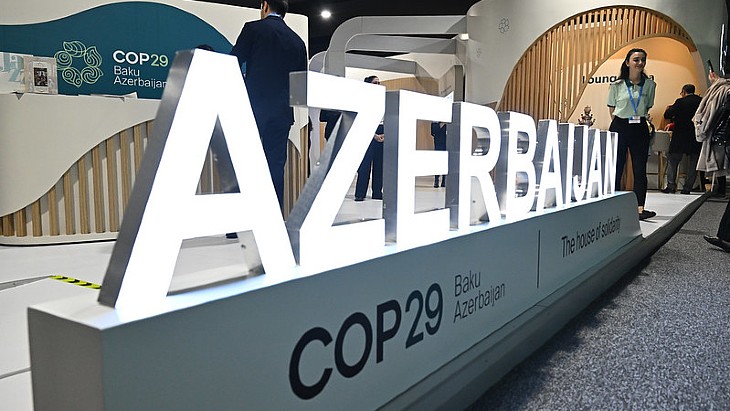
WNN Podcast: What happened with nuclear energy at COP29? (29 November 2024)
The main focus of COP29 was to agree a new climate finance goal. After fractious negotiations, a deal was finally struck where developed countries agreed to take the lead in providing $300 billion a year in climate finance by 2035, with other countries encouraged to also contribute. Additionally, there was a vaguer call to raise $1.3 trillion per year from a wider range of sources, including the private sector. The $1.3 trillion figure was what developing countries had said would be required to address the impacts of climate change. The agreement left many developing countries dissatisfied, but this was seen as the best deal that they could get.
COP29 also saw agreement being reached on details for carbon markets, which had first been outlined in Article 6 of the Paris Agreement, ten years previously.
One area of the COP29 negotiations where agreement was not reached was on how to take forward the pledges made in the Global Stocktake document. A draft document that was in development was forwarded for further negotiation at COP30. As the Global Stocktake includes nuclear as one method of reducing greenhouse gas emissions this is one area to monitor. While the symbolically significant mention of nuclear was just one word in a long document, keeping nuclear included as one of the mitigation technologies, if mentioned in future texts, should be pursued.
Outside of the formal COP29 negotiation process there were a lot of positive developments for nuclear energy.
The most significant was an event, co-organized by the Azerbaijan presidency, the US Department of Energy, World Nuclear Association and IAEA, where six countries were added to the Declaration to Triple Nuclear Capacity by 2050, bringing the total number of supporting countries to 31. The six new countries were El Salvador, Kazakhstan, Kenya, Kosovo, Nigeria and Turkey.
COP also saw bilaterial agreements on nuclear energy being signed by the US and Ukraine on SMR development, and US and UK on Generation IV reactors.
The COP also saw the announcement by the US government of their roadmap to add 200 GW of new capacity by 2050, bringing them to a domestic tripling of nuclear capacity when current reactors were included. That 2050 target has since been raised to a quadrupling of nuclear capacity by the new administration, requiring around 300 GW of new capacity, although the US government has also withdrawn from the UNFCCC process.
What is the future for the COP process and nuclear energy?
A decade ago, the Paris Agreement revitalized the COP process. However, since the agreement the NDC submissions that countries have made have been assessed to be insufficient to achieve the goal of the agreement to limit to global temperature increases to well below 2°C.
Recent COPs have also been criticized for being too influenced by countries and organizations dominated by fossil fuels.
This COP has so far escaped that criticism, although there have been concerns over the choice of Belém as the host city in Brazil. Lacking the infrastructure of other cities in Brazil, simply accommodating the tens of thousands of delegates expected to attend has been challenging.
The withdrawal of the United States will have an impact on COP, and nuclear’s role in the meetings. The US has previously withdrawn from the Kyoto Protocol and, under the first Trump administration, from the UNFCCC process. In each case the process continued in its absence, however, the absence of the largest economy in the world, and second largest emitter of greenhouse gases is significant.
The US has also been a key player in the recent positive outcomes for nuclear energy at COP, whether as one of the leading countries behind the Declaration to Triple Nuclear Energy, to announcing new bilateral agreements on nuclear energy at COP.
Nevertheless, the fact that the COP process is now focussed around national actions, as reflected in the NDC submissions, means that the support for nuclear energy in an increasing number of nations has a better chance of being reflected in the COP outcomes, than was the case ten or twenty years ago.
Looking ahead, next year’s COP will be held either in Australia – a major uranium producer with a active debate on nuclear energy – or Turkey, a country preparing to start its first nuclear reactor. In either location the case for nuclear energy must be made.
Written by Dr Jonathan Cobb, Senior Programme Lead for Climate, Policy & Industry Engagement, World Nuclear Association
If you have any questions or would like to discuss the briefing with the editor, please email us at info@world-nuclear.org.
The views expressed are those of the individual author and do not necessarily represent those of World Nuclear Association.