Financing Nuclear Briefing Series hosted by new member Stifel
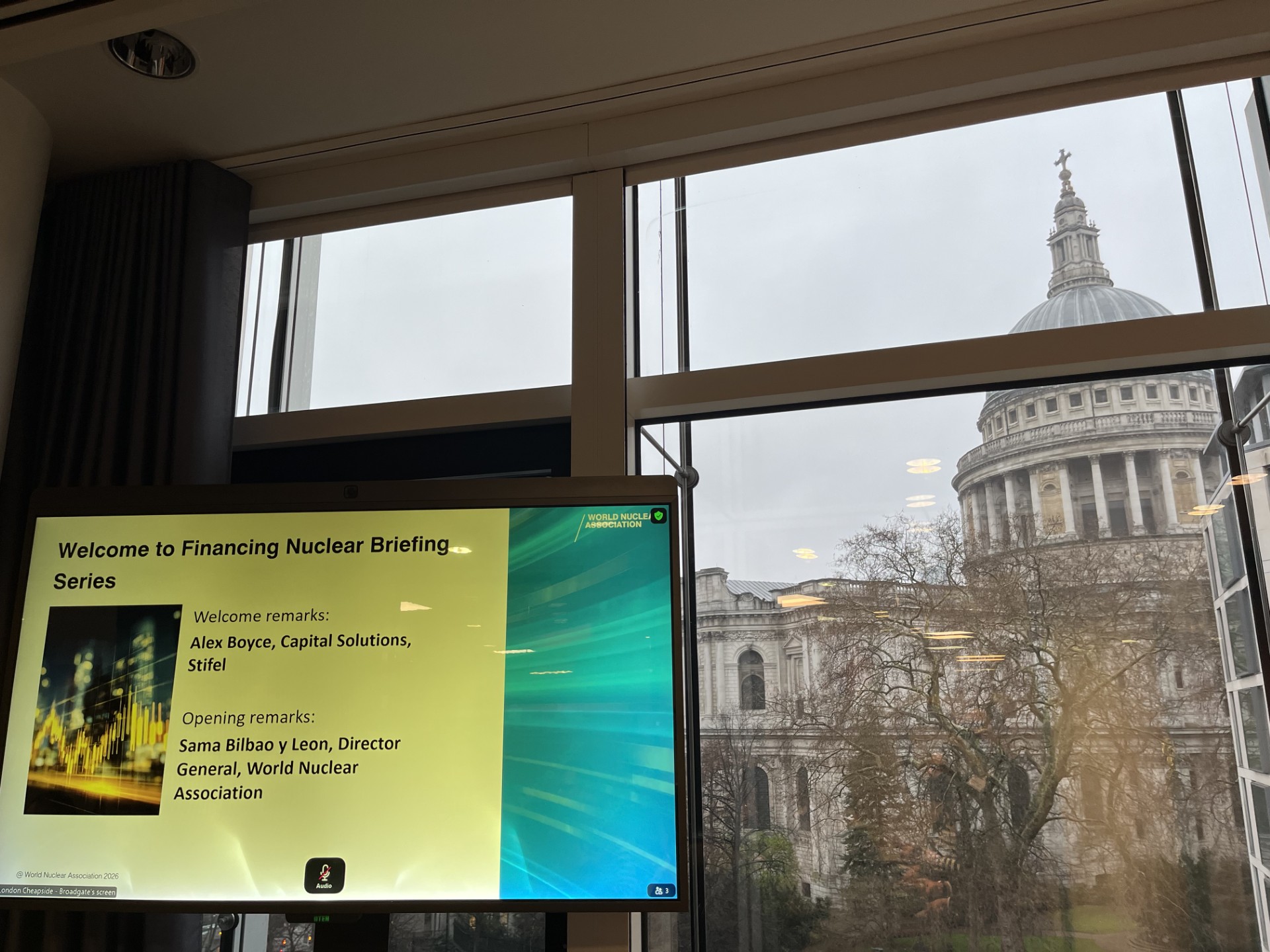
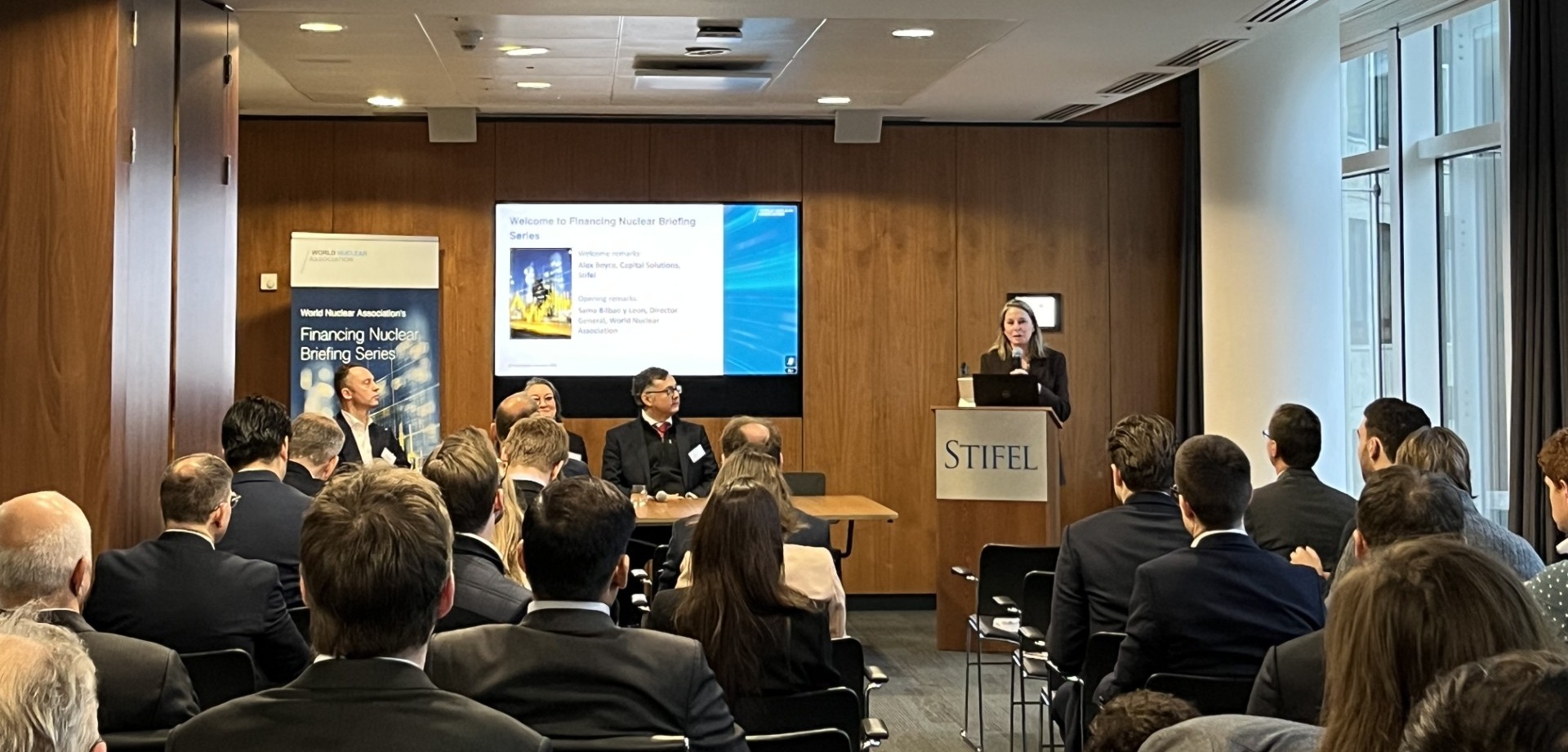
The latest session of the Financing Nuclear Briefing Series (FNBS) brought together financiers, analysts, and industry leaders in London to examine how investment strategies may develop to support the expansion of nuclear energy. Hosted by Stifel - World Nuclear Association’s newest member – at their Cheapside offices on 5 February 2026, the discussion focused on the theme: Nuclear's real cost of capital from the view of market practitioners.
Panellists included:
> Alex Boyce, Head of Capital Solutions, Stifel Investment Banking
> Jerome Brassart, Partner at Perella Weinberg
> Ximena Vasquez-Maignan, Nuclear Group Leader, White & Case
> Moderator: David Stearns, World Nuclear Association
The panel of practitioners addressed the cost of capital challenge through the broad range of stakeholders such as government, developers, owners, end-users, and financiers. The panel shared views on such questions as: whether the industry is on the critical path to scaling, whether industry is leading with sufficient urgency and what external stakeholders could be doing more effectively to ensure financial readiness and accelerate deployment.
 Standby for action
World Nuclear Association Director General Sama Bilbao y León opened the session by underscoring the Association’s efforts to support the industry to turn policy momentum into delivery and action. Highlighting findings from the recent, World Nuclear Outlook report, which shows there is a pathway to at least tripling global nuclear capacity by 2050, when Governments and the nuclear sector work together to deliver countries’ stated nuclear ambitions. Bilbao y León stressed that nuclear must “speak the same language” as the finance sector if the industry is to scale at the pace global energy systems now is the time for action.
The nuclear industry is in a unique moment. Large energy users are signalling urgent demand for stable, long-term, and low-carbon energy supply at scale. The combination of global political momentum, electrification and industrial demand is driving new conversations about nuclear with investors who have traditionally remained cautious.
Today was the third meeting in the series of financial briefings that World Nuclear Association hosts, with the intention of curating the new conversations needed to move the industry forward. These discussions are also informing the Association’s upcoming Financing Nuclear Investment Guide. The guide will support the industry deliver its ambitions through enabling constructive dialogue between the nuclear and financial communities and sketching jointly a success roadmap for financing the entire nuclear value chain.
Back to the future
The panel reflected on the lessons of past deployment waves. Deployment in the 1970s demonstrated the scale achievable when national ambitions align with policy, industry capacity and financing are aligned. For example, Sweden’s pragmatic nuclear growth policies or the latest developments in India with the passing of the SHANTI bill are re-establishing the policy framework that will enable to delivery of national energy goals.
With around 70 years of accumulated knowledge, today’s industry has experience on its side. Yet current markets differ sharply from the regulated, predictable environments that enabled earlier fleet construction. Investors in some markets now face deregulated price signals, more complex permitting, and higher scrutiny of project risks. The question is how to create the conditions that build on the current momentum and use the experience of a time where nuclear power plants were successfully being built and brought online at pace, while operating in modern financial markets.
Time to power
Panellists agreed that finance still sees nuclear as a risky business where “time” is the main enemy. The new metric emerging as central to energy decisions for industrial users, which is “time to power” i.e. how long it takes for a technology to deliver electricity to the grid or industrial cluster. Large energy users are increasingly frustrated by delays in infrastructure development and are technology-agnostic. Their priority is speed, reliability, and scalability.
For industries facing mounting pressure from digitalisation, electrification and 24/7 operations, certainty of supply is becoming a decisive factor. Nuclear’s ability to deliver reliable, low carbon energy, positions it as critical infrastructure for large energy users to invest in, provided projects can demonstrate predictable schedules and investment pathways.
All sides want certainty
The discussion repeatedly returned to the central issue shared by both industry and financiers: certainty. The early‑stage development gap remains a major barrier. First-of-a-kind projects in particular face challenges due to design novelty, supply chain constraints and evolving policy environments.
Participants stressed that while private sector demand is rising, government involvement remains essential. Clear policy signals, consistent licensing processes, and mechanisms that reduce early stage risk can significantly lower financing costs and shorten project timelines.
Speakers noted that large end-users will go to whatever gives them power first, which is beyond the simple cost metric. Alternative energy options not delivering the reliability of energy or supplying heat as well as electricity required by heavy industry are therefore limited. If Europe wants to retain industrial competitiveness without relying on fossil fuels, nuclear must form a core part of its future energy mix.
Finance the supply chain
Venture capital is already flowing into early stage nuclear technologies, but the shift from promising concepts to large scale deployment requires investment in the supply chain. This includes manufacturing capacity, component standardization, and workforce development.
The critical phase before final investment decision is where financing gaps are most acute. Panellists highlighted the importance of an internationally aligned licensing process and a more consistent approach to risk informed decision-making — both of which can accelerate timelines and reduce costs for newcomer countries looking to build new nuclear capacity.
We all need energy
The event closed with a shared recognition that nuclear’s role in meeting global energy demand is essential. There is significant attention on emerging technologies such as artificial intelligence, but the truth is that we all need energy, and nuclear remains an important option for delivering clean electricity at scale. The finance community continues to see time as a major risk to nuclear projects. For nuclear to be a viable option this time around, all stakeholders have a key role in helping shorten nuclear project timelines.
The Association thanks Stifel for hosting the third Financing Nuclear Briefing Series and welcomes them as A new member of World Nuclear Association. The next briefing will take place in Spring 2026.