Highlights from Executive Plenary Day Two
World Nuclear Symposium: final day wrap-up
As the final day of Symposium 2026 began, Tim Gitzel of Cameco reflected on the shift from climate, to energy security, to national security as the principal driver of nuclear’s momentum and the new addition of ‘fear of missing out’ among the investment community. The challenge, he argued, is no longer selling the story but taking action.
Key quotes:
- “This is the most exciting time we’ve had in my entire career. The future looks so, so bright for us. We just have got to get it going.” Tim Gitzel, CEO, Cameco
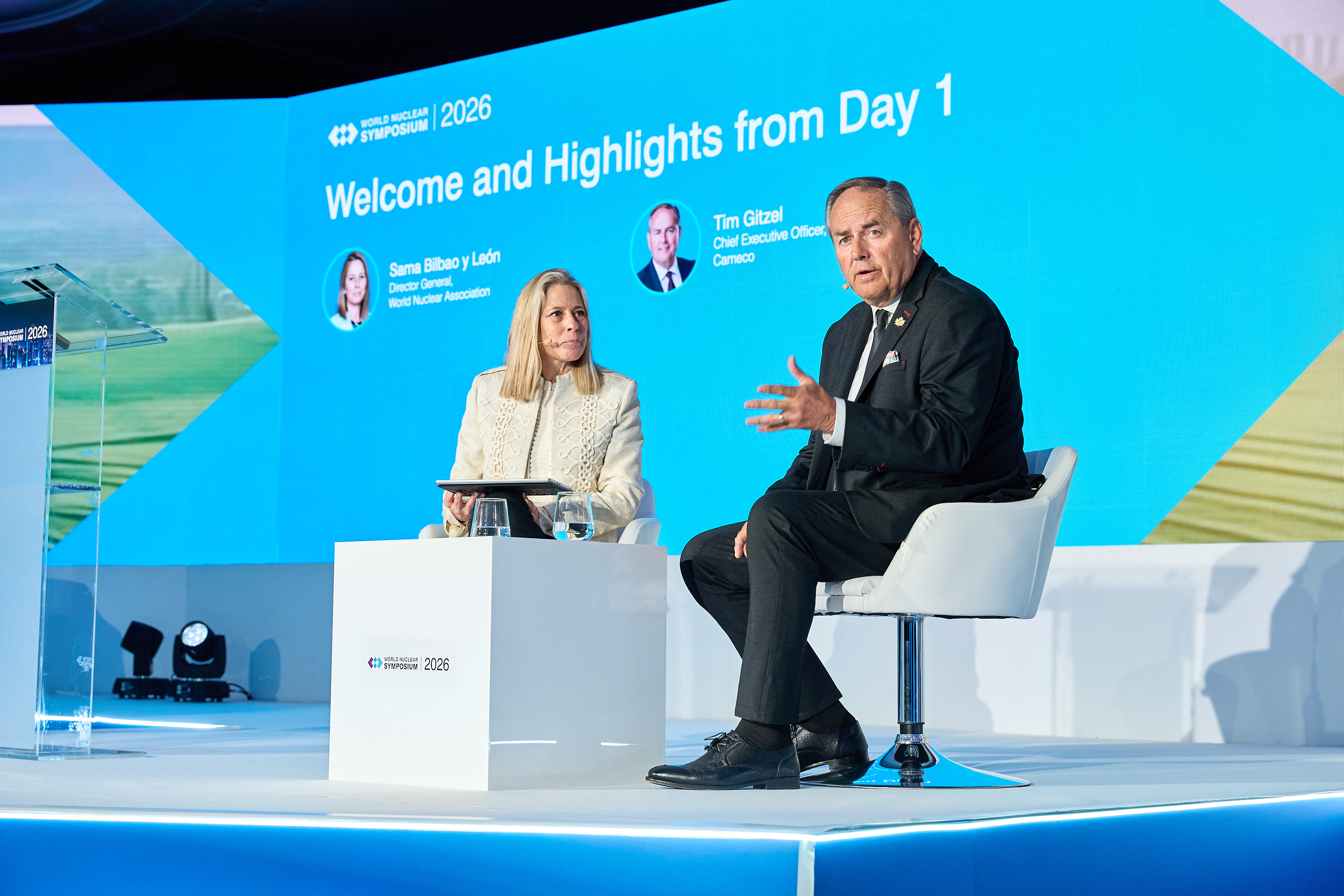
Caption: Dr Sama Bilbao y León and Tim Gitzel, CEO, Cameco
Ensuring and Expanding the Future Fuel Cycle
Two panels traced the fuel cycle from mine to repository.
The first covered the challenge for the fuel cycle of keeping pace with the tripling goal, pointing to 8-20 year timelines from discovery to production, regulatory and skills bottlenecks, and the social licence still to be earned in some legacy mining regions.
The second picked up the story downstream: Constellation reported LEU+ and accident-tolerant fuel now reaching the existing fleet, Global Laser Enrichment expects a licence for its Paducah plant in early 2027, Orano set out plans for a next-generation recycling complex built around modularity and common standards, and Posiva reflected on Finland's positive safety verdict on its Onkalo deep geologic repository. Across both panels the message was that options exist, but the constraints are timelines, capital formation and project execution.
Key quotes:
- “Let me start with a very simple message: Japan is back.” Toru Matsuda, General Manager, Nuclear Fuel Contracts, The Kansai Electric Power Co., Inc.
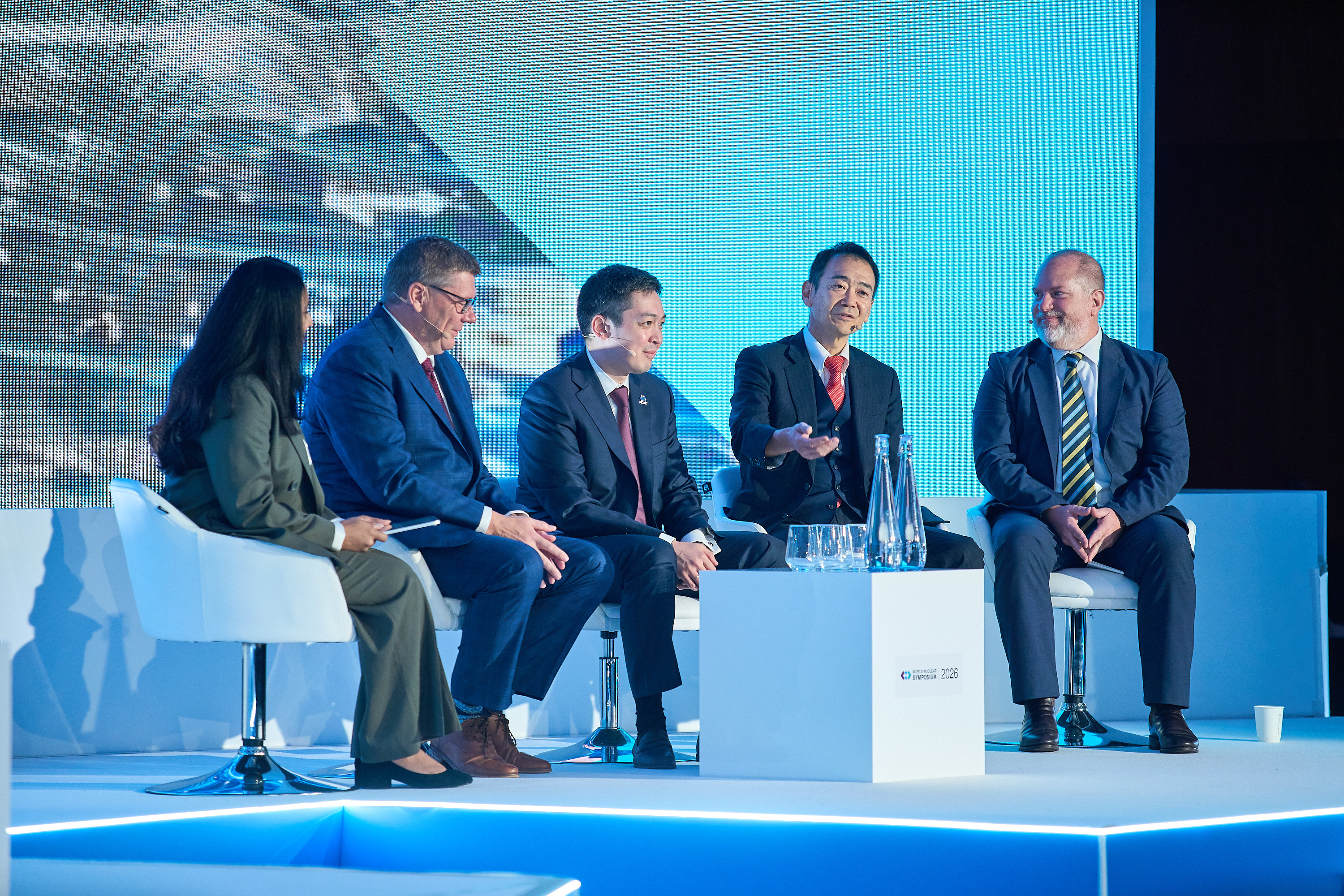
Caption: Toru Matsuda, General Manager, Nuclear Fuel Contracts, The Kansai Electric Power Co., Inc.
Scaling Nuclear Energy: Priorities for Joint Action
Polina Lion of Rosatom outlined an industry success story in scaling; Rosatom in the past 15 years has tripled its manufacturing capacity for key equipment and can now support the construction of about 20 nuclear units in parallel.
Gatekeepers and System Enablers
Senior regulators from the US, Canada, Finland and the Netherlands pushed back on the idea that they are the bottleneck to new nuclear. Each described a slimmer rulebook: Finland has cut some 8,000 binding requirements to around 1,500; the Netherlands has shrunk its new-reactor guidance to a third of its former size; and the US Nuclear Regulatory Commission has rewritten its mission around "enabling". Cross-border collaboration is deepening, from joint BWRX-300 work to a new European framework for shared design reviews. Their message to industry: engage early, bring robust safety cases, train your own newcomers, and stop waiting.
Expectations for Nuclear-Powered Ships in the Shipbuilding and Maritime Industry
Dr Jekyoung Lee of HD KSOE argued that nuclear merchant ships can't simply borrow naval reactor technology: commercial vessels must be cheap, accepted at civilian ports and licensed under a framework that doesn't yet exist. Echoing Arsenio Domínguez's Day One comments, Dr Lee pointed to the need for vessels to remain crewed by ordinary sailors. He was frank that this is a ten-year-plus journey, but said the prize if it works is around 10 GW of new propulsion capacity a year.
Key quotes:
- “…nuclear energy remains the most promising solution available to date.” Dr Jekyoung Lee, Senior Researcher, HD Korea Shipbuilding & Offshore Engineering
Beyond Offtake: New Roles for Energy Users
The panel brought together nuclear end users (Amazon Web Services, Equinix, ExxonMobil) and vendors (X-energy, TerraPower) to discuss how customer-vendor relationships are evolving. All participants agreed that the main challenge is deployment rather than technology, and the end users set out what they still need: complete licensable designs, a mature supply chain, organizations willing to own and operate the assets, and faster grid connections.
From Ambition to Action: Realizing the Tripling Nuclear Era
The closing panel of World Nuclear Symposium 2026 focused on turning the tripling ambition into delivery. Jennifer Jordan-Saifi of the Sustainable Markets Initiative said nuclear is now in every sector's energy-security conversation but needs horizontal collaboration with finance and offtakers; and Velaphi Ntuli of Eskom welcomed fleet standardization while warning that African markets need country-level, not just project-level, de-risking. All three panelists named finance as the priority for 2027. As Ntuli put it, “investors do not fear nuclear, they fear things that they cannot price.” Johan Svenningsson, of Uniper and chairman of World Nuclear Association, called for new storytelling, courage in a risk-averse industry and stronger leadership to drive nuclear into a new era of opportunity.