Highlights from World Nuclear Supply Chain: Day One
World Nuclear Supply Chain 2026: Day One
Senior executives, developers, and suppliers convened in Manila at World Nuclear Supply Chain (WNSC) 2026, a joint event with the Philippine International Nuclear Energy Forum 2026 (PINEF 2026), organized by World Nuclear Association and the Department of Energy of the Republic of the Philippines.
This international forum unites industry and policy leaders to capitalize on the multi-trillion-dollar global supply chain opportunity and strengthen capabilities for the roll out of nuclear projects. The key theme from the first day of the conference was scaling nuclear together.
Opening Keynote: The Philippines on the Road to Nuclear Power
Hon. Sharon Garin, Secretary of Energy of the Republic of the Philippines, opened the event by setting out the country’s need for clean baseload power. With net energy imports supplying more than half of primary energy, the Philippines’ roadmap targets 4800 MWe of nuclear capacity by 2050 to complement its renewable energy targets. Delivery, she said, demands strong institutions, investment, skilled professionals and qualified suppliers – and opens opportunities for Filipino professionals and enterprises in the global nuclear supply chain.
Key quotes:
- “Building on lessons from the Bataan Nuclear Power Plant, completed in the 1980s but never commissioned, we are moving forward with a clear commitment to the safe and responsible development of nuclear energy… Achieving these targets requires more than constructing nuclear power plants. It demands strong institutions, substantial investment, skilled professionals, qualified suppliers, and reliable supply chains that meet the highest international standards.” Hon. Sharon Garin, Secretary of Energy of the Republic of the Philippines
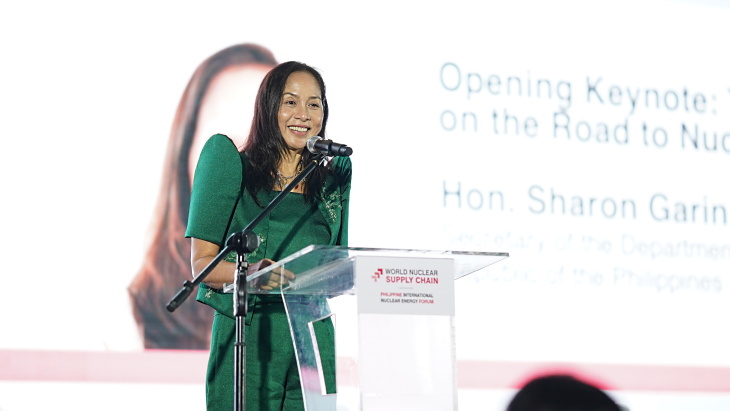 Philippines advances plans for nuclear power as energy demand rises
Scaling Nuclear Together: Opportunities and Challenges
Dr Sama Bilbao y León, Director General of World Nuclear Association, set out the global picture from the World Nuclear Outlook Report 2026: record generation in 2025, around 80 reactors under construction, and national ambitions that could take global capacity to nearly 1500 GWe by mid-century. Turning ambition into delivery, she said, requires a shift from projects to programmes, built on partnerships and de-risked finance, with developers, operators and suppliers working together to deliver nuclear at scale.
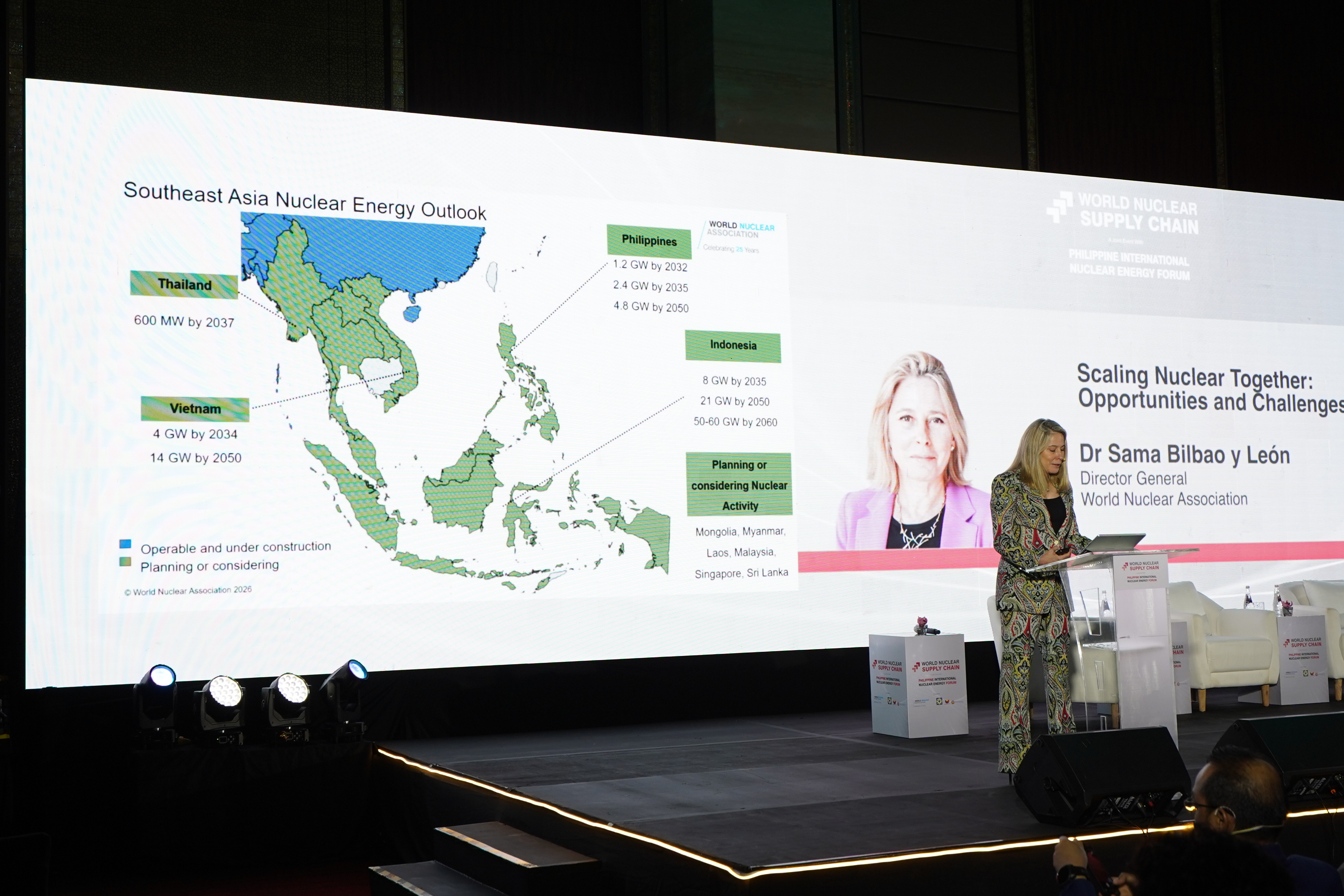
Caption: From World Nuclear Supply Chain Conference 2026: Opening key note by Dr Sama Bilbao y León, Director General of World Nuclear Association ”
ASEAN: Regional Pathways to Nuclear Readiness
The opening panel explored nuclear readiness across Southeast Asia. Energy security is now at the top of the regional agenda, with ASEAN energy demand projected to grow fourfold by 2060 and the ASEAN coordinated target scenario requiring 32.7 GWe of nuclear capacity by then. Momentum is building: Indonesia has announced 200 MWe and Vietnam plans 2.4 GWe, the Philippines, Thailand, Malaysia and Singapore have targets and studies under way, and a new Philippines-led ASEAN nuclear working group will cover regulation, financing, standards and skills.
Key quotes:
- “Readiness is our first strategic investment.” Ir. Ts. Dr Shamsul Amri bin Sulaiman, Chief Technology and Engineering Officer, TNB Genco
- “It’s a multi-generational commitment and a decision which must be considered carefully. And if the answer is to go ahead with nuclear power, it requires long-term commitment and long-term policy and regulatory stability.” Yinglun Teng, Energy Analyst, International Energy Agency
- “I urge all our dialogue partners to engage through us, [the] ASEAN Centre for Energy, or through the Philippines as the [lead] in this working group, and of course bilaterally [with] individual countries.” Dato’ Ir. Ts. Abdul Razib Dawood, Executive Director, ASEAN Centre for Energy
From Roadmap to First Contract: Delivering Nuclear in the Philippines
The Department of Energy is assessing candidate sites, completing policy and regulatory arrangements and preparing a nuclear energy tender. Pioneer projects would be certified as energy projects of national significance, with faster permitting and offtake tied to the plant’s licence. Private generators Aboitiz Power and Meralco PowerGen set out what they need to invest: an operational PhilATOM regulator, consistent policies and predictable long-term offtake with a creditworthy counterparty.
Key quotes:
- “For the Philippines, nuclear is a long-term national undertaking… We’ve also indicated [a] framework that the pioneer nuclear power plant project would have the offtake arrangements tied with the licensing of the plant.” Patrick T. Aquino, Director of the Energy Utilization Management Bureau, Department of Energy, Republic of the Philippines
- “We approach this as potential investors that are taking a long-term view, but also a view that is very disciplined about risks… It really is about what is it that makes a first nuclear project investable and how do we get there?” Nicole Yazon, Vice President – Strategy, Aboitiz Power Corporation
- “If we are going to invest a significant capital in a project like a nuclear power plant, we want to make sure that we understand the policies moving forward and that if there is going to be any revision or change, application has to be prospective, not retroactive.” Emmanuel V. Rubio, President and CEO, Meralco PowerGen Corporation (MGEN)
ASEAN Nuclear Deployment Pathways: Collaborative Opportunities Across the Value Chain
 Viewpoint: Unlocking ASEAN's nuclear potential - a case for regulatory convergence on SMRs
Panellists set out the groundwork needed before a first project: building institutional competencies, which take longest to develop; sharing licensing and supply chain information across ASEAN; and choosing technology to suit a country’s reasons for nuclear and its physical constraints. The Philippine Nuclear Research Institute is laying the framework for the PhilATOM regulator, has helped narrow candidate sites from ten to five and is leading a nuclear workforce strategy. Experience in Malaysia showed how persistent outreach can bring local construction, steel and manufacturing industries into the nuclear supply chain.
Key quotes:
- “Reactors you can buy if you want to, but people you can’t… Capability upskilling is the number one thing that always takes too long to do. The second point is you don’t have to do it alone.” Ming Tan, Global Practice Leader - Nuclear, Mott MacDonald
- “We are not essentially starting from scratch, but we just need to… nuclearize our workforce.” Dr Vallerie Ann I. Samson, Director, Philippine Nuclear Research Institute (PNRI)
- “You’re going to be meeting people who are opposed to it… but you need to persevere so that you can change opposition to encouragement and support.” Sheriffah Noor Khamseah Al-Idid, Consultant Nuclear Power, Venture Capital & Innovation Global Network Ambassador, World Nuclear Energy Day (WNED) - Malaysia
Championing Nuclear and Building Support
Hon. Mark Cojuangco, an advocate for nuclear power for close to two decades, shared five lessons on building support: anchor nuclear in a national ambition people can understand; make the case through evidence and direct experience; build an independent regulator that protects safety and decides in good time; have government lead on financing; and turn international cooperation into execution. He has proposed at least 16 GWe of nuclear capacity by 2045 and made the case for commissioning the completed 620 MWe Bataan plant, which could host further reactors, if an independent assessment shows it can be done safely and economically.
Key quotes:
- “Energy policy is economic policy. We cannot build an industrialized Philippines without the electricity to power it… I would rather use our foreign exchange for technology that produces electricity for at least eight decades than spend it year after year on fuel that disappears when we burn it. Energy security is national security.” Hon. Mark O. Cojuangco, Representative, House of Representatives, Republic of the Philippines
What Makes Programmes Succeed: Key Success Factors for Nuclear Deployment
Policymakers from Canada, the UK and Japan shared lessons from established nuclear programmes. Saskatchewan is licensing its first SMR site and has announced a 2000 MWe large-scale project; the UK has committed around £17 billion to new nuclear, using a regulated asset base model to lower the cost of capital at Sizewell C; and Japan has restarted 15 reactors and plans to replace two to five units by 2040. The panel’s message was to sequence programmes in the right order, invest in supply chains and skills ahead of demand, share risk between government and investors, and engage local communities early and transparently.
Key quotes:
- “Making investments into that supply chain is really going to be a condition precedent for the further deployment of nuclear around the world, because that’s actually going to be what drives costs down.” Hon. Jeremy Harrison, Minister of Crown Investments Corporation, Government of Saskatchewan
- “The central lesson is that a successful nuclear programme must be built in the right order… Reactor technology and vendor selection are often treated as a first and most visible decision, but in a well-sequenced programme they come at the end of that preparatory journey.” Rhiannon Harries, Deputy Trade Commissioner, UK Department for Business, Innovation, Science and Trade
- “I cannot emphasize too much safety and trust, and the public acceptance is very key, because once you lose that, it is very difficult to get back.” Osamu Onodera, Deputy Commissioner for International Affairs, Agency for Natural Resources and Energy, Ministry of Economy, Trade and Industry (METI), Japan
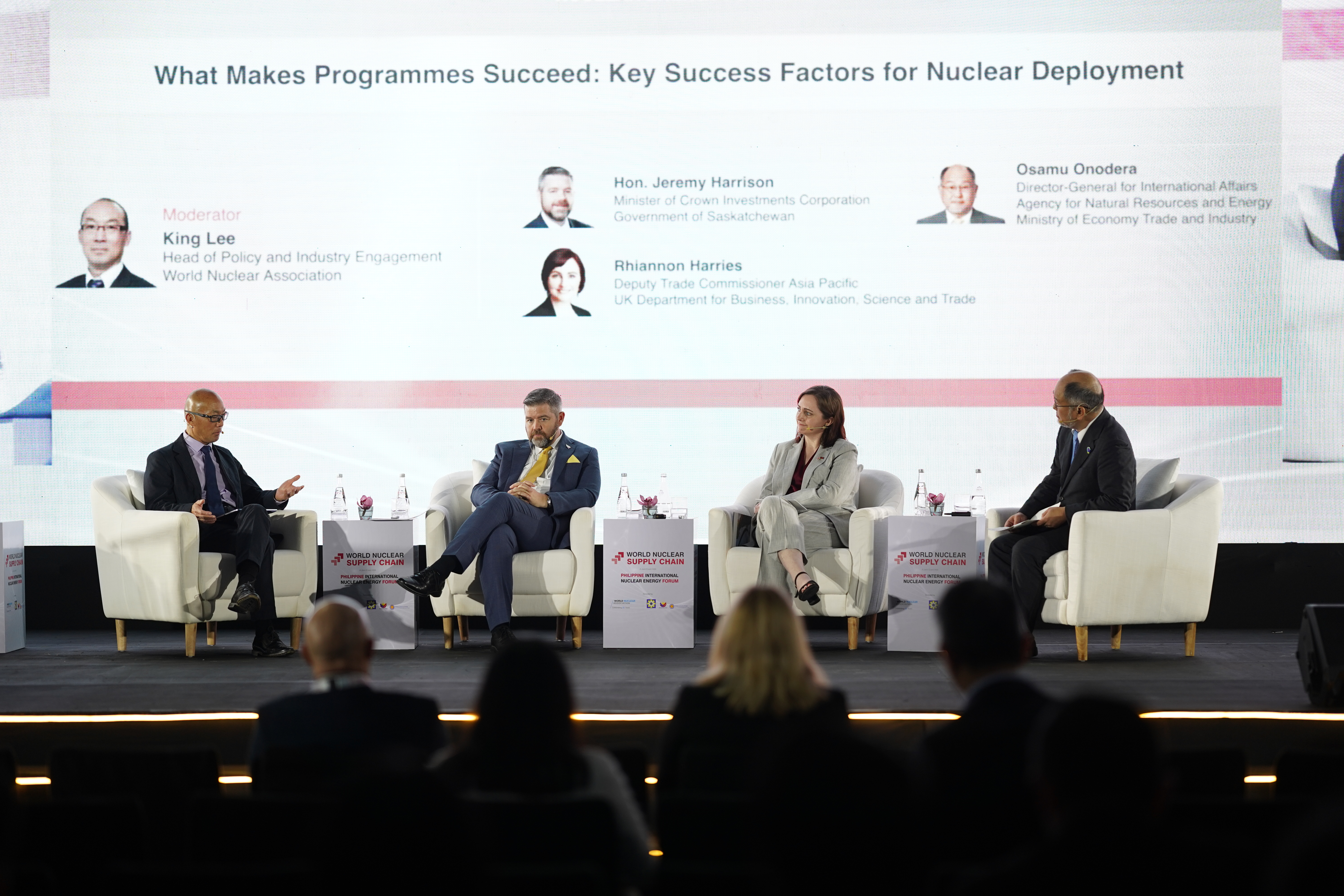
Caption: From World Nuclear Supply Chain Conference 2026: Panel moderated by King Lee “What Makes Programmes Succeed: Key Success Factors for Nuclear Deployment”
Mobilizing New Build Programmes
Choosing a delivery model to match an owner’s capabilities is essential, and more localization is not always better for a first-of-a-kind unit. Egypt’s El Dabaa plant shows how multi-unit sites can shift to local labour over time: all four units are under construction, reactor pressure vessels are installed at units 1 and 2, localization is planned to rise from 20% to 35% unit by unit, and more than 70% of the workforce is Egyptian. A pre-contract industrial survey, a joint owner–contractor localization committee and an annual industry forum have brought Egyptian suppliers into the project. KHNP drew on more than 50 years of continuous construction: a project in Korea takes around 11 years in total, including about five from first concrete to completion.
Key quotes:
- “[Successful] project delivery begins before the construction starts. So it is important to prepare for good site, regulatory capabilities, technology and supply chains as well.” Sang-won Shin, General Manager, Korea Hydro & Nuclear Power (KHNP)
- “Nuclear is among the most complex things you can build… we can only succeed if we standardize and do the same thing over and over again in repeated fashion.” Dr Benjamin Sauer, Partner, McKinsey & Company
Pathway to First Concrete: Delivering Nuclear in Vietnam
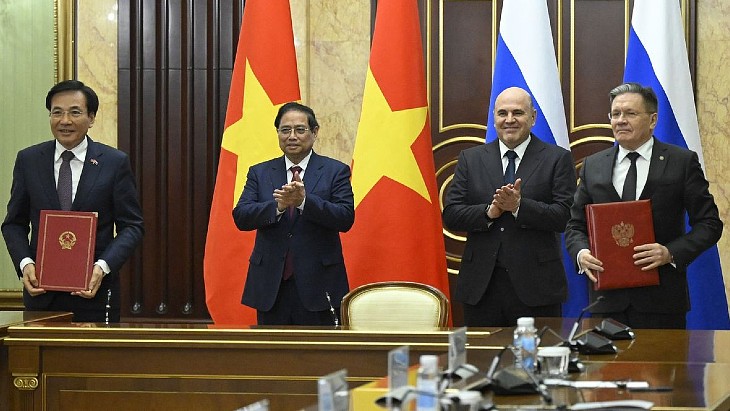 Vietnam, Russia sign agreement on new nuclear plant
Vietnam’s Ninh Thuan 1 project is moving towards construction after the government reversed its 2016 suspension in 2024. Nguyen Huu Huan said Vietnam and Russia signed an intergovernmental agreement in March 2026, EVN and Rosatom have held more than 30 contract discussion meetings, and approval of the investment policy by the National Assembly is hoped for next year. The government has also set a localization target of up to 30% of the investment in construction and installation work. Dmitry Raspopin said the agreement fixes the VVER-1200 as the reference technology. He described a wider nuclear ecosystem built around a Centre for Nuclear Science and Technology with a 10 MW research reactor, a supply chain of 100–200 mostly local companies, and more than 400 Vietnamese students and specialists already trained in Russia.
Key quotes:
- “For nuclear power projects to be successful… national policy must be considered and preparation must be made from legal framework, infrastructure, human resource and financial resource.” Nguyen Huu Huan, Deputy Manager, Economic and Planning Department, Vietnam Atomic Energy Institute (VINATOM)
Sustaining the Existing Nuclear Fleet: Benefits Through the Value Chain
Nathan Paterson, Senior Programme Lead – Supply Chain at World Nuclear Association, led a panel on what long-term operation, refurbishment and restarts require from suppliers and what they mean for plant workforces and host communities. Dr Chetan Prakash Kaushik of CORE Energy Systems drew on CORE’s replacement of the primary recirculation piping at NPCIL’s Tarapur plant, one of the world’s longest-serving reactors, to show how fleet work preserves critical manufacturing and engineering capabilities that can be transferred to new build. Fiaz Jadoon set out how the City of Pickering, host to nuclear generation for more than 50 years, is preparing local people and businesses to benefit from the Pickering refurbishment, where site work began last month, and offered advice to Southeast Asian communities hosting a plant for the first time.
ASEAN Nuclear Energy Cooperation
King Lee, Head of Policy and Industry Engagement at World Nuclear Association, spoke with Rully Hidayatullah, Senior Officer at the ASEAN Centre for Energy, about how regional cooperation can accelerate nuclear deployment. They discussed the work of the Nuclear Energy Cooperation Sub-Sector Network (NEC-SSN) under the ASEAN Plan of Action for Energy Cooperation (APAEC), covering safety standards, regulatory preparedness, technical capacity, financing and stakeholder engagement, along with its strategies and action plans for 2026–2030 and how international organizations can support ASEAN nuclear development.
Day One in Review: The Demand Signal, Insights and Takeaways
Dr Sama Bilbao y León closed the first day in conversation with Hon. Giovanni Carlo J. Bacordo, Undersecretary, Department of Energy, Republic of the Philippines, reflecting on the demand signal from the region. They discussed the message the region sent to the global supply chain, what the Philippines needs from international suppliers and partners as it moves from roadmap to first project, and how ASEAN countries can work together so that a regional pipeline gives suppliers the confidence to invest. Bilbao y León’s three takeaways were that the demand is real, that the region is moving at different speeds but in the same direction, and that the supply chain needs to engage early.