Nordic Nuclear Forum 2026 Opens in Stockholm with Strong Signal for Europe’s Nuclear Future
The Nordic Nuclear Forum 2026 (NNF26) opened in Stockholm this week with a clear message: nuclear energy is firmly back at the centre of Europe’s energy future.
Held for the first time outside Finland, this year’s event is the biggest in the forum’s history, bringing together around 800 delegates and 60 exhibitors from across the Nordic-Baltic region and beyond to discuss the policies, partnerships and industrial capacity needed to accelerate nuclear deployment.
The opening of Day 1 set the tone for the discussions ahead.
“Nuclear is back for good.”
With these words, Finland’s Minister of Climate and the Environment, Sari Multala, opened the conference, signalling the growing political momentum behind nuclear energy as a cornerstone of Europe’s clean energy transition.
Her remarks underscored the role of nuclear in delivering secure, affordable and fossil-free electricity as Europe strengthens its energy resilience.
The opening ministerial discussions reflected a shared view among policymakers: Europe must reduce regulatory friction and enable large-scale nuclear deployment to support energy security, industrial competitiveness and decarbonisation.
Sweden’s Minister for Energy, Business and Industry and Deputy Prime Minister, Ebba Busch, reinforced the strategic importance of nuclear power to national resilience.
“Without energy, there is no industry. Without industry, there is no defence. Without defence, there is no sovereignty.”
Her remarks highlighted Sweden’s shift toward a new era of nuclear development, moving decisively from plant closures toward facilitating new nuclear build.
Regulatory certainty also emerged as a central theme.
Speaking during the session Nuclear Energy for a Secure North, Petteri Tiippana, Director General of Finland’s Radiation and Nuclear Safety Authority, emphasised the importance of transparent and predictable frameworks for future deployment.
“Predictability does not mean predefined outcomes. It means clarity, consistency and transparency in regulatory processes.”
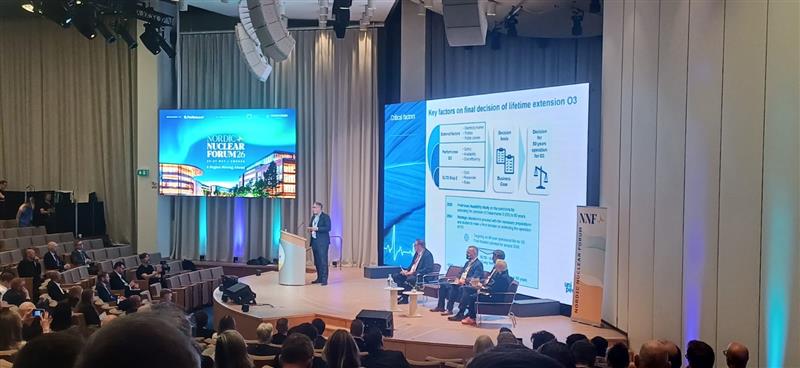
Day 1 also focused on the long-term operation of existing plants and the importance of maintaining expertise across the sector.
World Nuclear Association Chairman Johan Svenningsson, CEO of Uniper Sweden, joined industry leaders to discuss the strategic importance of long-term operation and investment planning for Europe’s nuclear future.
The discussion highlighted that extending the life of existing nuclear plants remains essential to Europe’s energy security and requires stable regulation, technical planning and sustained industrial capability.
Momentum in Swedish nuclear was further underlined by announcements around new project applications and continued investment interest across the region.
Powering the Industry: Building the Nuclear Future
World Nuclear Association's Director General led the discussion by moderating the panel on Powering the Industry: Supply Chains, Technical Expertise, and Fuel Solutions for a Nuclear Future. Bringing together senior leaders from Westinghouse, Framatome, GE Vernova Hitachi and Rolls-Royce SMR, the panel explored one of the defining challenges of this decade: how to transform political ambition into industrial delivery.
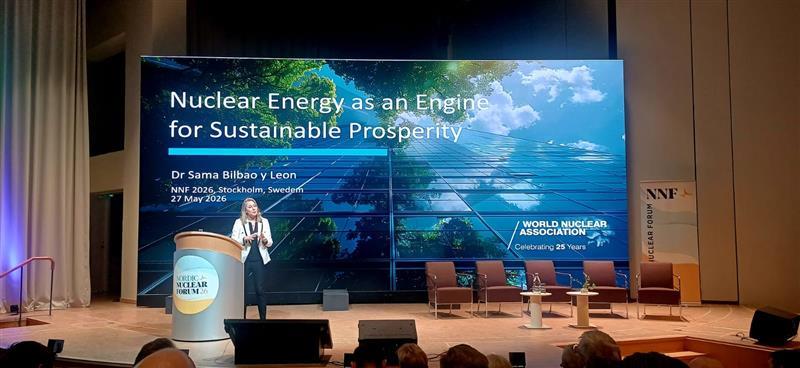
Opening the discussion, Bilbao y León framed the moment as a historic turning point for the sector.
“The global mandate to triple nuclear capacity has moved from a policy goal to an industrial mission.”
Bilbao y Leon highlighted how recent progress in fuel diversification and supply chain resilience has fundamentally reshaped the industry’s strategic outlook, with the Nordic region emerging as a global model for nuclear deployment.
Reflecting on the future of nuclear, the message was clear: nuclear energy must be understood not simply as infrastructure, but as the foundation for long-term economic resilience.
“Nuclear is an engine for sustainable prosperity.”
Bilbao y León outlined three priorities for the Nordic-Baltic region to accelerate progress:
- Creating strong demand signals through long-term offtake commitments
- Investing in supply chains and industrial capacity, not just individual projects
- Strengthening cross-border collaboration to standardise and scale
Her perspective reinforced one of the central themes of the conference: that the next phase of nuclear deployment will depend not only on technology readiness, but on building the industrial ecosystems capable of delivering at pace.
The panel discussions focused on how the region can strengthen domestic manufacturing capability, localise supply chains, develop workforce capacity and create the regulatory certainty needed to support simultaneous deployment of both large-scale reactors and SMRs.
The conversation also highlighted the strategic importance of energy sovereignty and the need to ensure secure, diversified fuel and component supply chains in a rapidly evolving geopolitical environment.
A Clear Direction for Europe
The message from Nordic Nuclear Forum 2026 was clear: Europe’s nuclear revival is accelerating.
Success will depend on predictable regulation, stronger regional collaboration, resilient industrial supply chains and sustained investment in people, infrastructure and expertise.
The Nordic-Baltic region is increasingly positioning itself not only as a participant in Europe’s nuclear resurgence, but as one of the regions helping define its future.