How is uranium made into nuclear fuel?
Each pellet of nuclear fuel – comparable to the size of your fingertip – contains as much energy as a tonne of coal (Image: Kazatomprom)
Uranium is the main fuel for nuclear reactors, and it can be found in small amounts in most rocks, and even in seawater. Mined uranium must be processed before it can be used as fuel for a nuclear reactor.
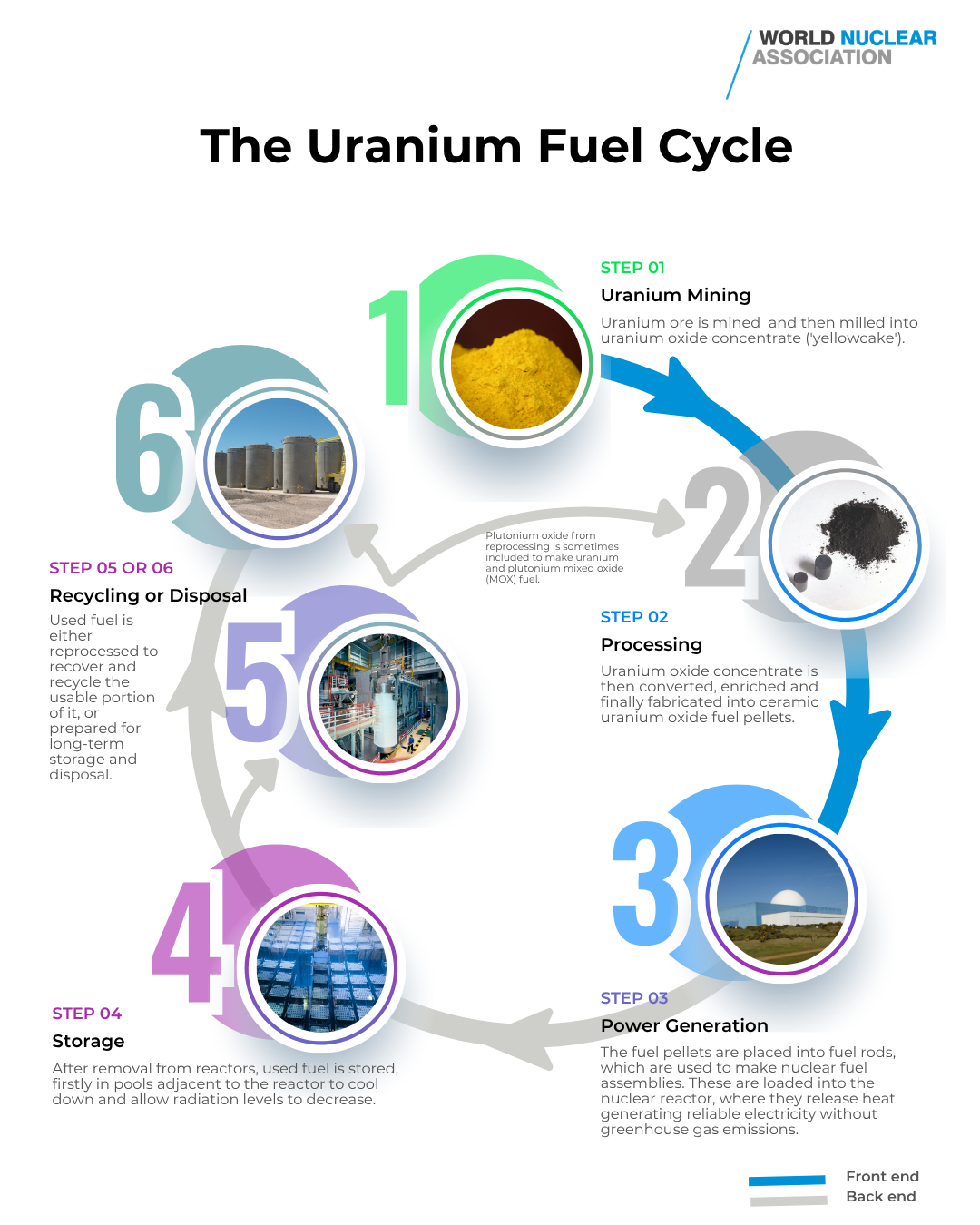
The five steps of the uranium fuel cycle
01 Mining Similar to many other metals +
A significant proportion of uranium is extracted through conventional mining methods, i.e. removing mineralized rock (ore) from the ground, breaking it up and treating it to remove the minerals being sought. However, close to 60% of the world's uranium is now mined using a method called in-situ leaching, where the mining is accomplished without any major ground disturbance. Water injected with oxygen (or an alkali, acid or other oxidizing solution) is circulated through the uranium ore, extracting the uranium. The resulting solution is pumped to the surface where it is separated, filtered and dried to produce uranium oxide concentrate, often referred to as ‘yellowcake’.
Fission Fact: Uranium mines operate in many countries, but about three-quarters of uranium is produced in three countries: Kazakhstan, Canada and Australia.
02 Processing Conversion & Enrichment +
Most nuclear reactors use the uranium-235 isotope as fuel, but this isotope comprises only a tiny part (0.7%) of natural uranium. So, the concentration of uranium‑235 must be increased through a process called enrichment.
To do this, the uranium is first converted into a volatile form in a process called conversion. This form (uranium hexafluoride) is then heated so that it becomes a gas, in which form it is spun at very high speeds in tall, fast‑rotating machines called centrifuges. The spinning separates the lighter uranium‑235 from the heavier uranium‑238, to increase the uranium-235 concentration for nuclear fuel.
Fission Fact: A small number of reactors, most notably the CANDU reactors from Canada, are fuelled with natural uranium.
03 Fuel fabrication The making of nuclear fuel +
The enriched uranium is transported to a fuel fabrication plant where it is converted to uranium dioxide powder. This powder is then pressed to form small cylindrical pellets, which are then heated to make a hard ceramic material. The pellets are subsequently inserted into thin tubes known as fuel rods, which are then grouped together to form fuel assemblies.
Fission Fact: The number of fuel rods used to make each fuel assembly ranges from around 90 to well over 200, depending on the type of reactor. Once loaded, the fuel normally stays in the reactor core for around three-to-four years.
04 Power generation Fuelling the reactor core +
Fuel is loaded into the reactor core undergoing the nuclear fission chain reaction to release heat energy. This heat energy is used to boil water into high pressure steam that turns a turbine to generate electricity. A fuel assembly, usually several metres long, can spend years in a reactor, generating immense amounts of electricity.
Fission Fact: About 27 tonnes of uranium – around 18 million fuel pellets housed in over 50,000 fuel rods – is required each year for a 1000 MWe pressurized water reactor. In contrast, a coal power station of equivalent size requires more than two and a half million tonnes of coal to produce as much electricity.
05 Storage, recylcing & disposal Long term approaches for used nuclear fuel +
Used fuel is very hot and highly radioactive, so it must first be stored safely under water to cool down. Later, it can stay in water ('wet storage') or be moved into sealed containers kept outside on storage pads or in air‑cooled buildings ('dry storage'). Letting the fuel cool and lose some radioactivity makes future recycling or disposal easier.
These storage methods are only temporary. Countries choose one of two main long‑term approaches: recycling used fuel or direct disposal. The choice depends on each country’s political, economic, and technological priorities.
Almost 5% of the world’s new nuclear fuel used today is manufactured, from plutonium recovered from used fuel and depleted uranium, into mixed-oxide fuel (MOX).
Fission Fact: Although some countries treat used nuclear fuel as waste, most of the material in used fuel can be recycled. Approximately 97% – the vast majority (~94%) being uranium – of it could be used to make fresh fuel.