Cooling Power Plants
- At some stage during construction or operation, all electricity generating options use water. Wind and solar energy generally have among the smallest water 'footprints', whereas biomass and hydropower have the largest. Fossil fuels and nuclear plant consume significant quantities of water in the operational phase for cooling.
- The amount of cooling required by any steam-cycle power plant (of a given size) is determined by its thermal efficiency. It has essentially nothing to do with whether it is fuelled by coal, gas or uranium.
- Nuclear plants share cooling needs with all steam-cycle plants, but they have one additional requirement: heat must continue to be removed after the reactor shuts down.
- Nuclear power plants have greater flexibility in location than coal-fired plants due to fuel logistics, giving more potential for their siting to be determined by cooling considerations.
- The most common method for cooling a nuclear power plant is a flow of seawater.
The most common types of nuclear power plants use water for cooling in two ways:
- To convey heat from the reactor core to the steam turbines.
- To remove and dump surplus heat from this steam circuit. (In any steam/Rankine cycle plant such as present-day coal and nuclear plants there is a loss of about two-thirds of the energy due to the intrinsic limitations of turning heat into mechanical energy.)
The bigger the temperature difference between the internal heat source and the external environment where the surplus heat is dumped, the more efficient is the process in achieving mechanical work – in this case, turning a turbine connected to a generatora. Hence the desirability of having a high temperature internally and a low temperature in the external environment. This consideration gives rise to desirably siting power plants alongside very cold water.*
Apart from proximity to main load centres, there is no reason to site nuclear power plants away from a coast, where they can use once-through seawater cooling. The high energy density of uranium means that logistical requirements for fuel are modest. A large light water reactor typically loads approximately 20-30 tonnes of fabricated uranium fuel each year. This compares with several million tonnes of coal annually for a coal plant of comparable size. In the event that water is so limited that it cannot be used for cooling, and a coastal location is not available, plants can be sited away from the load demand, but this will incur additional transmission costs.
* Many power plants, fossil and nuclear, have higher net output in winter than summer due to differences in cooling water temperature.
1. Steam cycle heat transfer
For the purpose of heat transfer from the core, the water is circulated continuously in a closed loop steam cycle and hardly any is lostb. It is turned to steam by the primary heat source in order to drive the turbine to do work making electricity, and it is then condensed and returned under pressure to the heat source in a closed systemc. A very small amount of make-up water is required in any such system. The water needs to be clean and fairly pured.
This function is much the same whether the power plant is nuclear, coal-fired, or conventionally gas-fired. Any steam cycle power plant functions in this way. Steam cycles still account for the great majority of the world's thermal generation, though their share of total electricity has fallen as wind and solar have grown.
In a nuclear plant there is an additional requirement. When a fossil fuel plant is shut down, the source of heat is removed. When a nuclear plant is shut down some heat continues to be generated from radioactive decay, though the fission has ceased. This needs to be removed reliably, and the plant is designed to enable and assure this, both with routine cooling and also Emergency Core Cooling Systems (ECCS) provided in case of major problem with primary cooling. The routine cooling is initially with the main steam supply circuit bypassing the turbine and dumping heat into the condenser. After pressure drops, a residual heat removal system is relied upon with its own heat exchanger. The intensity of this decay heat diminishes with time, rapidly at first, and after a day or two ceases to be a problem if circulation is maintained.*
2. Cooling to condense the steam and discharge surplus heat
The second function for water in such a power plant is to cool the system so as to condense the low-pressure steam and recycle it. As the steam in the internal circuit condenses back to water, the surplus (waste) heat which is removed from it needs to be discharged by transfer to the air or to a body of water. This is a major consideration in siting power plants. In Turkey, there is a one percent gain in output if any particular plant is sited on the Black Sea coast with cooler water (average 5°C lower) than on the Mediterranean coast. For the UAE's Barakah plant, because the Gulf seawater there is about 35°C, instead of about 27°C as with the Shin Kori 3&4 reference units, larger heat exchangers and condensers were required.
The cooling function to condense the steam may be done in one of three ways:
- Direct or "once-through" cooling. If the power plant is next to the sea, a big river, or large inland water body it may be done simply by running a large amount of water through the condensers in a single pass and discharging it back into the sea, lake or river a few degrees warmer and without much loss from the amount withdrawn.e That is the simplest method. The water may be salt or fresh. Some small amount of evaporation will occur off site due to the water being a few degrees warmer.
- Recirculating or indirect cooling. If the power plant does not have access to abundant water, cooling may be done by passing the steam through the condenser and then using a cooling tower, where an updraught of air through water droplets cools the water. Sometimes an on-site pond or canal may be sufficient for cooling the water. Normally the cooling is chiefly through evaporation, with simple heat transfer to the air being of less significance. The cooling tower evaporates up to 5% of the flow and the cooled water is then returned to the power plant's condenser. The 3 to 5% or so is effectively consumed, and must be continually replaced. This is the main type of recirculating or indirect cooling.
- Dry cooling. A few power plants are cooled simply by air, without relying on the physics of evaporation. This may involve cooling towers with a closed circuit, or high forced draft air flow through a finned assembly like a car radiator.
There are many factors (e.g. local meteorological conditions, water resource and withdrawal rights, seasonal variance in water availability, existing infrastructure) that determine the best cooling system for a particular plant.
With a fossil-fuel power plant some of the heat discharged is in the flue gases. With a large coal-fired plant some 15% of the waste heat is through the stack, whereas in a nuclear power plant virtually all the waste heat has to be dumped into the condenser cooling water. This gives rise to some difference in water consumption or use between a nuclear and a coal plant. (A gas turbine plant will discharge most of its waste heat in the exhaust.)
Beyond this, and apart from size, any differences between plants are due to thermal efficiency, i.e. how much heat has to be discharged into the environment, which in turn largely depends on the operating temperature in the steam generators. In a coal-fired or conventionally gas-fired plant it is possible to run the internal boilers at higher temperatures than those with finely-engineered nuclear fuel assemblies which must avoid damage. This means that the efficiency of modern coal-fired plants is typically higher than that of nuclear plants, though this intrinsic advantage may be offset by emission controls such as flue gas desulfurization (FGD) and in the future, carbon capture and storage (CCS).
A nuclear or coal plant running at 33% thermal efficiency will need to dump about 14% more heat than one at 36% efficiency.f Nuclear plants currently being built have about 34-36% thermal efficiency, depending on site (especially water temperature). Older ones are often only 32-33% efficient.
Gas combined cycle (combined cycle gas turbine, CCGT) plants need only about one-third as much engineered cooling as normal thermal plants (much heat being released in the turbine exhaust), and these often use dry cooling for the second stage.*
* CCGT plants have an oil- or gas-fired gas turbine (jet engine) coupled to a generator. The exhaust is passed through a steam generator and the steam is used to drive another turbine. This results in overall thermal efficiency of over 50%. The steam in the second phase must be condensed either with an air-cooled condenser or some kind of wet cooling.
Combined heat and power (CHP) plants obviously need less engineered cooling provision than others since the by-product heat is actually used for something and not dissipated uselessly.
Due to the heat loss through combustion gases in the stack, simple-cycle coal plants have a lower heat rejection load through the condenser and cooling system than simple-cycle nuclear plants. However, they also have water needs for scrubbing and coal ash handling, which diminishes the difference between water needs for nuclear and coal-fired plants.
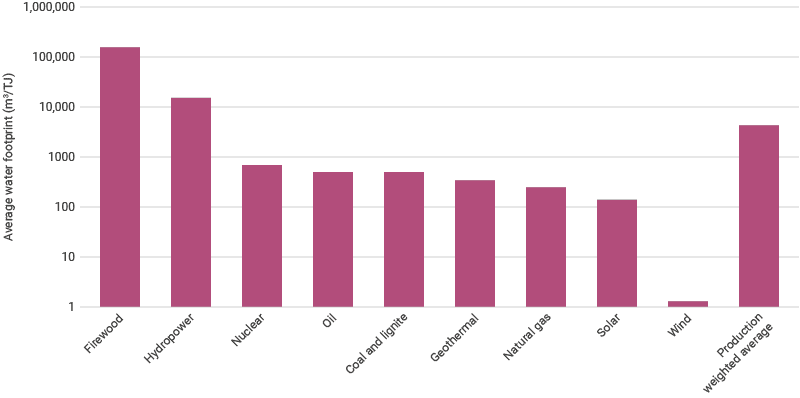
Water consumption per unit of electricity and heat produced 2008-2012 (source: Mekonnen et al., 2015)
Direct or once-through wet cooling
If a coal or nuclear plant is next to a large volume of water (big river, lake or sea), cooling can be achieved by simply running water through the plant and discharging it at a slightly higher temperature. There is then hardly any use in the sense of consumption or depletion on site, though some evaporation will occur as it cools downstream. The amount of water required will be greater than with the recirculating set-up, but the water is withdrawn and returned, not consumed by evaporation. In the UK the water withdrawal requirement for a 1600 MWe nuclear unit is about 90 cubic metres per second (7.8 GL/d).
Many nuclear power plants have once-through cooling (OTC), since their location is not at all determined by the source of the fuel, and depends first on where the power is needed and secondly on water availability for cooling. Using seawater means that higher-grade materials must be used to prevent corrosion, but cooling is often more efficient. According to a French government study, siting an EPR on a river instead of the coast would decrease its output by 0.9% and increase the kWh cost by 3%.
Any nuclear or coal-fired plant that is normally cooled by drawing water from a river or lake will have limits imposed on the temperature of the returned water (typically 30°C) and/or on the temperature differential between inlet and discharge. In hot summer conditions even the inlet water from a river may approach the limit set for discharge, and this will mean that the plant is unable to run at full power. In mid-2010 TVA had to reduce power at its three Browns Ferry units in Alabama to 50% in order to keep river water temperatures below 32°C, at a cost of some $50 million to customers. This was the same week when Rhine and Neckar River temperatures in Baden-Wuerttemberg approached the critical 28°C, and nuclear and coal-fired plants were threatened with closure. In August 2012 one unit of Millstone power station in Connecticut was closed because the seawater in Long Island Sound exceeded 24°C, but in 2014 the NRC approved it using seawater up to 26.7°C. The Turkey Point nuclear power plant in Florida uses 270 km of open canals to cool its condenser water, and in 2014 the NRC approved an increase in intake temperature limit to 40°C, from 37.8°C.
Sometimes a supplementary cooling tower is used to help, giving a dual system, as with TVA's Browns Ferry and Sequoyah plants in USA, many inland plants in France and Germany, and at the Huntly plant in New Zealand, but this means that some water is then lost by evaporation. In the mid 2010 Browns Ferry situation mentioned above, the six "seasonal" mechanical-draft cooling towers 18-24 m high were operating at full capacity and had been for most of the summer. TVA spent $160 million to add one larger (c 50 m) mechanical-draft cooling tower there, commissioned in 2012, and by 2017 had replaced four of the six original towers.
Recirculating or indirect wet cooling
Where a power plant does not have abundant water, it can discharge surplus heat to the air using recirculating water systems which mostly use the physics of evaporation.
Cooling towers with recirculating water are a common visual feature of power plants, often seen with condensed water vapour plumes. Sometimes in a cool climate it is possible to use simply a pond, from which hot water evaporates.
Most nuclear power (and other thermal) plants with recirculating cooling are cooled by water in a condenser circuit with the hot water then going to a cooling tower. This may employ either natural draft (chimney effect) or mechanical draft using large fans (enabling a much lower profile but using power*). The cooling in the tower is by transferring the water's heat to the air, both directly and through evaporation of some of the water. In the UK the water requirement for a 1600 MWe nuclear unit is about 2 cubic metres per second (173 ML/d), this being about half for evaporation and half for blow-down (see below).
* Chinon B in France (4x905 MWe) uses low-profile forced-draft cooling towers, and they were also to have been used at the proposed Calvert Cliffs 3 in the USA (1650 MWe). At Chinon B one cooling tower per unit is 30 m high (instead of 155 m required for a natural draft type there), 155 m diameter, and uses 8 MWe for its 18 fans (0.9% of power). At Calvert Cliffs the cooling tower fans would have used about 20 MWe (1.2%) of power.
Chinon B, France, with low-profile forced-draft cooling towers
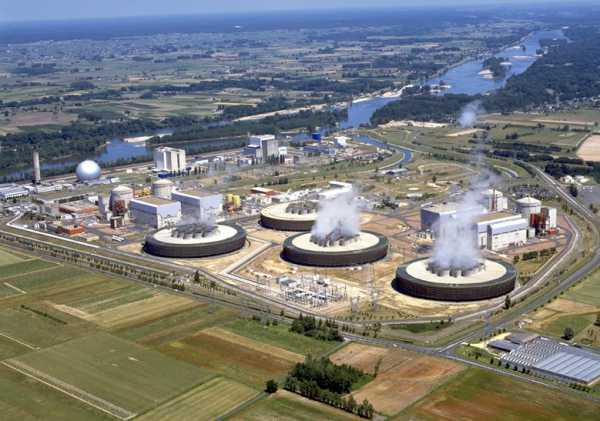
Credit: EDF/Marc Mourceau
The most common configuration for natural draft towers is called counterflow. These towers have a large concrete shell with a heat exchange 'fill' in a layer above the cold air inlet at the base of the shell. The air warmed by the hot water rises up through the shell by convection (the chimney effect), creating a natural draft to provide airflow to cool the hot water which is sprayed in at the top. Other configurations include crossflow, where the air moves laterally through the water, and co-current, where the air moves in the same direction as the water droplets. These towers do not require fans and have low operating but significant maintenance costs. For a large plant they may need to be over 200 metres high. They are used in large nuclear and coal-fired plants in Europe, eastern USA, Australia, and South Africa.
Mechanical draft cooling towers have large axial flow fans in a timber and plastic structure. The fans provide the airflow and are able to provide lower water temperatures than natural draft towers, particularly on hot dry days. However, they have the disadvantage of requiring auxiliary power, typically about 1% of the plant's output, and up to 1.2% of it. Mechanical draft towers are used exclusively in central and western USA since they can provide a more controlled performance over a wide range of conditions, ranging from freezing to hot and dry. Also they are less visually obtrusive, being less than 50 m high.
Such cooling towers give rise to water consumption, with up to 3.0 litres being evaporated for each kilowatt-hour producedg, depending on conditionsh. This evaporative water loss by phase change of a few percent of it from liquid to vapour is responsible for removing most of the heat from the coolant water at the cost of only a small fraction of the volume of the circulating liquid (though a rather large fraction of the water actually withdrawn from lake or stream). Water consumption by evaporation is reckoned to be typically about double that with direct cooling.
Cooling towers with recirculating water reduce the overall efficiency of a power plant by 2-5% compared with once-through use of water from sea, lake or large stream, the amount depending on local conditions.
Water evaporating from the cooling tower leads to an increasing concentration of impurities in the remaining coolant. Some bleed – known as 'blowdown' – is needed to maintain water quality, especially if the water is recycled municipal wastewater to start with – as at Palo Verde, Arizona*. Replacement water required is thus about 50% more than actual evaporation replacement, so this kind of system consumes (by evaporation) up to 70% of the water withdrawn.
* Some 220 ML/day of treated sewage is pumped 60 km from Phoenix, Az to the 3-unit 3875 MWe plant. Evaporation is 76 ML/day per unit, and blowdown 4.7 ML/day at a salinity approx that of seawater, discharged to evaporation ponds, hence about 2.6 L/kWh is used. It has three mechanical-draft cooling towers for each unit.
Even with the relatively low net water requirement for recirculating cooling, large power plants can exceed what is readily available from a river in summer. The 3000 MWe Civaux nuclear plant in France has 20 GL of water stored in dams upstream to ensure adequate supply through drought conditions.
A few nuclear plants employ cooling ponds, which are another type of closed-cycle cooling that reduce the evaporative losses associated with cooling towers. Cooling ponds require a significant amount of land and may not be feasible for other reasons. A cooling pond has the advantage of transferring a larger percentage of waste heat to the atmosphere via convection or slower evaporation due to lower differential temperatures, reducing the rate of evaporation and thus the rate of consumptive water loss relative to cooling towers. Also their environmental impacts are typically less than direct cooling.
Dry cooling
Where access to water is even more restricted, or environmental and aesthetic considerations are prioritized, dry cooling techniques may be chosen for conventional reactors. As the name suggests, this relies on air as the medium of heat transfer, rather than evaporation from the condenser circuit. Dry cooling means that minimal water loss is achieved. There are two basic types of dry cooling techniques available.
One design works like an automobile radiator and employs high-flow forced draft past a system of finned tubes in the condenser through which the steam passes, simply transferring its heat to the ambient air directly. The whole power plant then uses less than 10% of the water required for a wet-cooled plantj, but some power (around 1-1.5% of the power station's output) is consumed by the large fans required.k This is direct dry cooling, using air-cooled condenser (ACC) and its only routine use at a nuclear power plant was for the very small reactors at Bilibino in the Russian Arctic, the last of which shut down at the end of 2025, though the THTR-300 experimental reactor in Germany in the 1980s was also air-cooled.
Alternatively, there may still be a condenser cooling circuit as with wet recirculating cooling, but the water in it is enclosed and cooled by a flow of air past finned tubes in a cooling tower.* Heat is transferred to the air, but inefficiently. This technology is not favoured if wet cooling depending on evaporation is possible, but energy use is only 0.5% of output.
* Some mechanical draft towers are a hybrid design incorporating a dry section above the wet section. The mode of cooling used depends on the season, with dry cooling being preferred during the colder months (see below).
In both cases there is no dependence on vaporization and hence no evaporative loss of cooling water. The use of fans also allows for greater control over cooling than relying simply on natural draught. However, the heat transfer is much less efficient and hence requires much larger cooling plant which is mechanically more complex. Both types of dry cooling involve greater cost for the cooling set-up and are much less efficient than wet cooling towers using the physics of evaporationl since the only cooling is by relatively inefficient heat transfer from steam or water to air via metal fins, not by evaporation. In a hot climate the ambient air temperature may be 40ºC, which severely limits the cooling potential compared with a wet bulb temperature of maybe 20ºC which defines the potential for a wet system. However, if dry systems are retrofitted, the wet system is still available for hot weather.
In the UK, EN-7 lists dry cooling among the available cooling types and states that nuclear infrastructure using a dry cooling system "may be capable of deployment away from any substantial water body". The Environment Agency's 2010 assessment had treated dry cooling as an unlikely choice on cost and efficiency grounds, appropriate only where water is in extremely short supply. For large units there are also safety implications relating to removal of decay heat after an emergency shutdown with loss of power. In Iran, four 1300 MWe German reactors planned in the 1970s at Isfahan and Saveh were to use dry cooling, with two 260m tall and 170m diameter cooling towers each. It is unlikely that large nuclear plants will adopt dry cooling in the foreseeable future.
However, several small modular reactor (SMR) designs propose dry cooling as an option, potentially giving greater flexibility in siting. For example, Holtec’s SMR-300 can be paired with an air-cooled condenser. In May 2026, developers selected the SMR-300 for the preliminary Green River Advanced Nuclear Project in Utah, where Holtec identified its dry cooling option as particularly suitable for the arid environment.
China plans for small modular molten salt reactors to be an energy solution in the northwest of the country, where there is little water and low population density. China’s current experimental programme centres on the 2 MWt liquid-fuel TMSR-LF1 at Wuwei in Gansu, which achieved first criticality in October 2023 and full power in June 2024. China now aims to build a roughly 100 MW demonstration molten-salt reactor by 2035.
Hybrid cooling and alternative water sources
Freshwater is a valuable resource. Water-conservation hybrid systems substantially reduce the evaporative water consumption of an all-wet system, while reclaimed and saline sources shift direct demand away from freshwater. For plants in arid or water-stressed regions, both approaches can reduce dependence on rivers and aquifers and so improve resilience to drought.
Hybrid wet-dry cooling systems combine evaporative and dry elements in a single installation. There are two main designs. Plume-abatement designs are essentially wet towers with a small dry section added to suppress the visible vapour plume. In water-conservation designs the dry section carries much of the cooling load through the cooler months, and the wet section supplements it during summer heat.
Cooling water for plants away from a coastline need not be freshwater. The three-unit Palo Verde plant in Arizona is cooled with reclaimed municipal wastewater. Treated effluent from the Phoenix area is piped about 60 kilometres (36 miles) to the site, where it receives treatment before use in the cooling towers.
In 2012 the IAEA reported that 74% of nuclear power plants used once-through cooling – 45% using water from the sea, 15% from a lake, and 14% from a river. Recirculating systems with cooling towers were used by 26% of nuclear power plants. Some plants also supplement their main once-through cooling system with a recirculating system and cooling towers as a way to reduce impact on the body of water, for example during hot weather or periods of drought.
Environmental and social aspects of cooling
Each of the different methods of cooling entails their own set of local environmental and social impacts and is subject to regulation.
In the case of direct cooling, impacts include the amount of water withdrawn and the effects upon organisms in the aquatic environment, particularly fish and crustaceans. This latter includes both kills due to impingement (trapping of larger fish on screens) and entrainment (drawing of smaller fish, eggs and larvae through cooling systems) and the change in ecosystem conditions brought about by the increase in temperature of the discharge water.
In the case of wet cooling towers, impacts include water consumption (as distinct from just abstraction) and the effects of the visual plume of vapour emitted from the cooling tower. Many people consider such plumes as a disturbance, while in cold conditions some tower designs allow ice to form which may coat the ground or nearby surfaces. Another possible problem is carryover, where salt and other contaminants may be present in the water droplets.
Over time, knowledge of these effects has increased, impacts have been quantified and solutions developed. Technical solutions (such as fish screens and plume eliminators) can effectively mitigate many of these impacts but at an associated cost that scales with complexity.
In a nuclear plant, beyond some minor chlorination, the cooling water is not polluted by use – it is never in contact with the nuclear part of the plant but only cools the condenser in the turbine hall.
On a regional and global scale, less efficient means of cooling, especially dry cooling, will lead to an increase in associated emissions per unit of electricity sent out. This is more of a concern for fossil-fuel plants but arguably carries implications for nuclear as well in terms of waste generated.
Consumption also has a social and ecological dimension. For plants relying on river water, consumptive losses reduce the amount of surface water available downstream. NRC guidance requires consideration of municipal, agricultural and industrial users with which a plant may compete for water, as well as aquatic habitats and species sensitive to reduced water availability.
US regulation
In the USA, cooling water intakes are regulated under a rule finalized by the Environmental Protection Agency in 2014, covering facilities that withdraw more than 2 million gallons per day with at least 25% of the water used for cooling. Existing facilities choose among seven options for controlling impingement, with entrainment requirements determined site by site. New units at existing facilities must achieve reductions commensurate with closed-cycle cooling. New facilities remain subject to the EPA’s 2001 Phase I rule.
Performance during heatwaves and climate resilience
Cooling constraints on operating plants generally fall into two categories.
- Temperature can impact the operation of plants as discharge limits require output reductions or shutdown to protect the environment.
- Water levels and flow can impact the operation of plants in two main ways. Site regulations may require output to fall as river flow drops, as on the Meuse at Chooz, whilst at lower levels still a plant may be physically unable to draw water through its intakes, as the Danube's fall towards the suction level of the cooling-water pumps at Paks in Hungary and Cernavodă in Romania showed in 2026.
The OECD Nuclear Energy Agency concluded in a 2021 assessment that extreme weather has already affected nuclear plant operation, and that warmer cooling water reduces output through lower thermal efficiency. Adaptation measures identified include closed cooling systems, more robust water intakes and more efficient heat exchangers, with costs varying by reactor type and regulatory regime.
France
High water temperatures and low flow frequently impact the operation of nuclear plants in France during summer months, albeit the net effect on annual production is small. Fourteen of EDF's 18 nuclear power plant sites are inland and depend on river or estuary water for cooling.
EDF says that thermal and low-flow losses have averaged 0.3% of French nuclear output since 2000. The Cour des comptes, which puts the cost of those losses at €890 million over 2001-2023, has said that such unavailability could reach 1.4% of production by 2035 and triple or quadruple by 2050 without accelerated adaptation. In June 2026 EDF announced an adaptation plan of €8.7 billion over 15 years. RTE has projected in its long-range study that climate-related production losses at river-sited reactors could be roughly two-to-three times today's level by 2050.
Adaptation measures by EDF succeeded in reducing curtailment losses at river-cooled plants from 5.5 TWh in 2003 (1.31% of that year’s generation) to 0.5 TWh in 2022 – a 91% reduction.
France regulates thermal discharges through two-tier prescriptions set for each site. Each inland site has normal limits, plus limits that apply during 'exceptional climatic conditions' which may be used when the grid operator RTE states a minimum-power need. No regulator decision is needed as the limits are pre-set. Beyond the second tier, the regulator can grant temporary derogations. In summer 2022 such decisions temporarily modified thermal limits at five plants – Blayais, Bugey, Golfech, Saint-Alban and Tricastin. In the event four plants used them for a cumulative 24 days (Tricastin nine, Bugey eight, Golfech six, Saint-Alban one).
USA
In the USA plants using direct cooling from rivers must reduce power in hot weather. At TVA's three Browns Ferry units cooling water has always been diverted through helper cooling towers when the Tennessee River approaches the plant's permitted temperature limit, and if that is not enough the units are derated as happened in 2007, 2010 and 2011.
2026 European heatwaves
Extended heatwaves and drought across Europe during 2026 have impacted the operation of a number of inland nuclear power plants.
France
In the June heatwave EDF shut Golfech 2 (offline 22 June to 2 July), Bugey 3 (offline 25 June to 3 July) and Nogent 1 (offline 25 to 30 June). Other units were derated. At the peak about 5.5 GWe – 8.7% of installed nuclear capacity – was temporarily unavailable. Nogent 2 and Bugey 4&5 were kept online at the request of the grid operator RTE under the standing 'exceptional climatic conditions' limits. These units are equipped with closed-loop natural draft cooling towers, which dissipate the vast majority of the reactors' thermal energy into the atmosphere. In contrast, units that use once-through cooling, such as Bugey 3, transfer this energy to their source of cooling water.
Further French heatwaves followed in July and August. Golfech 2 shut from 9 to 26 July against the Garonne's 28°C limit; Bugey 3 shut on 10 July, restarting overnight on 17-18 July; and Chooz B2 shut from 11 July on low flow in the Meuse, where a 1998 Franco-Belgian agreement requires output to fall when flow drops below about 22 m³/s and generation to stop at 20 m³/s.
About eight further units were derated at the 12 July peak, and a third Golfech shutdown followed on 29 July. On 10 July the regulator temporarily allowed 1°C of additional Rhône warming at Bugey so that units 4&5 could stay online at RTE's request, until 20 July.
Chooz B1 was shut on 1 August, leaving both units at that site offline, and Cattenom 1 was taken off overnight on 31 July-1 August as flow in the Moselle fell. Golfech 2 was restarted on 7 August but shut again on the evening of 8 August in anticipation of the Garonne reaching 28°C, its fourth shutdown of the summer. Unit 1 was already offline for maintenance and refuelling. Bugey 3 was shut on 11 August in anticipation of the Rhône reaching 26°C. Golfech 2, both Chooz B units and Cattenom 1 were all still offline on 12 August, and on 13 August Bugey 4&5 were kept in production at adjusted output at RTE's request under the 'exceptional climatic conditions' limits. Saint-Alban 2, which had tripped automatically on 9 August, was kept offline from 12 August because of the Rhône's temperature, and Tricastin 1 was shut on 15 August for the same reason. As the rivers cooled, Bugey 3 was reconnected to the grid on 18 August, Tricastin 1 on 19 August and Golfech 2 on 20 August, while Saint-Alban 2, both Chooz B units and Cattenom 1 remained offline, with flow in the Meuse and Moselle still low.
EDF put the output lost to climatic conditions at about 1 TWh in June and 2 TWh in July, some 3% and 6% of its nuclear production in those months.
Romania, Bulgaria and Hungary (plants on the Danube)
During late July and early August, the principal constraint at Cernavodă and Paks was exceptionally low river flow and/or water level at the plants' cooling water intakes rather than temperature.
Cernavoda 1 in Romania was shut on 28 July under severe-drought procedures as the Danube flow at Romania's Baziaș entry section fell to about 1630-1750 m³/s against a multiannual July average of about 4700 m³/s. A shutdown of unit 2 was announced on 29 July but reversed the following day after a review of its operating parameters, and the government funded emergency works – barges at the Bala-Old Danube junction and the blasting of rock in the channel on 3 August – to direct more water towards the plant. Nuclearelectrica said on 4 August that the works had raised the level at the site and that unit 2 was continuing to operate at nominal capacity, with unit 1 remaining in a safe shutdown state and a shutdown of unit 2 still possible should the river fall further.
The river continued to fall, and on 11 August the level at the plant reached -230 cm, the point below which the cooling water pumps cannot be operated. Nuclearelectrica shut down unit 2 on the morning of 13 August. Nuclearelectrica said the timing of the plant’s return to service would depend on forecasts for the river's flow.
Hungary's Paks began progressively reducing output from 27 July. The available flow could still have cooled the units, but the river was approaching the suction level of the cooling-water pumps. Output was about 25% by 1 August and, early on 2 August, fell to a single turbine-generator operating at about 240 MWe, roughly a tenth of normal output. The river level fell to about -140 cm during the night of 3-4 August and then recovered as rainfall in Austria fed through, standing 19 cm above that low by 10 August. That was enough to return the second of unit 2's two turbine-generators to service, and the unit was back at full output late on 10 August after 11 days at half power. Units 1, 3&4 remained shut down. As the level began falling again in mid-August, the government started building a rock bed sill in the river just upstream of the plant to maintain a higher water level at its cooling-water intake, and positioned two barges to be sunk as a faster temporary measure. Controlled sinking of the barges began on 15 August and initially raised the level at the plant’s pumping station by one centimetre, while the level in the main channel continued to fall. The sluice of the Ráckeve-Soroksár side branch of the Danube was opened on 17 August, adding about 20 m³/s to the main river, and placement of rock into the sill began on 18 August. On 19 August the government said that these measures together had raised the level in the cooling water channel near the plant by more than 5 cm, and that the two turbine-generators still operating would not need to be shut down.
Bulgaria's Kozloduy operated normally with precautions, including coordination with Serbia's Iron Gate hydro complex to hold the river level. On 20 August, however, the plant announced that unit 5 would be preventively derated by about 120 MW from the following day as the Danube continued to fall – the first output reduction for meteorological and hydrological reasons in its 52-year operating history.
Slovenia
Due to low flow and elevated temperatures in the Sava (a tributary of the Danube), NEK reduced output at Krško to 80% to comply with environmental regulations. NEK said on 14 August that cooler weather and falling river temperatures would allow it to begin raising reactor power to 90% that evening. Power was returned to 100% on the evening of 18 August, with the full cooling tower system remaining in use to reduce the plant’s water withdrawal from the Sava.
Switzerland
Both units at the Beznau plant reduced output to 50% on 24 June and were taken offline on 26 June when the Aare downstream of the plant reached 25°C. Unit 2 returned briefly in early July but was shut again on 11 July. It restarted at reduced power on 17 July. Unit 1 stayed off until 24 July. Both were cut to 50% on 29 July and shut down again on 31 July as the river again reached 25°C. Unit 2 began a two-week refuelling outage on 4 August and unit 1 remained offline; both were still shut on 10 August, and Axpo said unit 1 could be restarted once the Aare had cooled sufficiently. On 17 August Axpo said that the river’s temperature was falling, but that unit 1’s return to service could be planned only once it had stayed below 25°C for several days, and that unit 2 would remain offline for more than another week.
Notes & references
a. At theoretical full efficiency and considering only the vapour phase this is known as the Carnot cycle. The Carnot efficiency of a system refers to the difference between input and output heat levels and is more generally referred to as thermal efficiency. [Back]
b. This thermodynamic process of turning heat into work is also known as the Rankine Cycle, or more colloquially as the steam cycle, which can be considered a practical Carnot cycle but using a pump to return the fluid as liquid to the heat source. [Back]
c. The function of the condenser is to condense exhaust steam from the steam turbine by losing the latent heat of vaporization to the cooling water (or possibly air) passing through the condenser. The temperature of the condensate determines the pressure in that side of the condenser. This pressure is called the turbine backpressure and is usually a partial vacuum. Decreasing the condensate temperature will result in a lowering of the turbine backpressure which will increase the thermal efficiency of the turbine. A typical condenser consists of tubes within a shell or casing.
There may be primary and secondary circuits, as in pressurized water reactors (PWRs) and two or three other types. In this case the primary circuit simply conveys the heat from reactor core to steam generators, and the water in it remains liquid at high pressure. In a boiling water reactor and one other type, the water boils in or near the core. What is said in the body of the paper refers to the latter situation or the secondary circuit, where there are two. [Back]
d. Within a nuclear reactor water or heavy water must be maintained at very high pressure (1000-2200 psi, 7-15 MPa) to enable it to remain liquid above 100ºC, as in present reactors. This has a major influence on reactor engineering.
A more detailed treatment of different primary coolants is in the Nuclear Power Reactors paper. [Back]
e. A US Geological Survey report in 1995 suggested 98% of withdrawal is typically returned to source. [Back]
f. For a given electrical output, because the plant needs to be bigger (for given output @36% 1.78 times as much heat needs to be dumped, at 33% 2.03 times as much heat has to be dumped – a 14% difference). If one simply looks at the proportion of heat lost in a particular plant at the two efficiencies the difference is 5% and there is 8% less electricity produced. [Back]
g. For each kWh electrical output, at 33% thermal efficiency 7.3 MJ of heat needs to be dumped. At 36% thermal efficiency 6.4 MJ is dumped. With latent heat of vaporization 2.26 MJ/L, this gives rise to 3.2 litres or 2.8 litres per kWh respectively evaporated if all the cooling effect is simply evaporative. This would amount to 77 or 67 megalitres per day respectively for a 1000 MWe plant if all cooling were evaporative only. In practice, about 60-75% is evaporative, depending on atmospheric factors. Other calculated figures for higher efficiencies: ultrasupercritical steam cycle (USC) using cooling towers would need about 1.5-1.7 L/kWh produced; a state-of-the-art CCGT is around 0.9-1.1 L/kWh. [Back]
h. The 2006 DOE report shows 2.9 litres/kWh as typical. Other US sources quote 1.5 litres/kWh for once-through direct cooling and 2.7 or 3.0 litres/kWh for evaporative cooling towers (e.g. NEI 2009, note 11; NEI 2012). [Back]
i. Coal supplied 44% of Australian electricity in 2024, some 119 TWh of a 273 TWh total (US EIA). An earlier estimate puts total evaporative losses at 225 GL/yr for inland power plants (Hunwick 2008). [Back]
j. About 0.18 to 0.25 litres/kWh at the Kogan Creek plant in Queensland, including a supplementary small amount of wet cooling, and 0.15 litres/kWh at Millmerran. [Back]
k. 48 fans each 9 metres diameter at Kogan Creek. [Back]
l. In Australia Kogan Creek (750 MWe supercritical) and Milmerran (840 MWe supercritical) coal-fired power stations use dry cooling with ACC, as do Matimba and Majuba plants in South Africa. Medupi (4764 MWe) and Kusile (4800 MWe) also use it, their last units having entered commercial operation in 2021 and 2025 respectively, and they are the largest dry-cooled power stations in the world. Kendal in South Africa uses indirect dry cooling system. Dry cooling is apparently also used in Iran and Europe. South African experience puts ACC cost as about 50% more than recirculating wet cooling and indirect dry cooling as 70 to 150% more. [Back]
m. These use supercritical water around 25 MPa which have "steam" temperatures of 500 to 600ºC and can give 45% thermal efficiency. Over 400 such plants are operating world-wide. One stream of development for Generation IV nuclear reactors involves supercritical water-cooled designs. At ultra supercritical levels (30+ MPa), 50% thermal efficiency may be attained.
Supercritical fluids are those above the thermodynamic critical point, defined as the highest temperature and pressure at which gas and liquid phases can co-exist in equilibrium, as a homogenous fluid. They have properties between those of gas and liquid. For water the critical point is at 374C and 22 MPa, giving it a "steam" density one third that of the liquid so that it can drive a turbine in a similar way to normal steam. [Back]
n. In the UK all nuclear plants are on the coast and total transmission losses in the system are 1.5%. [Back]
UK Environment Agency, 2010, Cooling Water Options for the New Generation of Nuclear Power Stations in the UK.
EPRI 2002, Water and Sustainability (volume 3): US Water Consumption for Power production - the next half century, EPRI Technical Report
DOE/NETL 2006: Estimating Freshwater Needs to Meet Future Thermoelectric Generation Requirements, DOE/NETL-2006/1235
DOE/NETL 2008: Estimating Freshwater Needs to Meet Future Thermoelectric Generation Requirements, update, DOE/NETL-400/2008/1339
DOE/NETL 2009: Water Requirements for Existing and Emerging Thermoelectric Plant Technologies, DOE/NETL-402/080108
Water Use in Electric Power Generation, Electric Power Research Institute report 1014026 (February 2008)
EPRI 2011, National Cost Estimate for Retrofit of U.S. Power Plants with Closed‐Cycle Cooling, EPRI Technical Brief 1022212; and Closed‐Cycle Retrofit Study: Capital and Performance Cost Estimates, EPRI Technical Report 1022491.
DOE/NETL August 2010, Water Vulnerabilities for Existing Coal-Fired Power Plants, report 1429. DOE/INL 2010, Cooling Water Issues and Opportunities at US Nuclear Power Plants, Oct 2010, INL/EXT-10-2028.
Hunwick, Richard 2008, Australia's Inland Power Stations: reducing their thirst
International Energy Agency and OECD Nuclear Energy Agency, Projected Costs of Generating Electricity 2010 Edition
International Energy Agency, World Energy Outlook 2015
International Energy Agency, World Energy Outlook 2016 – chapter 9 on water
Nuclear Engineering handbook 2010
ESAA, Electricity Gas Australia 2010
IAEA 2012, Efficient Water management in Water-Cooled Reactors, IAEA Nuclear Energy series No. NP-T-2.6.
William Skaff, Nuclear Energy Institute, Water Use, Electric Power, and Nuclear Energy: a Holistic Approach to Environmental Stewardship, presented at the Ground Water Protection Council (GWPC) 2009 Annual Forum, 14-16 September 2009
Nuclear Energy Institute, Water Use and Nuclear Power Plants fact sheet (November 2013)
ThinkClimate & Brown&Pang, Zero Carbon Options (for Port Augusta power plant), 2012
Mesfin Mekonnen et al., The consumptive water footprint of electricity and heat: a global assessment, Environmental Science: Water Research & Technology (March 2015)
Michael Tadrous et al., Cooling under fire: Can nuclear power remain thermodynamically resilient in a warming, water-constrained world?, Energy Policy (September 2026)