Mixed Oxide (MOX) Fuel
- Mixed oxide (MOX) fuel provides almost 5% of the new nuclear fuel used today and fuels about 10% of France's fleet.
- MOX fuel is manufactured from plutonium recovered from used reactor fuel, mixed with depleted uranium.
- MOX fuel also provides a means of burning weapons-grade plutonium (from military sources) to produce electricity.
- An innovative development in recycling plutonium and uranium as MOX is Russia’s REMIX fuel, not yet commercialized.
- A further alternative is Russia’s proposal for a dual-component power system, using two kinds of MOX fuel.
An important and fundamental aspect of nuclear power is that, instead of just using the prepared nuclear fuel once and then dumping it as waste, most if it can be recycled, thus closing the fuel cycle. The current means of doing this is by separating the plutonium and recycling that, mixed with depleted uranium, as mixed oxide (MOX) fuel. Very little recovered uranium is recycled at present. Another way of closing the fuel cycle is to recycle all the uranium and plutonium without separating them, and topping up with some fresh uranium enriched to a higher level than usual. This is regenerated mixture (REMIX) fuel, under development. In each case, the fission products and minor actinides are separated as high-level waste when the used fuel is processed.
In every nuclear reactor there is both fission of isotopes such as uranium-235, and the formation of new, heavier isotopes due to neutron capture, primarily by U-238. Most of the fuel mass in a reactor is U-238. This can become plutonium-239 and by successive neutron capture Pu-240, Pu-241 and Pu-242 as well as other transuranic isotopes (see information page on Plutonium). Pu-239 and Pu-241 are fissile, like U-235. (Very small quantities of Pu-236 and Pu-238 are formed similarly from U-235.)
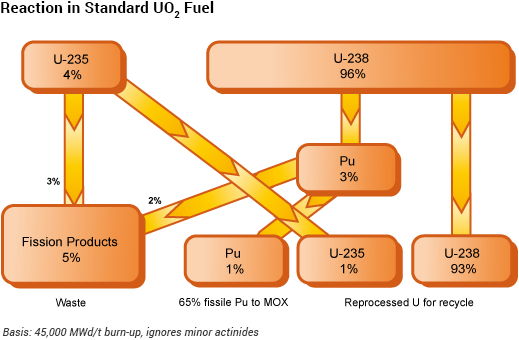
Normally, with the fuel being changed every three years or so, about half of the Pu-239 is 'burned' in the reactor, providing about one third of the total energy. It behaves like U-235 and its fission releases a similar amount of energy. The higher the burn-up, the less fissile plutonium remains in the used fuel. Typically about one percent of the used fuel discharged from a reactor is plutonium, and some two thirds of this is fissile (c. 50% Pu-239, 15% Pu-241). Worldwide, some 70 tonnes of plutonium contained in used fuel is removed when refuelling reactors each year.
The plutonium (and uranium) in used fuel can be recovered through reprocessing. The plutonium can then be used in the manufacture mixed oxide (MOX) nuclear fuel, to substitute for fresh uranium oxide fuel. A single recycle of plutonium in the form of MOX fuel increases the energy derived from the original uranium by some 12%, and if the uranium is also recycled this becomes about 22% (based on light water reactor fuel with a burn-up of 45 GWd/tU). This is well established, and two Russian proposals elaborate the basic process.
Today there is a significant amount of separated uranium and plutonium which may be recycled, including from ex-military sources. In addition, there are significant quantities of enrichment tails, with recoverable fissile uranium, especially where the original tails assay was about 0.25% or more. For lower tails assays, the main use for this depleted uranium is in diluting the plutonium to make MOX.
MOX use
MOX fuel was first used in a thermal reactor in 1963, but did not come into commercial use until the 1980s. Over 3000 tonnes of MOX fuel has been fabricated and loaded into power reactors since the 1980s.
MOX fuel is widely used in Europe and in Japan. According to Orano, 44 nuclear reactors have used MOX fuel since 1972, including: 22 in France, 10 in Germany, 5 in Japan, 3 in Switzerland, 2 in Belgium, 1 in the Netherlands and 1 in the USA.
Orano has reprocessed more than 36,000 tonnes of used fuel at La Hague since 1976, and its Melox plant has produced over 3100 tonnes of MOX fuel.
Use of plutonium in MOX in the EU
| kg Pu from reprocessing | Tonnes natural U saved (est) | Thousand SWU saved (est) | |
| 2020 | 5308 | 481 | 340 |
| 2021 | 4859 | 439 | 311 |
| 2022 | 3007 | 277 | 197 |
| 2023 | 4787 | 427 | 300 |
| 2024 | 6934 | 605 | 422 |
Source: Euratom Supply Agency Annual Report 2024, Annex 5
In the USA there was significant development work in 1960s and 1970s, and MOX fuel was used in several demonstration projects (San Onofre, Ginna PWRs, Dresden, Quad Cities and Big Rock Point). It performed acceptably and similar to uranium oxide fuel. In 2005 four MOX test assemblies made by Melox in France were tested successfully at the Catawba power station.
Russia uses MOX fuel in its BN-800 fast reactor. China plans to use MOX in future fast reactors.
The use of up to about 50% of MOX does not change the operating characteristics of a reactor, though the plant must be designed or adapted slightly to take it. More control rods are needed. For more than 50% MOX loading, significant changes are necessary and a reactor needs to be designed accordingly, as several new designs are. (Advanced light water reactors such as the EPR or AP1000 are able to accept complete fuel loadings of MOX if required.
An advantage of MOX is that the fissile concentration of the fuel and hence burn-up can be increased easily by adding a bit more plutonium, whereas enriching uranium to higher levels of U-235 is relatively expensive. As reactor operators seek to burn fuel harder and longer, increasing burn-up from around 30 GW days per tonne a few years ago to over 50 GWd/t now, MOX use becomes more attractive.
Reprocessing to separate plutonium for recycle as MOX is more economic when uranium prices are high. MOX use also becomes more attractive as the need to reduce the volume of spent fuel increases. Seven UO2 fuel assemblies give rise to one MOX assembly plus some vitrified high-level waste, resulting in only about 35% of the volume, mass and cost of disposal.
In Russia the reprocessed uranium (RepU) is categorized according to burn-up. That from low-burnup fuel is re-enriched at the Siberian Chemical Combine’s Seversk plant and used for VVER-440 or VVER-1000 reactors. That from fuel with 35-55 GWd/t burn-up is enriched at Seversk and mixed with natural or slightly-enriched uranium and can be used for RBMK or VVER reactors. That from high-burnup fuel (over 55 GWd/t) is sent to the Elektrostal conversion plant and mixed with slightly enriched uranium to be used in RBMK reactors. The only plutonium utilization, mixed with depleted uranium at the Mining and Chemical Combine (MCC) at Zheleznogorsk, is in MOX for fast reactors, notably the BN-800, but in the future REMIX fuel for VVER-1200 reactors may become the main use (see section below).
Recycling normal used fuel
If used uranium fuel is to be recycled, the first step is separating the plutonium (<1%) and the remaining uranium (about 96% of the spent fuel) from the fission products with other wastes (together about 3%). The plutonium is then separated from most or all of the uranium. All this is undertaken at a reprocessing plant (see information page on Processing of Used Nuclear Fuel).
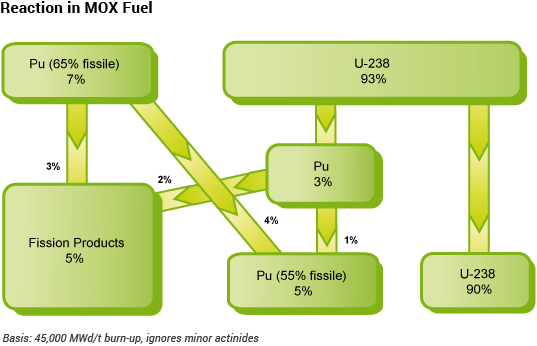
The plutonium, as an oxide, is then mixed with depleted uranium left over from an enrichment plant to form fresh mixed oxide fuel (MOX, which is UO2+PuO2). MOX fuel, consisting of about 7-11% plutonium mixed with depleted uranium, is equivalent to uranium oxide fuel enriched to about 4.5% U-235, assuming that the plutonium has about two-thirds fissile isotopes. If weapons plutonium is used (>90% Pu-239), only about 5% plutonium is needed in the mix. The plutonium content of commercial MOX fuel varies up to 10.8% depending on the design of the fuel, and averages about 9.5%. Fuel in an EPR with 30% MOX having less than 10.8% plutonium is equivalent to 4.2% enriched uranium fuel. An EPR with 100% MOX fuel can use a wider variety of used fuel material (in relation to burn-up, initial enrichment, plutonium quality) than with only 30% MOX.
Plutonium from reprocessed fuel is usually fabricated into MOX as soon as possible to avoid problems with the decay of short-lived plutonium isotopes. In particular, Pu-241 (half-life 14 years) decays to Am-241 which is a strong gamma emitter, giving rise to a potential occupational health hazard if separated plutonium over five years old is used in a normal MOX plant (where radiation levels are normally very low). The Am-241 level in stored plutonium increases about 0.5% per year, with corresponding decrease in fissile value of the plutonium. Pu-238 (half-life 88 years), a strong alpha emitter and a source of spontaneous neutrons, is increased in high-burnup fuel. Pu-239, Pu-240 and Pu-242 are long-lived and hence little changed with prolonged storage. (See also information page on Plutonium).
Fast neutron reactors allow multiple recycling of plutonium, since all transuranic isotopes there are fissionable, but in thermal reactors isotopic degradation limits the plutonium recycle potential. Used MOX fuel has an increased proportion of even-number isotopes*, along with minor actinides. Hence most spent MOX fuel is stored pending the greater deployment of fast reactors. (The plutonium isotopic composition of used MOX fuel at 45 GWd/tU burnup is about 37% Pu-239, 32% Pu-240, 16% Pu-241, 12% Pu-242 and 4% Pu-238.)
* giving reduced effective delayed neutron fraction, hence reduced operating safety margin in thermal reactors.
Recovered uranium from a reprocessing plant may be re-enriched on its own for use as fresh fuel. Because it contains some neutron-absorbing U-234 and U-236, reprocessed uranium must be enriched significantly (e.g. one-tenth) more than is required for natural uranium. Thus reprocessed uranium from low-burn-up fuel is more likely to be suitable for re-enrichment, while that from high burn-up fuel is best used for blending or MOX fabrication.
MOX production
World mixed oxide fuel fabrication capacities (t/yr)
| Fabricator | Country | Location | Capacity |
|---|---|---|---|
| Orano | France | Marcoule | 195 |
| DA Nuclear Fuel Complex | India | Tarapur | 5 |
| JAEA | Japan | Tokai-Mura | 130 |
| Mining and Chemical Combine | Russia | Zheleznogorsk | 60 |
| Total | 440 |
Only one plant in Europe currently produces commercial quantities of MOX fuel – in France. In 2006 a 40 t/yr Belgian plant closed1 and in April 2007 the French Melox plant was licensed for an increase in production from 145 to 195 t/yr. Also the Sellafield MOX Plant in the UK was downrated from 128 to 40 t/yr, and in August 2011 the Nuclear Decommissioning Authority announced that it had reassessed the plant's prospects and decided to close it.
Japan Nuclear Fuel Limited (JNFL) is building the 130 t/yr J-MOX plant at Rokkasho, now expected to be completed in fiscal year 2027 after multiple delays. The US Mixed Oxide Fuel Fabrication Facility (MFFF) at the Savannah River Site was cancelled in 2018 (see section below on MOX and disposition of weapons plutonium).
A 60 t/yr commercial MOX Fuel Fabrication Facility (MFFF) started up at Zheleznogorsk in 2015, operated by the Mining & Chemical Combine (MCC). This was built at a cost of some RUR 9.6 billion as part of Rosatom’s Proryv, or 'Breakthrough', project, to develop fast reactors with a closed fuel cycle whose MOX fuel will be reprocessed and recycled. It represents the first industrial-scale use of plutonium in the Russian civil fuel cycle, and is also the Russian counterpart to the US MFFF for disposition of 34 tonnes of weapons-grade plutonium (see section below).
The Zheleznogorsk MFFF makes pelletized MOX for 400 fuel assemblies per year for the BN-800 and future BN-1200 fast reactors. The MOX can have up to 30% plutonium. The capacity is designed to be able to supply five BN-800 units or equivalent BN-1200 capacity. The BN-800 each year requires 1.84 tonnes of reactor-grade plutonium recovered from 190 tonnes of used VVER fuel. (Plutonium from used BN fuel will be used in VVER-1000 reactors.) The MFFF is built in rock tunnels at a depth of about 200 metres. For the longer-term, MCC Zheleznogorsk was intending to produce MOX granules for vibropacked fuel (VMOX) using civil plutonium oxide, ex-weapons plutonium metal and depleted uranium. The granulated MOX is sent to RIAR Dimitrovgrad for vibropacking into FNR fuel assemblies. However, VMOX needs to be made in a hot cell, and its prospects are uncertain.
At present the output of Western reprocessing plants exceeds the rate of plutonium usage in MOX, resulting in inventories of (civil) plutonium in several countries.
In January 2025 the UK government decided to immobilize its approximately 140 tonnes of separated civil plutonium for eventual disposal in a geological disposal facility, rather than reuse it as reactor fuel. Two immobilization technologies are under investigation: Disposal MOX (DMOX) ceramic pellets and Hot Isostatic Pressing (HIP). A five-year development programme, with £154 million in funding, began in 2025. Earlier the UK had been investigating the incorporation of its reactor-grade plutonium into CANMOX fuel for Candu EC6 reactors.
MOX and disposition of weapons plutonium
Under the Plutonium Management and Disposition Agreement, Russia and the USA agreed in 2000 to each dispose of (or immobilize) 34 tonnes of weapons-grade plutonium deemed surplus to requirements (see information paper on Military Warheads as a Source of Nuclear Fuel).
The US Mixed Oxide Fuel Fabrication Facility (MFFF) at the Savannah River Site in South Carolina began construction in August 2007 to convert the US plutonium to MOX fuel. The MFFF was designed to turn 3.5 t/yr of weapons-grade plutonium into about 150 MOX fuel assemblies, both PWR and BWR. The contract to design, build and operate the MFFF was awarded to the Shaw AREVA MOX Services consortium in 1999, with the $2.7 billion construction option being exercised in May 2008.2 The project was cancelled in October 2018 after costs escalated to an estimated $49 billion to complete. The USA has instead adopted a 'dilute and dispose' approach, blending the 34 tonnes of surplus weapons-grade plutonium with inert material for disposal at the Waste Isolation Pilot Plant (WIPP) in New Mexico.
Under the Plutonium Management and Disposition Agreement (PMDA), Russia agreed to dispose of its 34 tonnes of weapons-grade plutonium by conversion to MOX fuel for the BN-600 and BN-800 reactors at the Beloyarsk nuclear plant. However, Russia suspended implementation of the PMDA in October 2016, citing the US decision to switch from MOX fabrication to dilute-and-dispose, and formally withdrew from the agreement in October 2025. Russian weapons plutonium disposition has not proceeded.
A Russian MOX plant for military plutonium was planned for Seversk, Siberia, but its status is uncertain following the suspension and withdrawal of the PMDA.
MOX reprocessing and further use
Used MOX fuel reprocessing has been demonstrated since 1992 in France, at the La Hague plant. In 2004 the first reprocessing of used MOX fuel was undertaken on a larger scale with continuous process. Ten tonnes of MOX irradiated to about 35,000 MWd/t and with Pu content of about 4% was involved. The main problem of fully dissolving PuO2 was overcome. MOX from German and Swiss reactors has been reprocessed, totaling about 70 tonnes, with a wide range of composition. As MOX is repeatedly recycled it is mixed with substantial proportions (70-80%) of plutonium from UOX fuel.
At present the French policy is not to reprocess used MOX fuel, but to store it and await the advent of fuel cycle developments related to Generation IV fast neutron reactor designs. Orano is continuing R&D on reprocessing of used MOX fuel. Used MOX fuel is several times more radioactive than used uranium oxide fuel, but this has little practical significance.
REMIX fuel
REMIX (Regenerated Mixture) fuel is produced directly from a non-separated mix of recycled uranium and plutonium from reprocessed used fuel, with a LEU (up to 17% U-235) uranium make-up comprising about 20% of the mix. This gives fuel with about 1% Pu-239 and 4% U-235 which can sustain burn-up of 50 GWd/t over four years. The spent REMIX fuel after four years is about 2% Pu-239* and 1% U-235, and following cooling and reprocessing the non-separated uranium and plutonium is recycled again after LEU addition. The wastes (fission products and minor actinides) are vitrified, as today from reprocessing, and stored for geological disposal.
* a 68% increase, compared with 104% in the MOX fuel cycle, according to Tenex.
REMIX fuel can be repeatedly recycled with 100% core load in current VVER-1000 reactors and correspondingly reprocessed many times – up to five times – so that with less than three fuel loads in circulation a reactor could run for 60 years using the same fuel, with LEU recharge.* As with MOX, the use of REMIX fuel reduces consumption of natural uranium in VVERs by about 20% at each recycle as compared with an open fuel cycle. REMIX can serve as a replacement for existing reactor fuel, but in contrast to MOX there is a higher cost for fuel fabrication due to the high activity levels – compared with UO2 fuel, the cost increment is 25-30%. The REMIX cycle can be modified from the above figures according to need.
* A VVER-1000 REMIX fuel assembly will contain only 86 kg of fresh enriched uranium instead of 433 kg. The 86 kg U enriched up to 17% requires 2426 kg of natural uranium (tails assay 0.1%) and 2981 SWU. By contrast, the production of 433 kg of uranium enriched to 5% needs 3030 kg Unat and 3566 SWU. Hence 20% saving in uranium and 17% in SWU.
REMIX is expected to give a saving in used fuel storage and disposal costs compared with once-through fuel cycle, matched by the reprocessing cost, though this is expected to reduce. Compared with the MOX cycle it has the virtue of not giving rise to any accumulation of reprocessed uranium (RepU) or allow any separated plutonium. The increasing concentrations of even isotopes of both elements is compensated by the fresh uranium top-up, presumably at increasing enrichment levels. In late 2021, six experimental REMIX fuel assemblies were loaded into Balakovo 1. They completed three 18-month fuel cycles by March 2026, with no deviations detected. Post-irradiation examination is under way to qualify uranium-plutonium fuel for commercial use in VVER reactors.
Tenex suggests REMIX could be the basis for a form of fuel leasing from a supplier to a utility, with repeated recycle between them.
Dual-component power system MOX fuel
Rosatom has proposed a fuel cycle involving both thermal and fast reactors, using two kinds of MOX fuel, and reducing uranium demand by about 30%, and potentially much more.
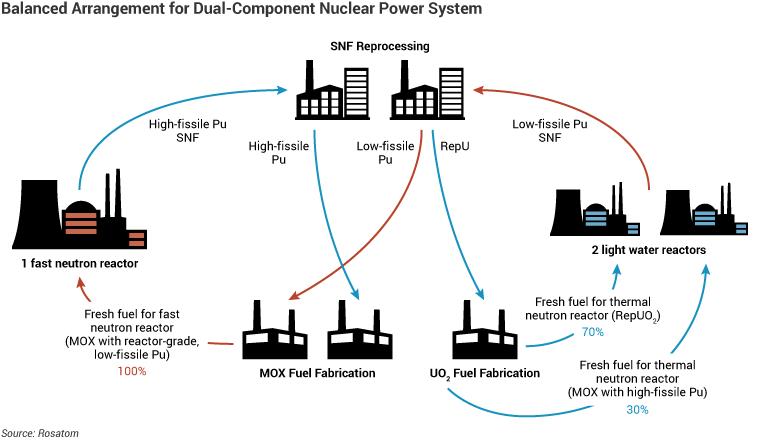
In this, normal thermal-neutron reactors are the primary plutonium source, but this plutonium is reactor-grade, with about one-third even-atomic weight non-fissile isotopes. Whether derived from uranium or MOX fuel, it is separated and made into MOX fuel for fast breeder reactors with a breeding ratio of not less than 1.2, and the used fuel from these has a much lower proportion of even-number non-fissile plutonium isotopes. This ‘clean’ or high-fissile plutonium recovered from fast reactor fuel (along with any weapons-grade plutonium for disposal) is then made into MOX fuel for the original thermal-neutron reactors, and comprises about 30% of their fuel. The other 70% is enriched reprocessed uranium (RepU), the depleted tails of which are also used for MOX fuel, instead of using normal depleted uranium. Their used fuel is reprocessed to continue the dual cycle.
To achieve balance, this system needs about twice the capacity of thermal reactors to fast reactors, and depends on the breeding ratio and fuel burn-up. Plutonium and most of the uranium do not leave the system, but are recycled as much as possible and there is little accumulation of used fuel; nor should there be accumulation of plutonium or RepU. Minor actinides are burned in the fast reactors. The system is self-sufficient apart from the constraint of the MOX fuel proportion in thermal reactors participating (now it is ~30%), and the proportion of U-232 in RepU. In these cases, part of the fuel needs to comprise enriched uranium of natural origin.
The amount of fission products to be removed as waste in the dual-component system is much less than that arising from today’s reprocessing, and the decay period is very much less. As with REMIX waste, it may be processed to recover valuable fission products such as isotopes of Cs, Sr and Tc.
Rosatom envisages implementing this system on existing fast breeder reactors, but particularly the BN-1200M.
Plutonium-thorium fuel
In the early 1990s Russia had a program to develop a thorium-uranium fuel, which moved to have a particular emphasis on the use of weapons-grade plutonium in a thorium-plutonium fuel.
Notes & references
References
1. Belgonucleaire's decision to close its MOX plant was explained in its 2005 Annual Report – see http://www.belgonucleaire.be/files/JAARVERSLAG2005EN.pdf [Back]
2. Final contract for US MOX, World Nuclear News, 27 May 2008. [Back]
General sources
Australian Safeguards and Non-Proliferation Office, Annual Report 1999
NATO 1994, Managing the Plutonium Surplus: Applications and Technical Options (ISBN 9780792331247)
OECD NEA 1997, Management of Separated Plutonium, the technical options (ISBN 9264154108)
Nuclear Europe Worldscan, European Nuclear Society, March/April 1997 (several articles)
Nuclear Engineering International, Europeans & MOX, July 1997
D Albright and K Kramer, Tracking Plutonium Inventories, Plutonium Watch, July (revised August) 2005 – see http://www.isis-online.org/global_stocks/end2003/plutonium_watch2005.pdf
International Atomic Energy Agency, Status and Advances in MOX Fuel Technology, Technical Review Series # 415 (2003)
Marc Arslan, 2012, Fuel Cycle Strategies to Optimise the use of MOX Fuels, World Nuclear Fuel Cycle conference, Helsinki
M. Baryshnikov, REMIX Nuclear Fuel Cycle, World Nuclear Fuel Cycle conference, Abu Dhabi (April 2016) and personal communication
M. Baryshnikov, Commercial Potential of Dual-component Nuclear Power System, World Nuclear Fuel Cycle conference, Toronto, Canada (April 2017) and personal communication
Related information pages
The Nuclear Fuel Cycle
Plutonium
Processing of Used Nuclear Fuel
Military Warheads as a Source of Nuclear Fuel
Japanese Waste and MOX Shipments From Europe
Related information
Military Warheads as a Source of Nuclear FuelPlutonium
Thorium
Japanese Waste and MOX Shipments From Europe
Nuclear Fuel Cycle Overview