Russia's Nuclear Fuel Cycle
- A significant increase in uranium exploration is planned.
- There is increasing international involvement in parts of Russia's fuel cycle.
- A major Russian political and economic objective is to increase exports, particularly for front-end fuel cycle services through Tenex, as well as nuclear power plants.
Russia uses about 6300 tonnes of natural uranium per year.
There is high-level concern about the development of new uranium deposits. In April 2026 the Federal Agency for Mineral Resources reported that more than RUB 6 billion of federal funding had been allocated to uranium geological exploration over the following three years, 6.5 times the level in previous years.
Uranium resources and mining
Russia has substantial economic resources of uranium, with about 8% of world reasonably assured resources plus inferred resources up to $130/kg – 476,600 tonnes U (2024 Red Book). Domestic mine production was 2738 tU in 2024, supplemented by that from Uranium One foreign operations, which produced 5829 tU in 2024. Russia's operating uranium production is centred on PIMCU in Zabaykalsky Krai, Khiagda in Buryatia and Dalur in the Kurgan region. Rosatom's Mining Division reported 497,200 tonnes of uranium resources in its Russian assets as at 1 January 2025.
Uranium One's foreign operations produced 5,829 tU in 2024, equivalent to about 10% of world mine production, with its uranium production concentrated in Kazakhstan.
Rosatom reported in February 2026 that Khiagda was developing infrastructure for the Namarusskoye and Dybrynskoye deposits, Shirondukuyskoye was being prepared to contribute about 400 tU per year from 2028, and Dalur had begun producing uranium at Dobrovolnoye. Rosatom Nedra also said it planned to bring the large Elkon uranium project out of hibernation.
JSC Atomredmetzoloto (ARMZ) was established as Rosatom's consolidated uranium-mining holding in 2007-08, when Russian uranium-mining enterprises and uranium exploration and production interests were brought together under ARMZ. Since December 2013 it has managed Rosatom's Russian uranium-mining assets. In 2024 the company was renamed JSC Rosatom Nedra and remains the holding company of Rosatom's Mining Division.
Rosatom Nedra's principal Russian uranium-mining assets are PIMCU in Zabaykalsky Krai, Khiagda in Buryatia and Dalur in the Kurgan region. The Mining Division now also includes service and engineering businesses and has diversified beyond uranium into rare and rare-earth metals, gold and other minerals.
Rosatom gained control of Uranium One in 2010, and Uranium One Inc became a wholly owned indirect subsidiary of Rosatom in 2013. Uranium One Group is now part of Rosatom's International Asset Management division, which includes TENEX, and is the key operator of Rosatom's foreign uranium-mining assets and overseas mineral-resource development.
Uranium One's current Kazakh uranium interests include the South Mining and Chemical Company, Akbastau and Karatau joint ventures. Its portfolio has been reduced in other areas: the 49.979% interest in Zarechnoye was sold to a Chinese-owned company in December 2024, while the 30% interests in Khorasan-U and Kyzylkum were transferred to China Uranium Development Company, with that transaction completed by January 2025. Uranium One's international asset portfolio includes Kazakhstan, Tanzania and Namibia. In addition to uranium, it is developing foreign mineral-resource projects involving non-ferrous, rare and rare-earth metals.
Domestic mining
Russia’s uranium mining is concentrated in three established production centres:
- The Trans-Ural district in the Kurgan region between Chelyabinsk and Omsk, with the Dalur ISL mine.
- Streltsovskiy district in the Transbaikal or Chita region of SE Siberia near the Chinese and Mongolian borders, served by Krasnokamensk and with major underground mines.
- The Vitimsky district in Buryatia about 570 km northwest of Krasnokamensk, with the Khiagda ISL mine.
The Elkon district in the Sakha Republic (Yakutia) some 1200 km north-northeast of the Chita region remains undeveloped but holds the largest reserves in the country.
Russian uranium mining
| Production centre | Region | First production | Orebody and mining method | Reported resources / reserves | Capacity / planned outpur |
|---|---|---|---|---|---|
| Priargunsky | Zabaykalsky Krai, Streltsovskiy district | 1968 | Volcanic; underground and heap leach | 73,600 tU @ 0.16% U recoverable resources | 3000 |
| Dalur | Kurgan Oblast, Trans-Ural district | 2004 |
Sandstone; ISL |
8700 tU @ 0.04% U recoverable resources | 600 tU/yr nominal; development of Dobrovolnoye is intended to support about 700 tU/yr |
| Khiagda | Buryatia, Vitimsky | 2010 | Sandstone; ISL | 23,400 tU @ 0.05% U recoverable resources | 1,300 tU/yr nominal capacity |
| Elkon | Yakutia/Sakha | deferred | Metasomatite; undergound | 303,600 @ 0.15% | Current development concept envisages about 2,000 tU/yr by 2036 |
Source: 2024 ‘Red Book’
Russian uranium production, tonnes U
| Production centre | 2012 | 2013 | 2014 | 2015 | 2016 | 2017 | 2018 | 2019 | 2020 | 2021 | 2022 | 2023 | 2024 |
|---|---|---|---|---|---|---|---|---|---|---|---|---|---|
| Priargunsky | 2011 | 2133 | 1970 | 1977 | 1873 | 1631 | 1456 | 1300 | 1240 | 1150 | 1002 | 1047 | |
| Dalur | 529 | 562 | 578 | 590 | 591 | 592 | 858 | 595 | 585 | 585 | 585 | 588 | |
| Khiagda | 332 | 440 | 442 | 488 | 540 | 693 | 590 | 1016 | 1021 | 900 | 920 | 950 | 1103 |
| Total | 2872 | 3135 | 2990 | 3055 | 3004 | 2916 | 2904 | 2911 | 2846 | 2635 | 2508 | 2710 | 2738 |
Trans-Ural, Kurgan region
Dalur operates the Trans-Ural uranium production centre in Kurgan Oblast. This is a low-cost ($40/kg) acid in situ leach (ISL) operation in sandstones. About 1350 km east of Moscow, Uksyanskoye is the town supporting the Dalur mine. The 2024 Red Book gives recoverable resources of 8,700 tU and a nominal production capacity of 600 tU per year.
Dalur is progressively extending production from the mature Dalmatovskoye deposit to additional ore bodies at Khokhlovskoye and to Dobrovolnoye.
At Khokhlovskoye, the Central and Western ore bodies are under development and mining has begun at the Eastern orebody. Dalur plans subsequently to develop the Far Eastern and Duryaginskaya ore bodies.
Dalur completed construction and commissioning of facilities at the pilot industrial site at Dobrovolnoye and shipped the first batch of uranium product in April 2025. Its development is expected to increase Dalur production from about 590 tU to 700 tU per year, sustaining supply until about 2045.
Transbaikal Chita region, Streltsovskiy district
The Priargunsky Industrial Mining and Chemical Union (PIMCU) operates the Streltsovskiy uranium production centre near Krasnokamensk. PIMCU was established in 1968, and produces some other metals than uranium. Uranium ore is currently mined at underground mines No. 1 and No. 8 and processed at the hydrometallurgical plant, with heap leaching also used for lower-grade material.
Historical cumulative uranium production at Priargunsky amount to over 150,000 tU, the largest aggregate production recorded for any uranium production centre in the world. The 2024 Red Book gives recoverable resources of 73,600 tU at an average grade of 0.16% U. Production was formerly up to about 3000 tU/yr, about one-tenth of it from heap leaching, but has since declined.
Development of Mine #6 will access the Argunskoye and Zherlovoye deposits remains the longer-term replacement project for PIMCU’s current mines. It has a design production capacity of about 2,300 tU per year. Construction of key surface buildings and mine-hoisting facilities is underway. Production from Mine #6 was originally expected from 2015 (with full capacity to be reached by 2019), but this timeline slipped significantly*. The latest project schedule targets the start of uranium production in 2030.
* In March 2015 ARMZ said it hoped to find co-investors in the project, and federal funds might be forthcoming. Then in June 2015 Rosatom’s Investment Committee decided to finance the development. In August 2016 ARMZ said that RUR 27 billion was required to enable 2022 commissioning. In March 2018 a new financing arrangement was announced to the extent of RUR 18.5 billion, with Priargunsky to own 51% of the project and ARMZ 49% directly. Most of the project financing – RUR 16.1 billion – would be from China National Nuclear Corporation (CNNC), with the balance of RUR 2.5 billion from a new Russia-China Investment Fund for Regional Development (RCIF) “as a first step in widening cooperation” with China. According to the Russian Gazette (quoted by Platts Nuclear Fuel), CNNC’s investment would give it a 49% stake in the joint venture, entitling it to that proportion of annual production. Construction recommenced in March 2018, then aiming for first production in 2023, but the schedule has slipped and first uranium is now expected in 2030. PIMCU describes Mine No. 6 as its main source of uranium production for the next 40-50 years, offsetting declining resources at its older mines..
A second future source of production is the Shirondukuyskoye molybdenum-uranium deposit, part of the Streltsovskiy ore district about 8 km from Krasnokamensk. PIMCU obtained a development licence in February 2025. The deposit has uranium reserves of 8000 tonnes in Russian C1/C2 categories in addition to molybdenum. Production of about 400 tU per is planned.
Olovskoye and Gornoye/Berezovoye uranium deposits remain undeveloped resources in the Transbaikal region near Priargunsky towards Khiagda. Earlier Rosatom plans envisaged mining in both areas, but no recent development has been reported.
There is a legacy environmental problem at Priargunsky arising from 30 waste rock and low-grade ore dumps as well as tailings. Rehabilitation of waste rock dumps and open pits is proceeding and low-grade ores are being heap leached. Dams and intercepting wells below the tailings dams with hydrogeological monitoring and wastewater treatment is addressing water pollution. Final rehabilitation of the impacted areas will occur after final closure takes place. In 2016 ARMZ announced a new heap leaching initiative for very low-grade ores stockpiled on the surface, to produce 50 to 63 tU/yr.
Buryatia, Bauntovsky Evenki district
JSC Khiagda's operations are in the Bauntovsky Evenki District of the Republic of Buryatia, within the wider Vitim uranium-ore district. The nearest towns are Romanovka, 133 km north of Chita, and Bagdarin.
In 2024 Khiagda produced 1103 tU, making it Russia's leading uranium producer that year.
These are acid in situ leach (ISL) operations in sandstones, and comprise the only ISL mine in the world in permafrost. Groundwater temperature is 1-4°C, giving viscosity problems, especially when winter air temperature is -40°C. The main uranium mineralization is a phosphate, requiring oxidant addition to the acid solution. In the Khiagdinskoye field itself there are eight palaeochannel deposits over 15 x 8 km, at depths of 90 to 280 metres (average 170 m). Single orebodies are up to 4 km long and 15 to 400 m wide, 1 to 20 m thick.
JSC Khiagda has resources of about 28,900 tU. Production capacity is planned at up to about 1100 tU/yr through 2037.
JSC Khiagda now mines five deposits of the Khiagda ore field: Khiagdinskoye, Istochnoe, Vershinnoye, Kolichkanskoye and Dybrynskoye. The first stage of the Kolichkanskoye deposit was commissioned in December 2023, and second-stage ISL facilities were reported commissioned in 2024. Construction of a sorption unit at the Dybrynskoye orefield began in October 2023. First-stage Dybrynskoye facilities were reported commissioned in 2024, with additional production infrastructure under construction during 2025.
Khiagda is developing technology to recover rare earth oxides (REO) as by-product.
Sakha/Yakutia, Aldan district
Rosatom Nedra is reviving the massive Elkon project in the Sakha Republic (Yakutia) some 1200 km north-northeast of the Chita region. The Elkon project is in a mountainous region with difficult climate conditions and little infrastructure, making it a challenging undertaking.
Elkon is Russia’s largest undeveloped uranium reserve. There are eight deposits in the Elkon project with recoverable resources of 303,600 tU* (RAR + IR) at average 0.146%U, with gold by-product: Elkon, Elkon Plateau, Kurung, Neprokhodimoye, Druzhnoye (southern deposits), as well as Yuzhnaya, Severnaya, Zona Interesnaya and Lunnoye (see below). Production from metasomatite deposits was planned to ramp up to 5000 tU/yr over ten years, for RUR 90.5 billion ($3 billion), and 2020 start up was envisaged, but this has been repeatedly deferred. In 2026 Rosatom Nedra said there were plans to bring the project "out of hibernation". The current development concept envisages initial uranium recovery from previously gold-leached oxidized ores from about 2028–29, followed by development of the primary ores, with main uranium production beginning around 2035 at 1500–2000 tU/yr
JSC Elkon Mining and Metallurgical Combine (EMMC) is now 100% owned by Rosatom. Development is being phased around infrastructure already established for the Severnoye gold project. Industrial development of its oxidized ores began in the fourth quarter of 2023, initially for gold and silver production. The infrastructure and cash flow from the gold operation are intended to support subsequent uranium development of the wider Elkon group.
Further mine prospects
Current uranium mine development in Russia is focused mainly on expanding the resource base around Rosatom Nedra's existing mining centres in Zabaykalsky Krai, Buryatia and Kurgan Oblast. This includes development of new or previously undeveloped deposits using existing infrastructure, notably Shirondukuyskoye and Mine No. 6 at PIMCU, Namaruskoye and Tetrakhskoye at Khiagda, and Dobrovolnoye at Dalur. The other major development prospect is Elkon in Yakutia, Russia's largest uranium deposit, which Rosatom Nedra is seeking to bring into production over the longer term.
Most of the other prospects identified in the 2009 Rosnedra tender and licensing programme are not currently identified as near-term development priorities. Current exploration is instead focused particularly on finding additional resources close to existing uranium mining operations and infrastructure.
Foreign and private equity in uranium mining
Earlier proposals for foreign equity participation in Russian uranium mining did not develop. Japan's Mitsui & Co studied participation in the Yuzhnaya area of the Elkon project from 2006, including a possible 25% interest. The proposed investment did not proceed to production. Yuzhnaya is now treated as part of the Elkon project (see above).
A 2007 agreement between Cameco and ARMZ similarly led to uranium exploration joint ventures in Russia and Canada. The Russian Karku venture was unable to proceed because of licensing difficulties.
Mine rehabilitation
Rehabilitation of the former Almaz mine in Lermontov, Stavropol Territory was undertaken 2008-15. Work included sealing mine workings and rehabilitating waste-rock dumps at Mine 1 on Beshtau Mountain and Mine 2 on Byk Mountain, as well as parts of the former hydrometallurgical plant and its tailings facility. RosRAO reported that 51.1 hectares had been rehabilitated by the end of the programme.
Secondary supplies
Reprocessed uranium is an important secondary source for Russian reactors. Rosatom says that all operating RBMK reactors use fuel incorporating reprocessed uranium.It reported in 2024 that the use of reprocessed nuclear materials at Russian nuclear plants had saved more than 4000 tonnes of natural uranium since 2021. Rosatom is also testing REMIX uranium-plutonium fuel in VVER-1000 reactors.
Plutonium recovered through reprocessing is used with depleted uranium to manufacture MOX fuel for fast reactors. The BN-800 reactor at Beloyarsk has operated with a full MOX core since 2022, an important step in Russia's programme to close the nuclear fuel cycle and reduce requirements for natural uranium. The plutonium used for this fuel is recovered from civilian used nuclear fuel. Seperately, Russia suspended its implementation of its Plutonium Management and Disposition Agreement with the USA in 2016 and formally withdrew from it in October 2025. Under the agreement each country had undertaken to dispose of at least 34 tonnes of surplus weapons-grade plutonium. Russia did not implement that disposition programme.
The separate US-Russian HEU Purchase Agreement, under which 500 tonnes of Russians weapons-grade HEU was downblended for use in US reactor fuel, was completed in 2013. See also Military Warheads as Source of Fuel paper.
Russia's long-term fuel cycle strategy emphasizes recycling rather than relying solely on mined uranium.
Fuel Cycle Facilities: conversion & enrichment
Many of Russia's fuel cycle facilities were originally developed for military use and hence are located in former closed cities (names bracketed) in the country. In October 2015 the ministry of economic development moved to open four of these which host facilities managed by Rosatom – Novouralsk, Zelenogorsk, Seversk and Zarechny – but the proposal did not proceed
In 2009 the conversion and enrichment plants were taken over by the newly-established JSC Enrichment & Conversion Complex, and in 2010 this became part of TVEL, a subsidiary of Atomenergoprom. Its enrichment plants are the Urals Electrochemical Combine at Novouralsk, Electrochemical Plant at Zelenogorsk, Siberian Chemical Combine (SCC) at Seversk, and Angarsk Electrolysis Chemical Complex. Uranium conversion has been consolidated at SCC, whose conversion capacity is sufficient to meet Russia's requirements for feed uranium hexafluoride
Seversk in Western Siberia continues to be a focus of new investment. SCC produces uranium hexafluoride and enriches natural and reprocessed uranium, while also undertaking decommissioning of legacy facilities and hosting Rosatom's Proryv project for a closed nuclear fuel cycle.
Conversion
Russia’s conversion of natural uranium is now concentrated at SCC Seversk, which states that it provides all of the industry’s requirement for feed uranium hexafluoride.
CC processes both natural and reprocessed uranium, and its conversion facilities continue to be modernized, including additional fluorine-production capacity commissioned in 2026.
SCC produces UF6 for enrichment and also processes natural and reprocessed uranium. Conversion facilities continue to be modernized and in January 2026 SCC commissioned additional fluorine-production equipment as part of a programme to increase uranium conversion capacity.
The previous main conversion plant was at Angarsk was shut down in April 2014. It now operates primarily as a uranium enrichment site.
TVEL also had conversion capacity at Kirovo-Chepetsky Chemical Combine (KCCC) in Glazoy, which was shut down in the 1990s. Since 2009 this has been a clean-up site of the Federal Environmental Operator, formerly RosRAO.
The Elektrostal conversion plant, 50 km east of Moscow, has 700 tU/yr capacity for reprocessed uranium, initially that from VVER-440 fuel. It is owned by Maschinostroitelny Zavod (MSZ) whose Elemash fuel fabrication plant is there. Some conversion of Kazakh uranium for west European company Nukem, and all 960 tonnes of recycled uranium from Sellafield in UK, owned by German and Netherlands utilities, was converted here. UK-owned recycled uranium was also sent here.
Uranium enrichment
Russia has four enrichment plants, all operated by TVEL: the Urals Electrochemical Combine (UECC) at Novouralsk, the Electrochemical Plant (ECP) at Zelenogorsk, the Siberian Chemical Combine (SCC) at Seversk, and the Angarsk Electrolysis Chemical Complex (AECC). All use gas centrifuge technology. TVEL accounts for about one-third of the world market for uranium enrichment services, supplying both Russian fuel fabrication plants and international customers through Tenex.
| Plant | Operator | Capacity (M SWU/yr) | Special features |
| Novouralsk | JSC Urals Electrochemical Combine | 10 | Can enrich to 30% |
|---|---|---|---|
| Zelenogorsk | PA ElectroChemical Plant (ECP) | 8.7 (expanding to 12) | |
| Seversk | JSC Siberian Chemical Combine (SCC, SGChE) | 3.0 | RepU enrichment |
| Angarsk | JSC Angarsk Electrolysis & Chemical Combine | 2.6 | Tails enrichment |
| Total | 24.3 (expanding to 27.6) |
The Novouralsk (Novo-Uralsk) plant is the largest, accounting for about half of Russia’s capacity. It has operated 8th generation centrifuges since 2003, and 9th generation units from 2013. The fourth cascade of 9th generation centrifuges was commissioned in August 2016. The plant can enrich to 30% U-235 (for research and BN fast reactors), the others only to 5% U-235.
The Zelenogorsk plant produces low enriched uranium. A six-year modernization of its enrichment plant, involving replacement of older centrifuges with generation 9+ machines, was completed in July 2025. The site is also used in the management of depleted uranium hexafluoride (DUF6), including deconversion to uranium oxide.
The Seversk enriches both natural and reprocessed uranium. As well as the enrichment plant with substantial capacity for recycled uranium the site has other facilities, and several plutonium production reactors (now closed). Modernization of the enrichment plant with generation 9+ centrifuges began in 2025, when the first new block entered industrial operation. Installation of further 9+ centrifuge blocks is planned through 2027. SCC also hosts uranium conversion facilities and Rosatom's Proryv closed fuel-cycle project.
Angarsk enriches natural uranium and depleted uranium hexafluoride. It is part of the JSC Angarsk Electrolysis & Chemical Combine (AECC).
Angarsk is the only enrichment plant located outside a 'closed' city, nor has it had any defence role, and hence it became the site of the International Uranium Enrichment Centre (IUEC) and fuel bank. The IUEC provides participating countries with guaranteed access to enrichment technology. Russia, Kazakhstan, Armenia and Ukraine are currently listed by the IUEC as participating states. A Russian reserve of low-enriched uranium is maintained at the IUEC under IAEA safeguards as an assurance-of-supply mechanism.
Technology: Diffusion technology was phased out by 1992 and all plants now operate modern gas centrifuges. Russia is progressively replacing older centrifuges with generation 9+ machines. The programme began at Novouralsk and Zelenogorsk, has moved to Seversk, and is planned subsequently for Angarsk. TVEL said in July 2025 that work was progressing on a 10th generation centrifuge, and that it was preparing for pilot industrial operation.
Gas centrifuges are developed and manufactured within TVEL, principally by NPO Centrotech at Novouralsk and Centrotech-Engineering in St Petersburg.
TVEL-Kazakh JV Uranium Enrichment Centre (UEC)
Kazatomprom obtains uranium enrichment services in Russia through the Uranium Enrichment Centre (UEC). In 2020 it sold its 50% holding in UEC, less one share, to TVEL for €90 million, retaining one share in order to preserve its contractual access to enrichment services.
Deconversion
Russia's W-ECP or W-EKhZ deconversion plant is at Zelenogorsk Electrochemical Plant (ECP). The 10,000 t/yr deconversion (defluorination) plant was built by Tenex under a technology transfer agreement with Areva NC (now Orano), so that depleted uranium can be stored long-term as uranium oxide, and hydrogen fluoride is produced as a by-product. The W1-ECP plant is similar to Areva's (now Orano’s) W2 plant at Pierrelatte in France and has mainly west European equipment. It was commissioned in December 2009 and the end of 2025 had processed 165,000 t depleted uranium hexafluoride. The Russian-designed phase 2 for production of anhydrous hydrogen fluoride was commissioned in December 2010.
In September 2026 TVEL commissioned a second unit, W2-ECP, with equipment from Orano Projects in France, taking ECP’s capacity to 20,000 t/yr depleted uranium hexafluoride and producing up to 2400 t/yr of anhydrous hydrogen fluoride.
Fuel fabrication
Fuel fabrication is undertaken by JSC TVEL, which supplies fuel for more than 70 power reactors across Russia and 14 other countries, as well as fuel and components for research reactors in ten countries.
Russian fuel technology is supported by TVEL’s A.A. Bochvar High Technology Research Institute of Inorganic Materials (VNIINM), Rosatom's principal research organization for materials science and nuclear fuel-cycle technologies. Its work includes fuel and structural materials for thermal and fast reactors, advanced uranium-plutonium fuels and accident-tolerant fuel.
Fuel cycles
Russia aims to maximize recycling of fissile materials from used fuel and, ultimately, close the nuclear fuel cycle. Hence reprocessing used fuel is a basic practice, with reprocessed uranium being recycled and plutonium used in MOX, so far routinely only for fast reactors.
Separately, pilot operation of REMIX uranium-plutonium fuel at Balakovo 1 was completed in March 2026. Both the REMIX cycle and Russia’s proposed Dual Component Power System are described below.
Uranium fuel fabrication
TVEL has two fuel fabrication plants with combined capacity of 2800 t/yr finished fuel:
- The huge Maschinostroitelny Zavod (MSZ) at Elektrostal 50 km east of Moscow – known as Elemash.
- Novosibirsk Chemical Concentrates Plant (NCCP) in Siberia.
TVEL's Chepetsk Mechanical Plant (CMP or ChMZ) near Glazov in Udmurtiya makes zirconium cladding and also some uranium products.
MSZ/Elemash produces fuel assemblies for Russian-designed reactors using fresh and recycled uranium. It also fabricates research reactor and icebreaker fuel. Elemash supplied fuel for the first refuelling of the two reactors of the Akademik Lomonosov, carried out in 2023–24, and delivered further fresh fuel for one of the reactors in 2026.
Novosibirsk produces fuel for VVER reactors and operates a dedicated production facility for TVS-K fuel for Western-designed PWRs. It supplied the start-up fuel for Akkuyu 2, delivered to the site in December 2024, and manufactured the initial fuel load for Bolivia's BRR-1 research reactor in 2024. NCCP previously supplied the initial and early reload fuel for Tianwan 1 and 2 before fabrication was transferred to China in 2010.
In 2024 the Fuel Division completed the Manoeuvre-1 experimental programme supporting load-following operation by VVER-1200 units. It also manufactured experimental VVER-1000 fuel rods with chromium-coated cladding for accident-tolerant fuel irradiation tests. Pilot operation of Russian accident-tolerant fuel at Rostov 2 was completed in March 2026 after three 18-month fuel cycles. Chromium-coated zirconium cladding was selected as the preferred option for commercial deployment.
Early in 2021 MSZ set up a new production line for fast reactor fuel, including HEU. Russia’s BN-600 reactor uses uranium fuel with three levels of enrichment: 17%, 21% and 26%. Fuel for China’s CFR600 is likely to be similar. On another production line MSZ also supplied fuel for China’s CEFR, including a 2020 reload, reported to be 64% enriched.
TVEL’s NCCP also produces pure lithium-7, and accounts for over 70% of the world supply of Li-7, both 99.95% for use in PWR cooling systems, and also now 99.99% pure. TVEL has done extensive work on the use of reprocessed uranium (RepU) in VVER-type reactors, and there are plans for all units of the Kola nuclear station to shift to RepU fuel. Some PWR reactors, e.g. Kalinin 2 and Balakovo 3, are using recycled uranium in TVSA fuel assemblies already. It supplies regenerated-uranium fuel regularly to Kola 2. Rosatom has also said that the VVER-1200 units at Novovoronezh II and Leningrad II are to be converted to regenerated-uranium fuel in 2027–28.
MOX is not yet in routine commercial use in Russian light-water reactors, but VVER fuel elements containing MOX have been under irradiation testing in the MIR research reactor since 2023, and in April 2026 three assemblies incorporating MOX fuel rods began pilot operation in Balakovo 1. Pilot operation of uranium-plutonium REMIX fuel has also been completed at the same unit.
TVEL's Moscow Plant of Polymetals (MZP) develops and manufactures reactor control and protection components.
REMIX fuel cycle
REMIX (Regenerated Mixture) fuel has been developed since 2005 by the V.G. Khlopin Radium Institute in cooperation with the Kurchatov Institute for Tenex as a development of MOX to supply light water reactors. Remix fuel is produced directly from a non-separated mix of recycled uranium and plutonium from reprocessing used fuel supplemented with enriched uranium.. It is distinct from conventional MOX in having a much lower plutonium concentration. After irradiation and cooling, the fuel could be reprocessed and its uranium-plutonium mixture recycled following the addition of further enriched uranium. The waste (fission products and minor actinides) is vitrified, as today from reprocessing, and stored for geological disposal. Design studies indicate that REMIX could be used as a 100% core load in existing VVER-1000 reactors and recycled about five times. In principle, three fuel inventories circulating through repeated irradiation, cooling and reprocessing could support a reactor over a 60-year operating life, with additions of enriched uranium and removal of wastes at each recycle. As with normal MOX, the use of Remix fuel reduces consumption of natural uranium in VVERs by about 20% as compared with open fuel cycle. Remix can serve as a replacement for existing reactor fuel, but fabrication using reprocessed uranium entails a greater radiological burden, including that associated with uranium-232 and its decay products. The Remix cycle can be modified from the above figures according to need. The increasing concentrations of even isotopes of both elements are compensated by the fresh uranium top-up, possibly at increasing enrichment levels.
A 2019 study showed that the use of regenerated uranium in Remix fuel for VVER reactors, and therefore the U-236 isotope, also significantly increases the proportion of Pu-238 in the fuel, which prevents its diversion for non-peaceful purposes.
Remix allows all the recovered uranium and plutonium to be recycled and will give a saving in used fuel storage and disposal costs compared with the once-through fuel cycle, matched by the reprocessing cost, though this is expected to reduce. Compared with the MOX cycle, it has the virtue of not giving rise to any accumulation of reprocessed uranium (RepU) or allow any separated plutonium.
Rosatom loaded three TVS-2M fuel assemblies each with six REMIX fuel rods into Balakovo 3 in June 2016. They remained for two fuel cycles, and a third 18-month cycle began in early 2020. These all showed good results. Six full-size REMIX fuel assemblies were then loaded into Balakovo 1 at the end of 2021, and pilot operation was completed in March 2026 with no deviations detected. The assemblies are to undergo post-irradiation examination at the Research Institute of Atomic Reactors (RIAR) in Dimitrovgrad before the fuel can be qualified. Rosatom states that the low plutonium content and uranium-fuel-like neutron spectrum should allow REMIX to be introduced without reactor modifications or significant additional safety measures, although commercial use remains subject to qualification and regulatory approval.
Tenex has previously suggested Remix being could be supplied with a form of fuel leasing from a supplier to a utility, with repeated recycle between them. Commercial application would follow qualification of the fuel.
In August 2020 Rosatom announced that Remix fuel for VVER-1000 reactors would be produced on a new production line at the Siberian Chemical Plant (SCC) at Seversk. In June 2021 TVEL commissioned equipment for the pilot fuel production line, enabling initial production of fuel assemblies by year end, using fuel pellets made at the MCC Zheleznogorsk plant. Six fuel assemblies were made in 2021.
MOX fuel fabrication (only for fast reactors)
Early Russian closed-fuel-cycle programmes linked pyrochemical reprocessing with vibropack fuel fabrication developed at RIAR. The goals included minimizing cost, recycling minor actinides through transmutation, excluding separated plutonium, and conducting operations remotely so that highly radioactive materials could be handled. However, industrial MOX production for the BN-800 adopted conventional sintered pellets. Vibropacked MOX remains under development for research reactors, including MBIR..
MCC Zheleznogorsk MOX plant: A 60 t/yr commercial mixed oxide (MOX) fuel fabrication facility (MFFF) commenced operation at Zheleznogorsk (formerly Krasnoyarsk-26, 70 km northeast of Krasnoyarsk) in 2015, operated by the Mining & Chemical Combine (MCC or GKhK). This was built at a cost of some RUR 9.6 billion as part of Rosatom’s Proryv, or 'Breakthrough', project, to develop fast reactors with a closed fuel cycle whose MOX fuel will be reprocessed and recycled. It represents the first industrial-scale use of plutonium in the Russian civil fuel cycle, and was also intended as the Russian counterpart to the US MFFF for disposition of 34 tonnes of weapons-grade plutonium.* About half the plant’s equipment was imported. The plant was initially associated with Russia’s proposed disposition of weapons-grade plutonium under the US–Russian Plutonium Management and Disposition Agreement, but serial BN-800 fuel production has used plutonium recovered from civilian reactor fuel. Russia suspended implementation of the agreement in 2016 and formally withdrew from it in October 2025. The corresponding US MOX fabrication project at Savannah River was terminated in 2018.
MCC’s MFFF has a capacity of 400 pelletized MOX fuel assemblies per year and supplies the BN-800 reactor at Beloyarsk 4. The facility completed assembly-production tests in August 2015, and serial production began in late 2018. The first batch of 18 MCC assemblies was loaded into the BN-800 in January 2020. The reactor began operating with a core comprising about 93% MOX assemblies in September 2022. The remaining uranium assemblies were discharged during the following refuelling. The MFFF is built in rock tunnels at a depth of about 200 metres. MCC Zheleznogorsk has since been selected as the priority site for industrial-scale MOX fuel production for the BN-1200M fast reactor, with the first full core due to be delivered in 2033 for the reactor's physical start-up.
The industrial BN-800 fuel supplied by MCC is pelletized. Vibropacked MOX nevertheless remains part of RIAR’s research programme. In 2024 RIAR manufactured pilot vibropacked MOX fuel elements intended for the standard fuel assemblies of the MBIR fast research reactor under construction at Dimitrovgrad.
Mayak MOX plant: A small pelletized MOX fuel fabrication plant has operated at the Mayak plant at Ozersk since 1993, for BN-350 and BN-600 fuel (40 fuel assemblies per year), and it supplied some initial pelletized MOX fuel for BN-800 start-up.
Seversk MOX plant: Another MOX plant for disposing of military plutonium was planned at Seversk (Tomsk-7) in Siberia, to the same design as its US equivalent, but was not completed.
RIAR Dimitrovgrad MOX plant: The Research Institute of Atomic Reactors (RIAR or NIIAR) at Dimitrovgrad, Ulyanovsk, has a small MOX fuel fabrication plant producing vibropacked fuel. It supplied experimental assemblies for the BN-800’s initial hybrid core before MCC assumed serial production of pelletized fuel. RIAR continues to develop vibropacked MOX and manufactured pilot fuel elements for MBIR.
Vibropacked MOX fuel (VMOX) is made by agitating a mechanical mixture of (U,Pu)O2 granulate and uranium powder, which binds up excess oxygen and some other gases (that is, operates as a getter) and is added to the fuel mixture in proportion during agitation. The getter resolves problems arising from fuel-cladding chemical interactions. The granules are crushed (U,Pu)O2 cathode deposits from pyroprocessing. VMOX needs to be made in hot cells. It has been used in BOR-60 since 1981 (with 20-28% Pu), and tested in BN-350 and BN-600 as part of a hybrid core (with some military plutonium). This was evaluated by OKBM and Japan Nuclear Cycle Development Institute.
Dual-component power system MOX
Rosatom has proposed a closed fuel cycle involving both thermal and fast reactors in which plutonium and reprocessed uranium recovered from used fuel are returned to the fuel cycle. The proposed BN-1200, planned as Beloyarsk 5, is intended to become a principal component of this system. Preparatory work for that unit began in July 2025 and first concrete is targeted by the end of 2027. In 2020 the first MOX using plutonium from conventional power reactors was loaded into Beloyarsk's BN-800 reactor, and the unit has operated with a full MOX core since September 2022. The reactor has been operating with an entirely MOX-fuelled core since 2023.
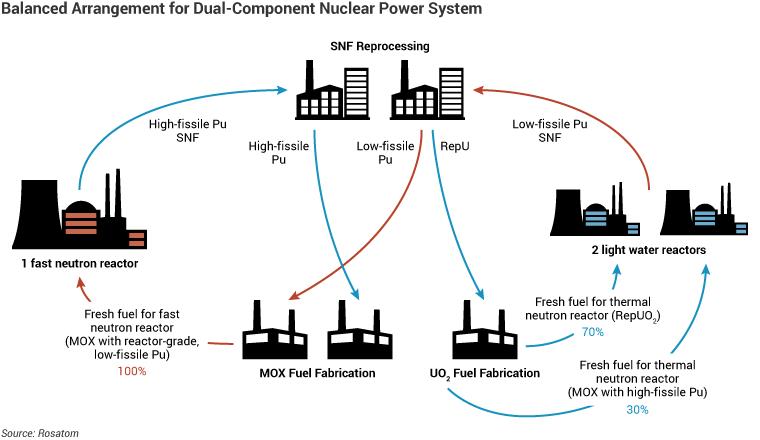
In this fuel cycle, normal thermal reactors are the primary plutonium source, but this plutonium is reactor-grade, with about one-third even-mass number non-fissile isotopes. The plutonium is mixed with deflourinated tails from uranium enrichment (i.e. depleted uranium). Whether derived from used uranium fuel or MOX fuel, it is separated and made into MOX fuel for fast breeder reactors with not less than 1.2 breeding ratio, and the used fuel from these has a much lower proportion of even-number non-fissile plutonium isotopes.
In future this ‘clean’ or high-fissile plutonium recovered from fast reactor fuel can then made into MOX fuel for the original thermal reactors, and comprise about 30% of their fuel. The other 70% could be enriched reprocessed uranium (RepU), the depleted tails of which are also used for MOX, instead of using normal depleted uranium. Their used fuel is reprocessed to continue the dual cycle. Minor actinides are burned in the fast reactors.
One fast reactor running on 'dirty' MOX would therefore be in balance with two VVER reactors fuelled with 'clean' MOX (30% of load) and RepU oxide enriched to about 17% U-235 (70% of load) via segregated reprocessing facilities and segregated fuel fabrication.
Further details are in the information paper on Mixed Oxide Fuel.
Nitride fuel fabrication for fast reactors
Rosatom’s Proryv or 'Breakthrough' project includes the Pilot Demonstration Power/Energy Complex (PDPC or PDEC) Siberian Chemical Combine (SCC) in Seversk. The complex comprises three interconnected facilities: a unit for fabricating and refabricating dense mixed uranium-plutonium nitride (MNUP) fuel; the lead-cooled BREST-OD-300 fast reactor; and an irradiated-fuel reprocessing unit. Construction of the reactor began in June 2021, and the fuel fabrication/refabrication unit entered pilot operation in December 2024. The original completion target of 2026 for BREST-OD-300 has slipped. It is now expected to start up 2028-29. The reprocessing unit is due to enter operation around 2030.
To avoid problems in reactor operation and spent fuel, nitrogen-15 is the preferred isotope. VNIINM has patented a technique for enrichment in N-15, annual demand for which is expected to be several tonnes.
SCC and other Rosatom organizations have manufactured experimental MNUP fuel and fuel assemblies to support development and qualification of fuel for BREST-OD-300. This pre-industrial programme preceded the dedicated PDEC fabrication/refabrication facility.
Experimental MNUP fuel assemblies have undergone irradiation in the BOR-60 research reactor and the BN-600 power reactor. Rosatom says that these tests provided the data needed to substantiate first-generation fuel for the initial BREST-OD-300 core at a burnup of 6% of heavy atoms. The development programme is intended to increase average burnup progressively to 12%. In 2025 SCC manufactured the OS-5 experimental assembly, incorporating a liquid-metal layer between the nitride fuel and cladding. Irradiation in BN-600 is planned following regulatory approval.
The PDEC fabrication/refabrication unit entered pilot operation in December 2024. Its four principal process areas cover carbothermal synthesis of uranium and plutonium nitrides, pellet fabrication, fuel-rod manufacture and fuel-assembly production. It has so far manufactured prototype BREST-OD-300 assemblies containing depleted-uranium nitride pellets. Production of the intended MNUP fuel cannot begin until Rostechnadzor authorizes the facility to handle plutonium. Rosatom plans to manufacture more than 200 MNUP fuel assemblies before the initial BREST-OD-300 core is loaded.
In October 2014 SCC announced a tender for a reprocessing plant to be completed by 2018, with VNIPIET as SCC’s preferred bidder. It included a module for processing used nuclear fuel, to examine technologies VNIINM and the VG Khlopin Radium Institute have developed. VNIINM said its experiments in 2016 had confirmed for the first time that the technology used for the reprocessing of used mixed nitride fuel enables the re-use of more than 99.9% of the actinides. The actual RUR 20 billion plant is to have a capacity of 5 t/yr used fuel from the BREST-300 and 0.5 t/yr of “rejects from electrolysis process and americium-containing burning elements.” It is expected to commence operation after 2029, once the BREST-300 is in service.
International Uranium Enrichment Centre (IUEC)
Russia and Kazakhstan established the International Uranium Enrichment Centre (IUEC) at Angarsk in 2007 to provide participating states with assured access to uranium-enrichment services without transferring sensitive enrichment technology. In September 2007 the joint stock company Angarsk International Uranium Enrichment Centre (JSC Angarsk IUEC) was registered and a year later Rostechnadzor licensed the centre.
The IUEC website lists Russia, Kazakhstan, Ukraine and Armenia as participating member states. They are represented respectively by Rosatom, Kazatomprom, Ukraine’s State Concern Nuclear Fuel and Armenian Nuclear Power Plant. The centre arranges guaranteed access to conversion and enrichment capacity at Russian nuclear fuel-cycle enterprises rather than operating a separate enrichment plant.
Russia also maintains an IAEA-controlled reserve at the IUEC storage facility containing 120 tonnes of low-enriched uranium enriched to no more than 4.95% uranium-235. The reserve was fully stocked in November 2010 and has been available to eligible IAEA member states since February 2011 as an assurance-of-supply mechanism.
This initiative complements the IAEA LEU Bank set up in Kazakhstan by making more material available to the IAEA for assurance of fuel supply to countries without their own fuel cycle facilities. The IAEA LEU Bank is located at the Ulba Metallurgical Plant (UMP) in Kazakhstan, which has 50 years of experience in handling UF6. A formal agreement with Kazakhstan to establish the legal framework was signed in August 2015, and the partnership agreement between the IAEA and UMP was signed in May 2016. Construction of the building with 600 m2 storage area started in September 2016, and the facility was formally opened at the end of August 2017. It became operational in 2019, and it awarded contracts to Orano and Kazatomprom to supply it.
Used fuel and reprocessing
Russian policy is to close the fuel cycle as far as possible and utilize recycled uranium, and also to use plutonium in MOX fuel. In 2011 only about 16% of used fuel was reprocessed, this being from VVER–440s, BN-600, research reactors and naval reactors. Historically, reprocessed uranium (RepU) was mainly used for RBMK fuel. Recycling has since expanded: the BN-800 reactor has operated with a full MOX core since September 2022, and pilot operation of REMIX fuel containing reprocessed uranium and plutonium in a VVER-1000 was completed in March 2026. Rosatom’s stated objective is to demonstrate closure of the nuclear fuel cycle under the Proryv project by 2030.
Commercial reprocessing started in 1977, and several projects at two sites have been under way to progress this intention:
- At Mayak Production Association in Ozersk, the RT-1 spent fuel reprocessing facility was modified to accept VVER-1000 fuel, with the first such fuel received in December 2016.
- At Mining and Chemical Combine (MCC) in Zheleznogorsk, the MOX fuel fabrication plant for fast reactors was commissioned in 2015 and began serial MOX-fuel production in 2019.
- At MCC the Pilot Demonstration Centre (PDC) for used nuclear fuel reprocessing was commissioned in 2015. Its first complex was a research facility. Pilot reprocessing of an irradiated Balakovo fuel assembly was reported in 2018. The second, pilot-industrial complex was launched in July 2025 and is expected to process about 200 tonnes of used fuel per year after reaching design capacity.
- At MCC a full-scale RT-2 facility was to be completed by 2025 to reprocess VVER, RBMK and BN used fuel into mixed-oxide (MOX) fuel or into REMIX – the regenerated mixture of uranium and plutonium oxides – but this has not been completed (see below). The 2024 federal programme described the PDC’s second complex as a source of operating data for a large-scale radiochemical plant then envisaged by 2040. In June 2026 Rosatom announced investment and site-selection studies for a new modular reprocessing plant. The site had not yet been selected.
- At MCC Zheleznogorsk the spent fuel pool storage has been supplemented by centralized dry storage, commissioned in 2012.
All used fuel is stored at reactor sites for at least three years to allow decay of heat and radioactivity. High burn-up fuel requires longer before it is ready to transport.
Under the current federal programme, used fuel is transported to centralized facilities – principally RT-1 at Mayak and MCC at Zheleznogorsk – for storage and subsequent processing. In 2024, 134.3 tonnes of used fuel was reprocessed and more than 6300 RBMK-1000 fuel assemblies were accepted for centralized storage at MCC.
RT-1 reprocessing plant, Mayak
Used fuel from VVER-440 reactors Kola 1-4 and Rovno 1-2 in Ukraine, the BN-600 (Beloyarsk) and from naval reactors has historically been sent to the Mayak Chemical Combine's 400 t/yr RT-1 plant (Chelyabinsk-65) at Ozersk, near Kyshtym 70 km northwest of Chelyabinsk in the Urals for reprocessing.* RT-1 now also processes VVER-1000 and BN-800 fuel.. An upgrade of the RT-1 plant to enable it to take VVER-1000 fuel was completed in 2016, and reprocessing of fuel from Rostov began late in the year.
* The original reprocessing plant at the site was hastily built in the mid-1940s, for military plutonium production in association with five producer reactors (the last shut down in 1990).
The RT-1 plant started up in 1971 and employs the Purex process. Since about 2000 the plant has been extended and modified so that it can accept a wide variety of inputs, including U-Be research reactor fuel. It had reprocessed about 5000 tonnes of used fuel to 2012 and was reported to be running at about 100 t/yr capacity, following the loss of foreign contracts. In 2015 RT-1 processed 230 tonnes of fuel, 35% more than in 2014, and its capacity was expected to reach 400 t/yr “within several years”, comprising all types from Russian designed reactors, notably VVER-1000 and RBMK. In practice throughput has remained much lower – a total of 993 tonnes was reprocessed over 2016 to 2024 – and in 2022 RT-1 reprocessed used fuel from the BN-800 reactor for the first time.
Regular shipments of used submarine fuel from Andreeva Bay storage to Mayak for reprocessing commenced in mid-2017, via Murmansk, and removal of the roughly 22,000 naval fuel assemblies was still under way in 2025.
In 2015 Mayak started reprocessing the uranium-beryllium fuel from dismantled Alfa-class submarines, as a ‘nuclear legacy project’. These unsuccessful vessels had a single reactor of 155 MWt cooled by lead-bismuth and using very highly enriched uranium – 90% enriched U-Be fuel. The experience gained with lead-bismuth eutectic is being applied in Russia’s fast reactor programme – notably BREST (since SVBR was dropped).
Recycled uranium is enriched to 2.6% U-235 by mixing RepU product from different sources and is used in all fresh RBMK fuel, while separated plutonium oxide is stored. High-level waste is vitrified and stored. Serial supplies of VVER-440 fuel containing reprocessed uranium are being made for Kola 2, and Rosatom has proposed its wider introduction in VVER-1200 and VVER-TOI units.
Zheleznogorsk MCC: Pilot Demonstration Centre and RT-2 reprocessing plant
A Pilot Demonstration Centre (PDC) for several reprocessing technologies is operated by MCC at Zheleznogorsk, built at a cost of RUR 8.4 billion and completed in 2015 as a "strategic investment project". The first line reprocessed its first VVER-1000 fuel assembly in June 2018, and a second, industrial-scale stage was launched in July 2025, expected to bring capacity to about 200 t/yr. It will have innovative technology including embrittlement by crystallization, and simultaneous gas, thermo and mechanical spent fuel assembly shredding. It deals initially with VVER-1000 fuel, and is to handle fuel from fast reactors later.
It was conceived as effectively the first stage of the larger redesigned RT-2 plant at the MCC/GHK site (but this did not proceed). Construction of the original project began in 1984 and was suspended in 1989.
In June 2026 Rosatom announced plans for a new high-capacity reprocessing plant able to process fuel from both thermal and fast reactors, with a first module of 400 t/yr and a modular design allowing later expansion.
Zheleznogorsk MCC: RBMK and VVER used fuel storage
The Mining and Chemical Combine (MCC) at Zheleznogorsk operates centralized wet and dry storage for VVER-1000 and RBMK used fuel. The VVER-1000 pool store dates from 1985, while the first stage of the centralized dry store entered service in 2012. Subsequent work has transferred fuel from reactor sites and older storage into centralized facilities.
During 2024, 13,824 RBMK fuel assemblies were transferred to centralized dry storage at MCC and 337 VVER-1000 assemblies were placed in temporary storage. RBMK fuel is prepared for dry storage in sealed canisters. VVER-1000 fuel can be held pending reprocessing.
The pool store was reconstructed between 2008 and 2011, increasing capacity by more than 2500 tonnes and extending its operating life to 2045. Used fuel will be stored for up to 50 years, pending reprocessing. MCC has flagged the possibility of storing foreign VVER-1000 used fuel, such as that from fuel take-back arrangements linked to foreign reactor sales (initially Iran). This can be reprocessed in Russia, but the waste must be repatriated.
At the end of 2024 Rosatom reported 27,099 tonnes heavy metal (tHM) of used fuel at nuclear-industry facilities, including 16,517 tHM under federal responsibility. During 2024, 453 tHM accumulated, 1,054.21 tHM was removed from storage and 134.5 tHM was reprocessed, equivalent to 22.9% of that year's generation.
Bilibino's LWGR used fuel is stored at Bilibino site.
(Three decommissioned graphite-moderated reactors which principally produced military plutonium, with associated underground reprocessing plant, are also at MCC Zheleznogorsk. The huge underground complex, 200-250 m deep, was originally established in 1950 for plutonium and weapons production.)
Other reprocessing plants
At SCC Seversk a reprocessing plant for nitride fuel from BREST fast reactors is envisaged to operate after 2029 as part of the Pilot Demonstration Energy Complex. See above.
In 2016 it was announced that decommissioning of the HEU downblending and mixing plant at SCC would be completed by 2022. The plant was built in 1996 at the conversion plant in order to implement the Russia-US program for blending down high-enriched uranium from Russian nuclear weapons into low-enriched uranium for export and use in US nuclear power plants. This program concluded in 2013.
Legacy materials
Russia has a significant amount of legacy materials, some as a result of military materials production (e.g. slightly irradiated uranium), others from the civil fuel cycle (e.g. reprocessed uranium), and as a result of reviews over 2006-08 these are now recognized as potentially having significant value. The total quantity is not such as to impact the civil market; there are some technical challenges (e.g. limiting U-232 to 5 ppb in enriched RepU), and in any case Russia’s preference is to use the material domestically while making resultant expertise available internationally.
The main material not found in the civil nuclear fuel cycle is slightly irradiated uranium (SIU, 0.65% U-235) from military plutonium production with low burn-up of natural uranium, after reprocessing to separate that plutonium. If SIU is enriched, the product can readily be used in nuclear plants and the tails become DSIU, with lower content of even uranium isotopes (232, 234, 236) than normal RepU, hence more valuable.
Historically, Russian used fuel from all but VVER-1000 civil reactors has been reprocessed at Mayak to yield RepU with about 0.9% U-235. This has mostly been enriched to provide fuel for RBMK reactors, with the tails as DRepU.
Also historically, to 2000, foreign used fuel was reprocessed and the RepU blended with LEU to yield reactor fuel which was returned as if the RepU had been enriched.
In the centrifuge enrichment process, different ways of feeding cascades with both Unat and RepU and blending the product can control U-232 levels and also U-236 levels (which if over 0.1% can be compensated by higher enrichment levels). Russian enrichment plants have provision for this flexible cascading. Then blending the enriched uranium product (from SIU, DSIU or RepU) with Unat or SIU can further reduce both of these even isotopes according to customer requirements, and below the pending Russian limit of 5 ppb U-232 (now 2 ppb).
Radioactive waste
Russia's Duma passed a new Federal Law on Radioactive Waste Management in June 2011, after 19 months consideration and many amendments. It was passed by the state Council in July and then signed into law. It establishes a legal framework for radioactive waste management, provides for a national radwaste management system meeting the requirements of the Joint Convention on the Safe Management of Spent Nuclear Fuel and on the Safe Management of Radioactive Waste ratified by Russia in 2006.
The second Federal Target Programme for Nuclear and Radiation Safety, launched for 2016-2030, now runs through 2035. It covers decommissioning of legacy facilities, used fuel and radioactive waste infrastructure, monitoring and scientific support. In 2024 Rosatom reported that three nuclear and radiation-hazardous facilities were decommissioned during the year, taking the cumulative total since 2016 to 56.
Rosatom and the National Operator for Radioactive Waste Management – FSUE NO RAO – is responsible for coordination and execution of works associated with radwaste management, notably its disposal. This includes military waste. The law establishes time limits for interim radwaste storage and volume limits for waste generators, and defines how they should bring waste in condition suitable for disposal and transfer it to the national operator along with payment of disposal charges. Import and export of radwaste is banned. All newly-generated waste is the responsibility of its generators who will pay for its disposal and storage, with funds accumulated in the SC Rosatom’s bank account as a special fund. However, the 2011 law did not address how to resolve property disputes in siting, nor local authority responsibilities, nor financing mechanisms for affected municipalities. In October 2014 NO RAO submitted to Rosatom proposals for changes in legislation on these matters so that it could proceed with its mandate. In 2015 RUR 6.5 billion was to be paid over by various enterprises to Rosatom’s reserved fund for radioactive waste disposal, at rates set in 2013 for the period to 2017.
Rosatom plans to draft two more laws: on decommissioning and used fuel management.
FSUE RosRAO – renamed the Federal Environmental Operator (FEO) in 2020 – is a Moscow-based Rosatom company providing commercial back-end radwaste and decommissioning services for intermediate- and low-level waste as well as handling non-nuclear radwaste and nuclear decommissioning. It commenced operation in 2009 under a temporary arrangement pending finalization of regulations under the new legislation, and became part of Rosatom’s Life Cycle Back-End Division (LC BED) in 2013. It incorporates Radon, and now has branches in each of seven federal districts.
Naval waste
The Federal Environmental Operator’s Far East Centre for Radioactive Waste Management is DalRAO, near Vladivostok in the Maritime Territory. It has Fokino and Viluchinsk divisions or regions, and operates a long-term open-air storage facility in Razboinik Bay for reactor compartments* from dismantled submarines. The long-term storage facility was under construction from 2006 with Japanese assistance and was commissioned in 2012. It has three nuclear service ships, and the Japanese government donated a floating dock and other equipment to move the reactor compartments. It plans to have the Regional Center for Conditioning and Long-term Storage of Radioactive Waste (RAW Regional Center) here, mainly for naval waste pending handover to NO RAO. In October 2014 the last spent fuel from dismantled nuclear submarines in the Maritime Territory was dispatched to the Mayak reprocessing plant.
* In 2014 the first three were brought ashore, in 2015 RosRAO planned to move five and then raise the number to ten per year, with a total of 54 three-compartment units to be placed.
The Federal Environmental Operator's Northwest Centre for Radioactive Waste Management is SevRAO, in the Murmansk region, which is engaged in remediation of the sites which were Navy Northern Fleet bases, and dismantling of retired nuclear-powered naval ships and submarines as well as nuclear service ships at several sites. Andreeva Bay is the main centre of attention today, and international funding was applied to removing its stock of used naval fuel under the Northern Dimension Environmental Partnership (NDEP). NDEP was established in 2002 and supported by many countries and the EU through the European Bank for Reconstruction and Development (EBRD) until the NDEP nuclear funds were terminated at the end of November 2023. Its Nuclear Window funded work at Andreeva Bay, dismantling Lepse and the Papa-class submarine at Severodvinsk, with €165 million pledged to mid-2017.
Sayda Bay west of Murmansk was a low-level waste storage site for the navy and has become a regional radioactive waste storage centre as well as a major ship and submarine dismantling centre. After being docked for 24 years at Atomflot’s base near Murmansk, the nuclear service ship Lepse was towed to the Nerpa shipyard in Sayda Bay in 2012 and cut up on a slipway over 2013-16, leaving two problematical sections of the hull. It had served as a floating receptacle for used fuel from Russian icebreakers from 1961 to 1988, and stored damaged fuel from the Lenin. An aft section contained radioactive waste that was sent to the nearby Sayda Bay facility, and a fore section contained 639 used fuel assemblies from icebreakers, many of them badly damaged, were removed over 2019-21 inside a special structure and sent to Mayak. All this was funded internationally under the NDEP, and dismantling of Lepse was completed in November 2023.
The old Volodarsky, used as a nuclear service ship from 1966 to 1991 and laden with a lot of low- and intermediate-level radioactive waste, anchored near Murmansk until 2013, was also towed to Sayda Bay, unloaded and then dismantled by the end of 2014. This was funded by the Russian government. Other solid radioactive waste was collected at Andreeva Bay for transport to Sayda Bay for long-term storage. A lot of submarine dismantling was undertaken at Sayda Bay, with many three-compartment reactor units now stored there on land. In August 2021 Rosatom reported that 120 out of 123 decommissioned submarines in the Arctic region had been dismantled.
Gremikha is a former naval base between Murmansk and Archangel where SevRAO undertook the defuelling and dismantling of 11 highly-radioactive liquid metal-cooled naval reactors from Alfa-class submarines from 2014. The 11th and final fuel consignment was dispatched to Mayak in late 2024, completing the removal of used fuel from Gremikha. After the 50-tonne reactors are removed from the hull segments shipped apparently from Sayda Bay, they are put into a hot cell and then defuelled, with the fuel loaded into containers for transport to Mayak for reprocessing. This work takes about a year for each core. Raising the scuttled K-27 submarine with similar reactors and dismantling it is pending there (see below).
Andreeva Bay, in Litsa Fjord about 55 km from the Norwegian border, was used for Northern Fleet submarine refuelling and accumulated about 22,000 used fuel assemblies after a storage-pool leak in 1982. Removal began in June 2017. Fuel is moved in casks by the Rossita to Atomflot's railhead at Murmansk and then to Mayak for storage and reprocessing. Rosatom reported that 16 casks were prepared for unloading in 2024 as the programme continued.
Submarine fuel is shipped to Andreeva Bay in the 1620 dwt Rossita. This is a dedicated ship to transport up to 720 tonnes of used nuclear fuel and radioactive waste, and was built for Atomflot in Italy in 2011. The Rossita is primarily for naval waste and fuel from decommissioned submarines, and is used on the Northern Sea Route cruising between Gremikha, Andreeva Bay, Sayda Bay, Severodvinsk and other Russian facilities which dismantle nuclear submarines. Rossita also moves casks of used submarine fuel from Andreeva Bay to the railhead at the Atomflot base at Murmansk, for transport to Mayak.
A new vessel built in Italy under a 2013 contract, the semi-submersible pontoon dock Itarus, designed to transport three-compartment units of dismantled Russian nuclear submarines for SevRAO in Sayda Bay, was delivered in 2016.
As SevRAO has made good progress, there are plans costed at €123 million to recover seven items of radioactive debris from Arctic waters, where most were dumped in Soviet times, by 2032. This includes submarine reactor compartments and two entire submarines with fuel still in their reactors – K-27 which was scuttled in 1982 in shallow water after major failure in one of its lead-bismuth cooled reactors, and K-159 which sank while under tow to decommissioning in 2003. The majority of the debris is in the eastern bays of the Novaya Zemlya, in the Kara Sea. Some is in the Barents Sea. The total radioactivity of nuclear submarines in both seas is estimated at 37 PBq.
Civil waste
RosRAO is envisaged as an international operator, providing back-end fuel cycle services globally.
The National Operator for Radioactive Waste Management (NO RAO) is a federal-state unitary enterprise set up in March 2012 as the national manager of Russia's radioactive waste, including its disposal. It is the national operator for handling all radioactive waste and the single organization authorized to carry out its final disposal, and also other related functions. Its functions and tariffs are set by government, notably the Ministry of Natural Resources. Its branches are at Zheleznogorsk in Krasnoyarsk, Seversk in Tomsk, Dimitrovgrad in Ulyanovsk and (from late 2013) Novouralsk in Sverdlovsk.
NO RAO is developingan underground research laboratory in Nizhnekansky granitoid massif near Krasnoyarsk for study into the feasibility of disposal of solid HLW and solid medium-level long-lived waste. Construction of the laboratory began in 2018, and it is planned to enter operation in 2028, followed by a long-term research programme. See section below on High-level waste disposal, geological repositories.
The System of State Accounting and Control of Nuclear Materials and Radioactive Waste (SSAC RM&RAW) is intended to perform physical inventory testing of nuclear materials and radioactive waste at their locations, and carry out accounting and control of them at the federal, regional and departmental levels. In February 2015 Rosatom introduced an automated system for accounting and control of radwaste from more than 2000 organizations, which was to be fully implemented by the end of that year.
Plant 20 at PA Mayak, Ozersk, is understood to be a military plutonium processing facility employing 1900 people. There was a plan to close it down and transfer operations to the Siberian Chemical Combine at Seversk as part of restructuring the nuclear weapons complex, but this was cancelled in March 2010. In 2011 Rostechnadzor said that urgent attention was needed “to the 20 open liquid radioactive waste pools, including decommissioning those at FGUP PA Mayak as containing the highest concentration and amount of liquid radioactive waste.”
Used fuel from Russian-built foreign power and research reactors is repatriated, much of it through the port of Murmansk. Some 70 containers were unloaded and moved south by rail over 2008-2014.
High-level waste disposal, geological repositories
No repository is yet available for high-level waste. Earlier, site selection was proceeding in granite on the Kola Peninsula, and 30 potential disposal sites have been identified in 18 regions, including Siberia, the Urals, the Volga region and the Northwest federal district in order of priority. In 2003 Krasnokamensk in the Chita region 7000 km east of Moscow was suggested as the site for a major spent fuel repository.
Then in 2008 the Nizhnekansky Rock Massif at Zheleznogorsk in Krasnoyarsk Territory was put forward as a site for a national deep geological repository. Rosatom said the terms of reference for the facility construction would be tabled by 2015 to start design activities and set up an underground rock laboratory. Public hearings on the Nizhnekansky Granite Massif were held in July 2012 and in November 2013 it was identified in the Regional Energy Planning Scheme as the planned repository site. In August 2016 the Territorial Planning Scheme to 2030 confirmed the site and approved construction of repository facilities here for 4500 m3 net of class 1 waste and 155,000 m3 net of class 2 waste.
The National Operator for Radioactive Waste Management (NO RAO) envisages the establishment of an underground laboratory in the Yeniseysky area near Krasnoyarsk for this waste and then no less than nine years' research. It completed the design documentation for the underground laboratory in March 2015 and began construction in 2018. The laboratory is planned to enter operation in 2028, and a decision on repository construction will follow the research programme. Phase 1 of the facility is to be designed to hold 20,000 tonnes of intermediate- and high-level waste, which will be retrievable.
Low- and intermediate-level waste
These are mostly handled similarly to those in other countries. Radon has been the organization responsible for medical and industrial radioactive waste. It has had 16 storage sites for waste up to intermediate level. Not far outside Moscow, the major Radon facility has both laboratories and disposal sites. Other near-surface storage facilities were in 2008 planned for Sosnovy Bor, Glazov, Gatchina, Novovoronezh, Kirovo-chepetsky, Murmansk, Sarov, Saratov, Bilibino, Kransokamensk, Zelenogorsk, Seversk, Dimitrovgrad, Angarsk, and Udomlya.
NO RAO planned to establish repositories for at least 300,000 m3 of low- and intermediate-level waste (LILW, class 3&4 radioactive waste), with those plans to be in place by 2018. One facility would be built in each of Russia’s seven federal districts to dispose of these three waste streams. In August 2016 the Territorial Planning Scheme to 2030 approved construction of the following near-surface repository facilities:
- 100,000 m3 LILW at Ozersk in Chelyabinsk region for Mayak.
- 200,000 m3 LILW at Tomsk/ Seversk for SCC.
- 48,000 m3 LILW from Urals Electrochemical Combine at Novouralsk.
- 50,000 m3 LILW at Sosnovy Bor in the Leningrad oblast.
In December 2015 NO RAO received a licence to operate the first stage of a repository at Novouralsk. The licence permits the near-surface disposal of solid radioactive waste by its Seversk branch on behalf of the Urals Electrochemical Combine, and the first stage of 15,000 m3 was opened in December 2016. The second stage entered operation in April 2022, taking capacity to about 55,000 m3. The facility with a total final capacity of 150,000 m3 is planned to operate until 2035. “The investments in design, operation and care & maintenance of the facility, as well as subsequent monitoring of the environment will be RUR 6 billion (US$820 million), as per preliminary estimates,” according to NO RAO.
NO RAO has received local government approval in the Chelyabinsk and Tomsk regions respectively for the final disposal of low- and intermediate-level waste (LILW) at the sites of Mayak Production Association in Ozersk, and Siberian Chemical Combine (SCC), based in Tomsk. In 2017 NO RAO said it planned a 214,000 m3 repository near Ozersk, and 150,000 m3 at Seversk near Tomsk. In March 2026 both were reported as still under construction, with their first stages scheduled for commissioning during the year.
However, Russia has also for many years used deep-well injection for low- and intermediate-level waste from some facilities, notably Seversk, Zheleznogorsk and Dimitrovgrad. This is mainly waste from reprocessing. A Central Europe review report in 1999 said that the wells ranged from 300 up to 1500 metres deep, and that Seversk was the main site utilising the method, with 30 million cubic metres injected. This practice has delayed Russian acceptance of an IAEA standard for radioactive waste disposal, since it has no packaging or engineered barriers and relies on the geology alone for safe isolation. The new 2011 Radioactive Waste Management law said: “Underground disposal of liquid radioactive waste may be executed, in accordance with the requirements of federal regulations and rules, inside geological formations (‘collector horizons’) as limited by the bounds of the area allotted, within which liquid radioactive waste must remain localised.”
Russia continued to operate three class 5 deep-disposal facilities for liquid radioactive waste in 2024, at Dimitrovgrad, Seversk and Zheleznogorsk. These facilities inject eligible liquid waste into licensed geological collector horizons and are distinct from the near-surface repositories used for solid class 3 and 4 waste.Energospetsmontazh announced in March 2015 that the trial operation of plasma-based processing of radioactive waste had started at Novovoronezh. The system is designed for plasma pyrolysis processing of solid radioactive waste of medium and low activity containing both combustible and non-combustible components.
Kyshtym accident and related pollution
There was a major chemical accident at Mayak Chemical Combine (then known as Chelyabinsk-40) near Kyshtym in Russia in 1957. This plant had been built in haste in the late 1940s for military purposes. The failure of the cooling system for a tank storing many tonnes of dissolved nuclear waste resulted in an explosion due to ammonium nitrate having a force estimated at about 75 tonnes of TNT (310 GJ). Most of the 740-800 PBq of radioactive contamination settled out nearby and contributed to the pollution of the Techa River, but a plume containing 80 PBq of radionuclides spread hundreds of kilometres northeast. The affected area was already very polluted – the Techa River had previously received about 100 PBq of deliberately dumped waste, and Lake Karachay had received some 4000 PBq. This ‘Kyshtym accident’ killed perhaps 200 people and the radioactive plume affected thousands more as it deposited particularly Cs-127 and Sr-90. It is rated as a level 6 ‘serious accident’ on the International Nuclear Event Scale, only surpassed by Chernobyl and Fukushima accidents.
Up to 1951 the Mayak plant had dumped its waste into the Techa River, whose waters ultimately flow into the Ob River and Arctic Ocean. Then they were disposed of into Lake Karachay until at least 1953, when a storage facility for high-level waste was built – the source of the 1957 accident. Finally, a 1967 duststorm picked up a lot of radioactive material from the dry bed of Lake Karachay and deposited it on to the surrounding province. It appears that some radioactive discharges into the Techa River continued, and that in particular between 2001 and 2004, some 30-40 million cubic metres of radioactive effluent was discharged near the reprocessing facility, which “caused radioactive contamination of the environment with the isotope strontium-90.” There is no radiological quantification.
The outcome of these three events made some 26,000 square kilometres the most radioactively-polluted area on Earth by some estimates, comparable with Chernobyl.
Decommissioning
Decommissioning and remediation are carried out under the Federal Target Programme for Nuclear and Radiation Safety, which now extends through 2035. Rosatom reported three nuclear and radiation-hazardous facilities decommissioned in 2024 and 56 cumulatively since the programme began in 2016, one more than the cumulative target for that point.
Several civil reactors are being decommissioned: an experimental 50 MWt LWGR type at Obninsk which started up in 1954 (5 MWe) and was the forerunner of RBMKs, two early and small prototype LWGR (AMB-100 & 200) units – Beloyarsk 1&2 – the Melekess VK-50 prototype BWR, and three larger prototype VVER-440 units at Novovoronezh, a V-210 and V-365 and a V-179. Five were shut down 1981-90 and await dismantling. The fuel has been removed from these and that from Novovoronezh has been shipped to centralized storage in Zheleznogorsk and will be stored there for about ten years before reprocessing. The Beloyarsk fuel is still onsite since reprocessing technology for it is not yet available. The plant is being dismantled, and the site is due to be clear by 2032.
Shutdown Civil Power Reactors
| Reactor | Power, MWe | (Proto)type | Started | Shutdown |
| Obninsk AM-1 | 6 (50 MWt) | LWGR | 1954 | 2002 |
| Beloyarsk 1, AMB-100 | 108 | LWGR | 1964 | 1981 |
| Beloyarsk 2, AMB-200 | 160 | LWGR | 1968 | 1990 |
| Melekess | 50 | VK-50 | 1964 | 1988 |
| Novovoronezh 1 | 210 | VVER-440/V-210 | 1964 | 1988 |
| Novovoronezh 2 | 336 | VVER-440/V-365 | 1970 | 1990 |
| Novovoronezh 3 | 385 | VVER-440/V-179 | 1971 | 2016 |
| Leningrad 1 | 950 | RBMK | 1974 | 2018 |
| Bilibino 1 | 11 | LWGR | 1974 | 2019 |
| Leningrad 2 | 950 | RBMK | 1976 | 2020 |
| Kursk 1 | 925 | RBMK | 1977 | 2021 |
| Kursk 2 | 925 | RBMK | 1979 | 2024 |
| Bilibino 2 | 11 | LWGR | 1975 | 2025 |
| Bilibino 3 | 11 | LWGR | 1976 | 2025 |
| Bilibino 4 | 11 | LWGR | 1977 | 2025 |
At Novovoronezh 1&2 a decommissioning project with partial dismantling of equipment was largely completed in 2020. The work will take several years, and buildings are likely to be re-used. In particular that portion of the site houses the district heating pumps and equipment, which provides 75% of the heat for the city, and a spare parts store for Rosenergoatom. Novovoronezh 3 was shut down in December 2016 and it will be cannibalized to keep unit 4 (also V-179) operating for up to 60 years.
In 2010 Siberian Chemical Combine (SCC) in collaboration with Rosatom set up the JSC Pilot Demonstration Center for Decommissioning of Uranium-Graphite Reactors (PDC UGR) at SCC site to implement a decommissioning concept for 13 shut-down uranium-graphite production reactors (PUGR) for military plutonium. These are at Mayak Chemical Combine at Ozersk (5), near Kyshtym, at Siberian Chemical Combine, Seversk (5), and at Mining & Chemical Combine, Zheleznogorsk (3). The last plutonium production reactor, ADE-2 at Zheleznogorsk, finally closed for decommissioning in April 2010.* The fuel has been removed from the shut-down reactors and nearly all of it has been reprocessed at Mayak and Seversk. The concept provides for building multiple safety barriers and sealing of shut-down reactors rather than their dismantling, at a cost estimated to be RUR 2 billion (US$ 67 million) each. Entombment is the option selected for EI-2, ADE-4 and ADE-5 reactors. All 13 are expected to be decommissioned by 2030. EI-2, also described as Russia’s first industrial nuclear power station since it produced power as well as military plutonium, operated to the end of 1990 and was decommissioned in 2015. In 2009 SCC won a tender to prepare for decommissioning of the four Bilibino reactors (all now shut down, the last three during December 2025) and two closed ones at Beloyarsk (all LWGRs).
*Russia's plutonium was produced by 13 reactors at three sites: PO Mayak in Ozersk, also known as Chelyabinsk-65 (A, AV-1-3, AI-IR); SKhK – the Siberian Chemical Combine in Seversk, also known as Tomsk-7 (ADE-3,4&5, EI-1, EI-2); and GKhK – the Mining and Chemical Combine in Zheleznogorsk, also known as Krasnoyarsk-26 (AD, ADE-1&2). The five Mayak reactors produced an estimated 31t of weapons-grade plutonium between 1948 and 1990, the five SKhK reactors produced 68t between 1955 and 2008, and the three GKhK reactors produced 46t between 1958 and 2010. Ten of these reactors were shut down between 1987 and 1992, leaving only ADE-2, 4 and 5 until 2008 & 2010. Of four heavy water reactors at Mayak (OK-180, OK-190, OK-190M and LF-2) the first was intended for plutonium production but in fact all were used for producing isotopes and tritium. LF-2 remains in operation.
In January 2014 Rosatom announced that the PDC UGR, having established its credibility and expertise, would cease to be part of SCC and become part of its new End-of-Life (EOL) Management Division, under the Federal Centre for Nuclear and Radiation Safety (FC NRS).
Three nuclear-powered icebreakers have been decommissioned: Lenin, Sibir and Arktika, also the support vessel: Lepse which held some used nuclear fuel from the Arctic fleet. Lepse was taken out of the water in October 2014 for further dismantling at the Nerpa Shipyard in Murmansk. Lenin is being turned into a museum. SevRAO, the northern branch of the Federal Environmental Operator, dismantles nuclear-powered naval vessels at its Sayda Bay site in Murmansk, and Atomflot is considering using it for retired icebreakers.
In 2014 the Angarsk Electrolysis & Chemical Complex (AECC) said that decommissioning of its conversion plant and diffusion enrichment plants would require RUR 20 billion ($500 million). Decommissioning the conversion capacity at Kirovo-Chepetsky Chemical Combine which was shut down in the 1990s is expected to cost RUR 2.1 billion.
Organization
The State Corporation (SC) Rosatom is a vertically-integrated holding company which took over Russia's nuclear industry in 2007, from the Federal Atomic Energy Agency (FAEA, also known as Rosatom). This had been formed from the Ministry for Atomic Energy (Minatom) in 2004, which had succeeded a Soviet ministry in 1992. The civil parts of the industry, with a history of over 60 years, are consolidated under JSC AtomEnergoProm (AEP).
During 2008 there was a major reorganization or "privatization" of nuclear industry entities involving change from Federal State Unitary Enterprises (FSUE) to Joint Stock Companies (JSC), with most or all of the shares held by AtomEnergoProm. By mid August 2008, 38 of 55 civil nuclear FSUEs had been reformed. Some renaming occurred due to new restrictions on the use of "Russia" or derivatives (eg "Ros") in JSC names. In mid 2014 eight of the remaining FSUEs were designated ‘federal nuclear organisation’, including Mayak PA and MCC.
The State Nuclear Energy Corporation Rosatom (as distinct from the earlier Rosatom agency) is a non-profit company set up in 2007 to hold all nuclear assets, including more than 350 companies and organizations, on behalf of the state. In particular, it holds all the shares in the civil holding company AtomEnergoProm (AEP). It took over the functions of the Rosatom agency and works with the Ministries of Industry and Energy (MIE) and of Economic Development and Trade (MEDT) but does not report to any particular ministry. Early in 2012 the government announced that its civil divisions might be privatized, at least to a 49% share in individual entities. The total workforce is about 400,000.
SC Rosatom divisions are:
- Nuclear weapons complex.
- Nuclear & radiation safety and waste.
- Nuclear power – Atomenergoprom, Rosenergoatom.
- Applied and fundamental science, composite materials.
- Atomflot – Arctic fleet of seven nuclear icebreakers and one nuclear merchant ship.
AtomEnergoProm (Atomic Energy Power Corporation, AEP) is the single vertically-integrated state holding company for Russia's nuclear power sector, separate from the military complex. It was set up at the end of 2007 to consolidate the civil activities of Rosatom including uranium production, engineering, design, reactor construction, power generation, isotope production and research institutes in its several branches, but not used fuel reprocessing or disposal facilities. It incorporates more than 80 enterprises operating in all areas of the nuclear fuel cycle. The April 2007 Presidential decree establishing it specifies nuclear materials, which may be owned exclusively by the state, lists Russian legal entities allowed to possess nuclear materials and facilities, existing joint stock companies to be incorporated into Atomenergoprom, and lists federal state unitary enterprises to be corporatized first and incorporated into Atomenergoprom at a later stage. Exclusive state ownership of nuclear materials had been seen as a barrier to competitiveness and other Russian corporate entities will now be allowed to hold civil-grade nuclear materials, under state control.
Entities from Atomenergoprom itself down to various third-level subsidiaries will be joint stock companies eventually. Public investment in the bottom level operations is envisaged – the joint venture between Alstom and Atomenergomash to provide large turbines and generators is cited as an example.
JSC AtomEnergoProm's many entities include the following (most are JSCs):
- Rosatom Nedra (formerly ARMZ Uranium Holding Co, JSC AtomRedMetZoloto) – uranium production – owns Russian mine assets.
- Uranium One Group (U1 Group) – responsible for all foreign uranium mining, 78.4% owned. It sold its stake in the Zarechnoye joint venture in Kazakhstan in December 2024, and its stakes in Khorasan-U and Kyzylkum to Chinese buyers early in 2025.
- Techsnabexport (TENEX) – foreign trade in uranium products and services, with North American subsidiary TENAM.
- JSC Enrichment & Conversion Complex.
- TVEL – conversion, enrichment and nuclear fuel fabrication. The BREST-300 reactor is being built by TVEL at SCC Seversk, apparently due to the integration of fuel cycle facilities in the project.
- ASE Group is Rosatom’s engineering division, accounting for 30% of the global nuclear power plant construction market according to Rosatom. Most foreign projects are ASE's responsibility. It now incorporates the following entities:
- Atomproekt, the new name for VNIPIET (All-Russia Science Research and Design Institute of Power Engineering Technology) which since 2013 incorporates St Petersburg Atomenergoproekt (SPbAEP) – design of nuclear power projects, radiochemical plants and waste facilities. From 2015 this is part of the ASE Group.
- Nizhny-Novgorod Atomenergoproekt (NN AEP or NIAEP) – power plant design, from 2012: holding company for ASE. Sometimes then known as NIAEP-ASE, but re-named Atomstroyexport in December 2016. From October 2014 this is the parent company of Moscow JSC Atomenergoproekt (AEP), so the whole entity became the ASE Group (united company NIAEP-ASE-AEP). Then in 2015 Atomproekt was added to it.
- Atomstroyexport (ASE) – construction of nuclear plants abroad, merged with NIAEP in 2012. Sometimes known as NIAEP-ASE until re-named Atomstroyexport in December 2016. From the end of 2014, ASE owns all the shares in JSC Atomenergoproekt and 49% of those in NIAEP, taking them over from Atomenergoprom.
- Moscow Atomenergoproekt (AEP) – power plant design, became part of NIAEP-ASE.
- Energospetsmontazh – construction and assembly, also repair of nuclear plants.
- Atomenergomash (AEM) – a group of companies building reactors.
- OKBM Afrikantov (formerly just OKBM – Experimental Design Bureau of Machine-building – Mashinostroyeniya) at Nizhny Novgorod- reactor design and construction.
- OKB Gidropress (Experimental Design Bureau pressurised water – Hydropress) at Podolsk near Moscow – PWR reactor design.
- JSC Rosenergoatom (briefly Energoatom) – responsible for construction and operation of nuclear power generation.
- Rusatom Overseas was established in 2011 to promote Russian nuclear technologies in world markets. After restructuring in May 2015, it is divided into two companies served by Rusatom International Network which runs Rosatom's regional offices around the world, supporting the activities of Rosatom's divisions in foreign markets, seeking new business opportunities and promoting Rosatom's products and services abroad. The two companies are:
• JSC Rusatom Energy International, 44% owned by Rosatom and 56% by Atomenergoprom. It manages foreign construction projects and operation of those nuclear power plants as a shareholder in project companies. It is a major shareholder in JSC Akkuyu Nuclear in Turkey, and held 34% of Fennovoima Oy in Finland, whose Hanhikivi project was cancelled in 2022. The functions of the company include financing, construction on budget and on time, safe and efficient operation of nuclear power plants, and sale of electricity on foreign markets.
• JSC Rusatom Overseas Inc, based in Moscow and responsible for promotion of the integrated offer of nuclear power plant construction projects in international markets. Its key tasks are growth of the overseas orders portfolio of Rosatom companies and retaining the leading positions of Russia in global nuclear market. It is to ensure full back-up of the customer nuclear power programmes at all stages of implementation, including financing, training, localization of supply chain, fuel supply with take-back of used fuel for reprocessing, and decommissioning.
- Rusatom Overseas Germany (RAOS Germany) in 2016 was to take over the international sales and marketing activities of NUKEM Technologies GmbH in the regions outside of the Western European markets, hence bundling all international marketing activities in the nuclear back-end area and high-temperature reactor fuel with Rusatom Overseas.
- Rusatom Service – coordination of servicing nuclear plants abroad, providing “customised solutions for the modernization and operating period extension of VVER-based nuclear power plants”.
- Atomenergoremont – maintenance and upgrading of nuclear power plants,
- NUKEM Technologies GmbH and NUKEM Technologies Engineering Services GmbH, active worldwide in the management of radioactive waste and the decommissioning of nuclear facilities, were wholly-owned subsidiaries of JSC Atomstroyexport and, from 2016, were apparently part of Rusatom Overseas. A decision to sell was taken in 2022, and in September 2024 the operating company, NUKEM Technologies Engineering Services, was acquired by Japan's Muroosystems Corp from the insolvency administrator of its German parent, ending Russian ownership.
- Research & Development Institute for Power Engineering (NIKIET) at Moscow – power plant design (originally: submarine power plants)
- Central Design Bureau for Marine Engineering (CDBME) of the Russian Shipbuilding Agency – involved in some reactor design.
- JSC State Specialised Design Institute (SSDI or GSPI) was a direct subsidiary of Atomenergoprom set up in 1948 for producing plutonium but now designing SMRs.
Electricity:
JSC Rosenergoatom is the only Russian organization primarily acting as a utility operating nuclear power plants. It was established in 1992 and reorganized in 2001 and then in 2008 as an open JSC. From December 2011 JSC Atomenergoprom holds 96% of the shares, and SC Rosatom (which owns Atomenergoprom) holds 4%. Rosenergoatom owns Russia's nuclear power plants, both operating and under construction.
InterRAO UES was formerly a joint venture of Rosenergoatom and RAO UES, the utility which was broken up in mid 2008. It is now 57.3% owned by Rosatom and focused on electricity generation in areas such as Armenia and the Kaliningrad part of Russia, as the country's exporter and importer of electricity. It had 8 GWe of generating plant of its own and planned to increase this to 30 GWe by 2015, with the Baltic nuclear plant at Kaliningrad as an early priority. It heads a group of over 20 companies located in 14 countries, involving 18 GWe of capacity. Inter RAO-WorleyParsons (IRWP, with Inter RAO 51%) was set up in mid 2010 to work on the transfer of power engineering technology into Inter RAO's market and to promote Inter RAO's projects oversees.
Engineering and general designers:
In July 2008 the St Petersburg, Moscow and Nizhny-Novgorod divisions of Atomernergoproekt were converted to joint stock companies, with all shares held by Atomenergoprom. The first two are engineering companies and general designers of nuclear power plants mainly using VVER reactors developed by Gidropress. By the end of 2015 all the following engineering companies had been consolidated into the ASE Group as Rosatom's engineering division.
Atomproekt at St Petersburg was formed from the 2013 merger of St Petersburg Atomenergoproekt (SPbAEP) with the All-Russia Science Research and Design Institute of Integrated Power Engineering Technology – VNIPIET (established in 1933) to create the country’s largest nuclear power plant design and development company. It has a particular focus on fast reactors as well as VVER. The company supports all stages of the nuclear fuel cycle, from a decision to start a nuclear power plant construction project to decommissioning. On completion of the merger in mid-2014 it became Atomproekt. Earlier, SPbAEP worked closely with Atomstroyexport (ASE) on exported plants. Atomproekt is responsible for Leningrad II plant, Beloyarsk, Baltic, and also the Belarus, Tianwan and Paks II plants as export projects.
Atomproekt is also much involved in fuel fabrication and radioactive waste management. It is Russia's sole design company for used nuclear fuel storage facilities. It is closely involved with the Proryv project for closed fuel cycle with fast reactors.
Atomenergoproekt (formerly Moscow AEP) established in 1986 is a major general design and engineering company for nuclear power plants. It may also function as general contractor. In October 2014 it became a subsidiary of NIAEP-ASE.
Its version of the AES-2006 evolved to the VVER-TOI, which Rosatom says is planned to be standard for new projects in Russia and worldwide. It is general designer of Novovoronezh II, being built by NIAEP-ASE, Kursk II, Smolensk II as well as Kudankulam in India and Akkuyu in Turkey. It has been responsible for Kursk and Smolensk RBMK plants, Novovoronezh I, Balakovo, and the Zaporozhe, Temelin and Bushehr plants.
NIAEP-ASE: Nizhny-Novgorod Engineering Company Atomenergoproekt (NIAEP) set up in 1951 is building plants at Rostov (Volgodonsk) and Kalinin. NIAEP in March 2012 was merged with Atomstroyexport (ASE) to bolster the latter's engineering capability. (Earlier it had linked with ASE to utilize some 1980s VVER equipment not required for Bulgaria's proposed Belene plant, and built it at Kalinin.) NIAEP became a holding company for JSC ASE, but NIAEP-ASE was being used as acronym to late 2014.
Atomstroyexport (ASE), established by merger in 1998, emerged from the reorganization as a closed joint stock company owned by Atomenergoprom (50.2%) and Gazprombank (49.8%, it is 69% owned by Gazprom). Early in 2009 the Atomenergoprom and related equity was increased to 89.3% by additional share issue, leaving Gazprombank with 10.7%. It was responsible for export of nuclear plants to China, Iran, India and Bulgaria. In 2009 German-based Nukem Technologies GmbH, which specializes in decommissioning, waste management and engineering services, became a 100% subsidiary of Atomstroyexport. In 2012 ASE merged with Nizhny-Novgorod Atomenergoproekt (NN AEP or NIAEP) to form NIAEP-ASE.
Rosatom, through NIAEP-ASE, offers both EPC (engineering, procurement, construction) and BOO (build, own, operate) contracts for overseas nuclear power plant projects, the latter involving at least 25% Rosatom equity. Rosatom offers various kinds of project financing, including attraction of strategic and institutional investors and debt financing. Some project finance is covered by international agreements involving either export credits, Russian government credit or the participation of Russian state banks. It says that lending rates can be optimized for nuclear power plant projects, and up to 85% of the finance may be provided by government credit from Russia.
In November 2014 the projects in hand on the company website were: Rostov 3&4, Baltic 1&2, Nizhny Novgorod 1&2, Kursk II, all in Russia, and Kudankulam 1&2, Tianwan 3&4, Akkuyu 1-4, Ostrovets 1&2, Bushehr 1, Ninh Thuan 1&2. In mid-2013 Rooppur in Bangladesh was added (but then removed). It is also building a large (3x400 MWe) gas combined-cycle plant: South Ural/Yuzhnouralskaya GRES-2 units 1&2.
NIAEP (post 2012 merger) has a design institute in Nizhny-Novgorod, project management offices in Nizhny-Novgorod, Moscow and St Petersburg, and 11 representative offices in Europe and Asia to oversee projects.
Titan-2 was a major subcontractor for the Leningrad II construction, and in 2015 it took over as general contractor for units 1&2. It was also to have been general contractor for the Hanhikivi project in Finland, which was cancelled in 2022.
Other:
Rusatom Service was set up in October 2011 by Rosenergoatom (51%), Atomenergomash (16%), Gidropress (16%) and Atomtekhenergo (16%). It will undertake maintenance and repair as well as modernization of Russian-design nuclear power plants abroad, applying Russian domestic experience. The company is also to work in the area of technical consultancy, training and retraining of plant personnel. The market is estimated at €1.5 billion per year, rising to €2.5 billion by 2020, including western-design reactors by then.
OTsKS – Rosatom Branch Centre for Capital Construction – was set up in August 2012 to manage its capital investment program in Russia and internationally. It oversees regulatory, technical and legal aspects of capital construction projects, as well as estimating costs and developing schedules. It also provides training for customer-contractors and general contractors such as NIAEP-ASE as well as the personnel of construction companies. Rosatom subsidiary companies had to complete their transition to new rules on planning capital construction projects developed by OTsKS, by the end of 2013. Its main customer is Rosenergoatom..
AKME-engineering was established in 2009 to implement the SVBR-100 project at Dimitrovgrad, including design, construction and commercial operation. It is a JV of Rosatom and JSC Irkutskenergo, and is licensed for construction and operation of nuclear plants by Rostechnadzor.
Uralenergostroy in Yekaterinburg is a civil works general contractor responsible for BN-800, BN-1200 and MBIR plants.
The Federal Centre of Nuclear and Radiation Safety (FC NRS) is a federal-state unitary enterprise set up in 2007 by Rosatom as part of its End-of-Life (EOL) Management Division. The Pilot Demonstration Center for Decommissioning of Uranium-Graphite Reactors (PDC UGR) is to become part of it, rather than staying with SCC.
The National Operator for Radioactive Waste Management (NO RAO) is a federal-state unitary enterprise set up in 2012 responsible for waste management and disposal. It is the National Operator for handling all radioactive waste, with functions and tariffs set by government.
FSUE RosRAO – now the Federal Environmental Operator (FEO) – provides commercial back-end radwaste and decommissioning services for intermediate- and low-level waste as well as handling non-nuclear radwaste. It commenced operation in 2009 under a temporary arrangement pending finalization of regulations under the new legislation. It incorporates Radon, which was the organization responsible for medical and industrial radioactive waste, and now has branches in each of seven federal districts. Its Far East Centre (DalRAO) operates long-term storage for over 70 submarine reactor compartments, pending their recycling. Its northern centre is SevRAO, in the Murmansk region, is engaged in remediation of the sites of Navy Northern Fleet bases, and dismantling of retired nuclear-powered naval ships and submarines. RosRAO is envisaged as an international operator. RosRAO became part of Rosatom’s Life Cycle Back-End Division (LC BED) in 2013.
In 2013 Rosatom’s Life Cycle Back-End Division (LC BED) was set up to incorporate entities hitherto the responsibility of FC NRS: the Mining and Chemical Combine (MCC), RosRAO, SPA V.G.Khlopin Radium Institute and Radon. FC NRS will continue involvement with the new division.
FSUE Atomflot is a Rosatom division operating the nuclear powered icebreakers and merchant ship in Arctic waters.
Situation and Crisis Centre of Rosatom was established in 1998 acts as the Operator of the Nuclear Industry System for Prevention and Management of Emergencies. It keeps track of nuclear enterprises and transport of nuclear materials.
SNIIP Systematom is an engineering company for nuclear and radiation safety systems. It will supply the equipment for automated radiation monitoring systems (ARMS) at the Kalinin 1 nuclear unit in Russia and Tianwan 4 in China.
The VI Lenin All-Russian Electrotechnical Institute and its affiliated Experimental Plant were made FSUEs by presidential decree in March 2015, and removed from the Ministry of Education & Science.
Supply chain entities
Atomenergomash (AEM) was set up in 2006 to control the supply chain for major reactor components. After an equity issue in 2009 it was 63.6% owned by AEP, 14.7% by TVEL and 7.6% by Tenex, and 7% by AEM-finance. In 2009 AEM had sales of RUR 16 billion. AEM companies claim to have provided equipment in 13% of nuclear plants worldwide. Rosatom has one of the largest procurement budgets in the Russian economy, with the annual value of its orders totaling more than RUR 1000 billion ($17.8 billion) in recent years. Almost 85,000 companies are registered as suppliers to Rosatom and 70,000 contracts are signed each year by the group.
Supply chain reliability for nuclear procurement is a significant concern for Rosatom, and it is seeking reform from the Federal Antimonopoly Service (FAS), in particular to ensure a credible ability to deliver high quality goods and services on time rather than just accepting the lowest price. Rosatom wants to conduct audit checks of suppliers prior to their participation in competitive bidding procedures, in order to verify that they would actually be able to fulfil the orders on which they bid. Rosatom cited as an example of the need for procurement reform the purchase of circulation pumps and combined valves for the Novovoronezh power plant. The supplier agreed to a schedule, but this stretched to 80 months and the equipment eventually delivered failed safety tests at the plant. A similar situation occurred at the Beloyarsk plant. The costs of such delays to Rosatom far exceed any compensation it can claim from delinquent suppliers.
The former main nuclear fabrication company, Atommash, was established in 1973 at Volgodonsk and went bankrupt in 1995. It was then profoundly restructured and resurrected as EMK-Atommash before becoming part of JSC Energomash, a major diversified engineering company apparently independent of Rosatom/AEP. Atommash largely moved away from nuclear equipment, though Atomenergomash (subsidiary of AEP) was keen to resuscitate it as an alternative heavy equipment supplier to OMZ. In 2009 Atomenergomash was doing due diligence on the Energomash group, with a view to taking a half share in it, "to create competition in the segment of monopoly suppliers of long-lead nuclear equipment.” In October 2014 AEM-Assets, a subsidiary of Rosatom, acquired the production assets and a 100% interest in Energomash LLC (Volgodonsk)-Atommash, the forging company, and Energomash JSC (Volgodonsk)-Atommash, which provides services related to the lease of equipment and immovable property. Atommash was integrated into Rosatom as part of AEM-Technology, and can now produce four complete sets of nuclear island equipment per year. The reactor pressure vessel supplied to Belarus in 2015 was the first it had produced in 30 years. Two reactor pressure vessels for the RITM-200 reactors for Russia’s new icebreaker were also produced in 2015. In 2017 it was building the reactor pressure vessel for the MBIR fast research reactor.
Objedinennye Mashinostroitelnye Zavody (OMZ – Uralmash-Izhora Group) itself is the largest heavy industry company in Russia, and has a wide shareholding. Izhorskiye Zavody, the country's main reactor component supplier, became part of the company in 1999, and Skoda Steel and Skoda JS in Czech Republic joined in 2003 (ČEZ acquired Škoda JS from OMZ in 2022). OMZ was expected to produce the forgings for all new domestic AES-2006 model VVER-1200 nuclear reactors (four per year from 2016), plus exports. At present Izhora can produce the heavy forgings required for Russia's VVER-1000 reactors at the rate of two per year, and it is manufacturing components for the first two Leningrad II VVER-1200 units.
The Power Machines Company (JSC Silovye Mashiny Concern, or Silmash) was established in 2000 and brought together a number of older enterprises including Leningradsky Metallichesky Zavod (LMZ), Elektrosila, Turbine Blades Factory, etc. It is now wholly owned by Severgroup. Silmash makes steam turbines up to 1200 MWe, including the 1000 MWe turbines for Atomstroyexport projects in China, India and Iran, and has supplied equipment to 57 countries worldwide. It is making 1200 MWe turbine generators for the Leningrad and Novovoronezh II nuclear plants. A significant amount of Power Machines' business is in Asia.
The Russian EnergyMachineBuilding Company (REMCO) was established as a closed joint stock company in Russia in 2008, amalgamating some smaller firms, with half the shares owned by Atomenergomash. It is one of the largest manufacturers of complex heat-exchange equipment for nuclear and thermal power plants, oil and gas industry. Its subsidiaries include JSC Machine-Building Plant ZiO-Podolsk and JSC Engineering Company ZIOMAR.
JSC Machine Building Plant ZiO-Podolsk is one of the largest manufacturers designing and producing equipment for nuclear power and other plants. It has made equipment, including steam generators and heat exchangers, for all nuclear plants in the former USSR. It is increasing capacity to four nuclear equipment sets per year. It appears to be 51% owned by REMCO. It is making the reactor pressure vessel and other main equipment for the BN-800 fast reactor at Beloyarsk as well as steam generators for Novovoronezh, Kalinin 4, Leningrad and Belene.
In April 2007 a joint venture company to manufacture the turbine and generator portions of new nuclear power plants was announced by French engineering group Alstom and JSC Atomenergomash. The 49:51 Alstom-Atomenergomash LLC (AAEM) joint venture, in which both parties would invest EUR 200 million, was established at Podolsk, near Moscow. It includes the technology transfer of Alstom's state of the art Arabelle steam turbine and generator (available up to 1800 MWe) tailored to Russian VVER technology. In 2010 AAEM signed an agreement with Inter RAO-Worley Parsons (IRWP) to establish an engineering consortium to design turbine islands for Russia's VVER reactor-based nuclear power plants. At the same time Alstom signed strategic agreements with major Russian energy companies to jointly provide power generation products and services for Russia's power industry in hydro, nuclear and thermal power generation and electricity transmission. Another agreement, between Alstom Power and Rosatom, details plans to set up a local facility to manufacture Alstom's Arabelle steam turbines for nuclear plants. In 2011 Petrozavodskmash joined the group, and its site is more suitable for shipping large components, so in 2011 the company decided to build its factory for Arabelle manufacture at Petrozavodsk, in Karelia, by 2015 instead of continuing with ZiO-Podolsk near Moscow. First production was expected in 2013 with output reaching three 1200 MWe turbine and generator sets per year in 2016. The Baltic plant will be the first customer, in a RUB 35 billion order, with Russian content about 50%. This will increase to over 70% for subsequent projects.
In September 2007 Mitsubishi Heavy Industries (MHI) signed an agreement with Russia's Ural Turbine Works (UTZ) to manufacture, supply and service gas and steam turbines in the Russian market. Under the agreement, MHI, Japan's biggest machinery maker, will license its manufacturing technologies for large gas turbines and steam turbines to UTZ – part of the Renova Group. The agreement also calls for a joint venture to be established in Russia to provide after-sales service.
Russia has developed several generations of centrifuges for uranium enrichment. Ninth-generation machines are now being deployed, 10th generation ones are being developed, and 11th generation are being designed. The 9th generation units are said to be 1.5 times as efficient as 8th. Overall since 1960, the machine weight, size and power characteristics have remained practically unchanged, but their efficiency was raised more than six-fold, design service life was increased from 3 to 30 years, and the SWU cost was reduced “several times”. Centrifuges for China under a US$ 1 billion contract are manufactured at both Tocmash and Kovrov Mechanical plant, both of which will become part of the Fuel Company being established by TVEL. Russia intends to export its centrifuges to the USA and SE Asia.
For more up to date information on heavy engineering, see paper on Heavy Manufacturing of Power Plants.
Early in 2006 Rosenergoatom set up a subsidiary to supply floating nuclear power plants (BNPPs) ranging in size from 70 to 600 MWe. The plants are designed by OKBM in collaboration with others. The pilot plant, Akademik Lomonosov, entered commercial operation at Pevek in May 2020. Its capacity is 70 MWe plus heat output and incorporates two KLT-40S reactors based on those in icebreakers.
Regulation and safety
Two main laws govern the use of nuclear power: the Federal Law on the Use of Atomic Energy (November 1995 and Federal Law on Radiation Safety of Populations (January 1996). These are supported by federal laws including those on environmental protection (2002) and the Federal Law on Radioactive Waste Management (2011). The 1996 Federal Law on Radiation Safety of Populations is administered by the Federal Ministry of Health.
Rostekhnadzor is the regulator, set up (as GAN) in 1992, reporting direct to the President. Because of the links with military programs, a culture of secrecy pervaded the old Soviet nuclear power industry. After the 1986 Chernobyl accident, changes were made and a nuclear safety committee established. The State Committee for Nuclear and Radiation Safety – Gosatomnadzor (GAN) succeeded this in 1992, being responsible for licensing, regulation and operational safety of all facilities, for safety in transport of nuclear materials, and for nuclear materials accounting. Its inspections can result in legal charges against operators. However, on some occasions when it suspended operating licences in the 1990s, Minatom successfully overrode this. In 2004 GAN was incorporated into the Federal Ecological, Technological & Atomic Supervisory Service, Rostechnadzor, which has a very wide environmental and safety mandate. It has executive authority for development and implementation of public policy and legal regulation in the environmental field, as well as in the field of technological and nuclear supervision. It controls and supervises natural resources development, industrial safety, nuclear safety (except for weapons), safety of electrical networks, hydraulic structures and industrial explosives. It licences nuclear energy facilities, and supervises nuclear and radiation safety of nuclear and radiologically hazardous installations, including supervision of nuclear materials accounting, control and physical protection. A 2011 overview is on IAEA website.
Safety has evidently been improving at Russian nuclear power plants. In 1993 there were 29 incidents rating level 1 and higher on the INES scale, in 1994 there were nine, and since then to 2003, no more than four. Also, up until 2001 many employees received annual radiation doses of over 20 mSv, but since 2002 very few have done so.
In 2008 Rostechnadzor was transferred to the Ministry of Natural Resources and the Environment, but this was reversed in mid 2010 and it was brought back under direct control of the government and focused on civil nuclear energy. Following other changes in federal legislation, an IAEA Integrated Regulatory Review Service (IRRS) mission in 2013 said that Rostechnadzor had made "significant progress" in its development since 2009 and had “become an effective independent regulator with a professional staff”. Rostechnadzor undertook to make the final IRRS report early in 2014 public.
Glavgosexpertiza, the Russian State Expert Examination Board, is the authority responsible for appraising design documentation and engineering services on behalf of the Ministry of Construction of Russia. Glavgosexpertiza ensures compliance of all major infrastructure construction projects with national technical regulations and statutory requirements.
Rosprirodnadzor, the Federal Service for Supervision of Natural Resources needs to give environmental approval to new projects, through its State Environmental Commission.
Exports: fuel cycle
Soviet exports of enrichment services began in 1973, and Russia has strongly continued this, along with exports of radioisotopes. After 1990, uranium exports began, through Techsnabexport (Tenex). At 2015 Atomexpo it was announced that at the start of the year Rosatom’s foreign portfolio totaled US$ 101.4 billion, of which $66 billion was reactors, $21.8 billion was the contracted sales of EUP and SWU, and the remaining $13.6 billion was attributable to the sales of fabricated fuel assemblies and uranium. Rosatom’s goal is to gain half its revenue from exported goods and services.
Tenex aimed to increase its share in the global market for front-end fuel cycle services to 40% by 2030, assisted by offering an ‘integrated product’ covering the entire nuclear fuel cycle, and to contribute up to half of Rosatom’s foreign currency revenue. Tenex revenue in 2014 was over $2.2 billion, and forward orders totalled almost $23 billion, including almost $6 billion in over 20 contracts with US utilities for enriched uranium product. Tenex sees the Asia-Pacific market as a growth area, using a new transport route through Vostochny Seaport, Primorye Territory.
In 2009 Tenex signed long-term enrichment services contracts with three US utilities – AmerenUE, Luminant and Pacific Gas & Electric – and one in Japan – Chubu. The contracts covered supply from 2014 to 2020. Then it contracted to supply enriched uranium product over the same period with Exelon, the largest US nuclear utility. By the end of 2010, the value of contracts with US companies rose to about $4 billion, beyond the diluted ex-military uranium already being supplied to 2013 from Russian weapons stockpiles. In 2012, Tenex supplied about 45% of world demand for enrichment services and 17% of that for fabricated fuel. It exported fuel for 34 reactors as well as supplying 33 Russian ones.
This US-Russian "Megatons to Megawatts" programme supplied about 15% of world reactor requirements for enriched uranium and was part of a US$ 12 billion deal in 1994 between US and Russian governments, with a non-proliferation as well as commercial rationale. USEC and Tenex were the executive agents for the programme. Rosatom confirmed in mid-2006 that no follow-on programme of selling Russian high-enriched uranium from military stockpiles was anticipated once this one concluded in 2013. The 20-year programme was equivalent to about 140,000 to 150,000 tonnes of natural uranium, and supplied about half of US needs.
TVEL in 2010 won a tender to construct a fuel manufacturing plant in Ukraine, against competition from US company Westinghouse. Russia's long-term contract to supply fuel to the Ukrainian market was to run until the end of the useful life of existing Ukrainian reactors, but Ukraine ended its nuclear fuel relationship with Russia following the 2022 invasion and now obtains its fuel from Westinghouse.
TVEL in 2014 secured contracts with foreign partners that exceeded $3 billion, keeping its ten-year order book at more than $10 billion. Contracts were signed with Finland, Hungary and Slovakia, as well as for research reactors in the Czech Republic, the Netherlands and Uzbekistan. TVEL said it has 17% of the global nuclear fuel supply market.
Since 2022, trade measures have constrained Russian nuclear fuel exports to Western markets. In May 2024 the USA enacted the Prohibiting Russian Uranium Imports Act, banning imports of Russian low-enriched uranium from August 2024, with waivers available to the end of 2027 where no alternative supply is available, and the ban running to 2040. Russia responded in November 2024 with temporary restrictions on enriched uranium exports to the USA, deliveries continuing under one-off licences. The UK banned imports of Russian uranium from May 2026 and is committed to removing Russian nuclear fuel from its supply chains by the end of 2028. By mid-2026 the European Union had adopted no import restrictions on Russian nuclear fuel, though the European Commission's May 2025 REPowerEU roadmap announced an intention to propose trade measures on Russian enriched uranium. In 2025 Russia supplied about 23% of the EU's enrichment deliveries and 16% of its natural uranium.
In 2024 TENEX supplied uranium products to 26 customers in 13 countries. It signed seven new contracts with six customers in five countries and reported that all contractual supply obligations were fulfilled.
Rosatom has claimed to be able to undercut world prices for nuclear fuel and services by some 30%.
It was also pushing ahead with plans to store and probably reprocess foreign spent fuel, and earlier the Russian parliament overwhelmingly supported a change in legislation to allow this. The proposal involved some 10% of the world's spent fuel over ten years, or perhaps up to 20,000 tonnes of spent fuel, to raise US$ 20 billion, two thirds of which would be invested in expanding civil nuclear power. In July 2001 President Putin signed into effect three laws including one to allow this import of spent nuclear fuel (essentially an export of services, since Russia would be paid for it).
The President also set up a special commission to approve and oversee any spent fuel accepted, with five members each from the Duma, the Council, the government and presidential nominees, chaired by Dr Zhores Alferov, a parliamentarian, Vice-President of the Russian Academy of Sciences and Nobel Prize physicist. This scheme was progressed in 2005 when the Duma ratified the Vienna Convention on civil liability for nuclear damage. However in July 2006 Rosatom announced it would not proceed with taking any foreign-origin used fuel, and the whole scheme lapsed.
Exports: general, plants and projects
Russia is engaged with international markets in nuclear technology, well beyond its traditional eastern European client states. An important step up in this activity was in August 2011 when Rosatom established Rusatom Overseas company, with authorized capital of RUR 1 billion. In mid-2015 it was split into JSC Rusatom Overseas Inc. and JSC Rusatom Energy International.
Rusatom Overseas Inc is responsible for implementing non fuel-cycle projects in foreign markets, though apparently it also promotes products, services and technologies of the Russian nuclear industry generally to the world markets. According to Rosatom, "Rusatom Overseas acts as an integrator of Rosatom's complex solutions in nuclear energy, manages the promotion of the integrated offer and the development of Russian nuclear business abroad, as well as working to create a worldwide network of Rosatom marketing offices." Rusatom Overseas planned to open some 20 offices around the world by 2015, as a market research front and shop window for all Rosatom products and services.
Rusatom Energy International acts "as a developer of Rosatom's foreign projects, which are implemented with the build-own-operate (BOO) structure" and is a shareholder in those project companies. One of the first projects that Rosatom is implementing using the BOO structure is the Akkuyu plant in Turkey. A second was to be Hanhikivi in Finland, but that project was cancelled in 2022.
At the end of 2024 Rosatom reported a ten-year overseas order portfolio of $128.8 billion and overseas revenue of $18.0 billion. Its projects and activities extended to more than 60 countries.
International collaboration
Russia is engaged with international markets in nuclear energy, well beyond its traditional eastern European client states. In June 2011 Rosatom announced that it was establishing Rusatom Overseas company, a new structure to be responsible for implementing non fuel-cycle projects in foreign markets. It could act as principal contractor and also owner of foreign nuclear capacity under build-own-operate (BOO) arrangements. It is vigorously pursing markets in developing countries and is establishing eight offices abroad.
President Putin's Global Nuclear Infrastructure Initiative was announced early in 2006. This is in line with the International Atomic Energy Agency (IAEA) 2005 proposal for Multilateral Approaches to the Nuclear Fuel Cycle (MNA) and with the US Global Nuclear Energy Partnership (GNEP). The head of Rosatom said that he envisages Russia hosting four types of international nuclear fuel cycle service centres (INFCCs) as joint ventures financed by other countries. These would be secure and maybe under IAEA control. The first is an International Uranium Enrichment Centre (IUEC) – one of four or five proposed worldwide (see separate section). The second would be for reprocessing and storage of used nuclear fuel. The third would deal with training and certification of personnel, especially for emerging nuclear states. In this context there is a need for harmonized international standards, uniform safeguards and joint international centers. The fourth would be for R&D and to integrate new scientific achievements.
In March 2008 AtomEnergoProm signed a general framework agreement with Japan's Toshiba Corporation to explore collaboration in the civil nuclear power business. The Toshiba partnership is expected to include cooperation in areas including design and engineering for new nuclear power plants, manufacturing and maintenance of large equipment, and "front-end civilian nuclear fuel cycle business". In particular the construction of an advanced Russian centrifuge enrichment plant in Japan is envisaged, also possibly one in the USA. The companies say that the "complementary relations" could lead to the establishment of a strategic partnership. Toshiba then owned 77% of US reactor builder Westinghouse, which was acquired in November 2023 by Cameco and Brookfield, holding 49% and 51% respectively.
Regarding reactor design, Rosatom has said it is keen to be involved in international projects for Generation IV reactor development and is keen to have international participation in fast neutron reactor development, as well as joint proposals for MOX fuel fabrication.
In April 2007 Red Star, a government-owned design bureau, and US company Thorium Power (now Lightbridge Corporation) agreed to collaborate on testing Lightbridge's seed and blanket fuel assemblies at the Kurchatov Institute with a view to using thorium-plutonium fuel in VVER-1000 reactors, partly in order to dispose of surplus military plutonium (see information papers on Fuel Fabrication and Military Warheads as a Source of Nuclear Fuel for details).
In 2006 the former working relationship with Kazakhstan in nuclear fuel supplies was rebuilt. Kazatomprom has agreed to a major long-term program of strategic cooperation with Russia in uranium and nuclear fuel supply, as well as development of small reactors, effectively reuniting the two countries' interests in future exports of nuclear fuel to China, Japan, Korea, the USA and Western Europe.
In June 2010 Rosatom signed a major framework agreement with the French Atomic Energy Commission (CEA) covering "nuclear energy development strategy, nuclear fuel cycle, development of next-generation reactors, future gas coolant reactor systems, radiation safety and nuclear material safety, prevention and emergency measures." Much of the collaboration will be focused on reprocessing and waste, also sodium-cooled fast reactors. Subsequently EdF and Rosatom signed a further cooperation agreement covering R&D, nuclear fuel, and nuclear power plants - both existing and under construction.
In March 2007 Russia signed a cooperation declaration with the OECD's Nuclear Energy Agency (NEA), so that Russia became a regular observer in all NEA standing technical committees, bringing it much more into the mainstream of world nuclear industry development. Russia had been participating for some years in the NEA's work on reactor safety and nuclear regulation and is hosting an NEA project on reactor vessel melt-through. This agreement was expected to assist Russia's integration into the OECD, and in October 2011 Russia made an official request to join the NEA. It was accepted as the 31st member of the OECD NEA in May 2012, effective from January 2013, represented by its Ministry of Foreign Affairs, Rosatom, and nuclear regulator Rostechnadzor. Russia's participation in the NEA was suspended from May 2022.
Over two decades to about 2010 a Russian-US coordinating committee* was discussing building a GT-MHR prototype at Seversk, primarily for weapons plutonium disposition. Today OKBM is responsible to collaboration with China on HTR development, though NIIAR and Kurchatov Institute are also involved.
* involving SC Rosatom, NIIAR, OKBM, RRC Kurchatov Institute and VNIINM on the Russian side and NNSA, General Atomics, Oak Ridge National Laboratory on the US side.
Research & development
In mid-2009 the Russian government said that it would provide more than RUR 120 billion (about US$3.89 billion) over 2010 to 2012 for a new program devoted to R&D on the next generation of nuclear power plants. It identified three priorities for the nuclear industry: improving the performance of light water reactors over the next two or three years, developing a closed fuel cycle based on deployment of fast reactors in the medium term, and developing nuclear fusion over the long term. Rosatom said that its 2014 spending on R&D would amount to RUR 27-28 billion (US$ 528 million), about 4.5% of its revenue. In 2013 it spent RUR 24 billion, and in 2012 RUR 22.7 billion on R&D. In 2015 Rosatom said that it invested 5% of its revenues in R&D “to reinforce our technological leadership.”
Many research reactors were constructed in the 1950s and 60s. In 2015, 52 non-military research and test reactors were operational in Russia, plus about three in former Soviet republics and eight Russian ones elsewhere. Most of these use ceramic fuel enriched to 36% or 90% U-235. Overall over 130 research reactors have been built based on Russian technology. MBIR is now under construction at Dimitrovgrad.
Kurchatov Institute
Russia has had substantial R&D on nuclear power for seven decades. The premier establishment for this is the Russian Research Centre Kurchatov Institute in Moscow, set up 1943 as the Laboratory No. 2 of the Soviet Academy of Sciences. In 2010 it joined the Skolkovo project, an R&D centre set up to rival Silicon Valley in the USA, and became a Federal State Unitary Enterprise. It has run twelve research reactors there, six of which are now shut down. The 24 kW F-1 research reactor was started up in December 1946 and has passed its 70th anniversary in operation. The largest reactor is IR-8, of 8 MWt, a high-flux unit used for isotope production.
The Kurchatov Institute has designed nuclear reactors for marine and space applications, and continues research on HTRs. Since 1995 it has been involved internationally with accounting, control and physical protection of nuclear materials. US Lightbridge Corporation's seed and blanket fuel assemblies are being tested there with a view to using thorium-based fuel in VVER-1000 reactors.
Kurchatov’s Molten Salt Actinide Recycler and Transmuter (MOSART) is fuelled only by transuranic fluorides from uranium and MOX LWR used fuel, without U or Th support. The 2400 MWt reactor has a homogeneous core of Li-Na-Be or Li-Be fluorides without graphite moderator and has reduced reprocessing compared with the original US design. Thorium may also be used, though MOSART is described as a burner-converter rather than a breeder.
Since 1955 the Institute has hosted the main experimental work on plasma physics and nuclear fusion, and the first tokamak systems were developed there. Since 1990, much of its funding comes from international cooperation and commercial projects.
Petersburg Nuclear Physics Institute (PNPI)
The Petersburg Nuclear Physics Institute (PNPI) is near St Petersburg but part of the Kurchatov Institute. It was formerly the B.P. Konstantinov Petersburg Nuclear Physics Institute (PIYaF). In 1959 the 18 MWt WWR-M high-flux research reactor was put into operation, and in 1970 the 1 GeV proton synchrocyclotron SC-1000 started up, these continue in operation.
A 100 MWt high-flux reactor with 25 associated research facilities, PIK, achieved criticality in 2011 at Gatchina but further major work led to its launch at 100 kW in 2019. It uses 27 kg of 90% enriched uranium fuel, tenders for which were called in 2020. PIK is the most powerful high-flux research beam reactor in Russia and is planned to be the basis for the International Centre for Neutron Research. In October 2020 Glavgosexpertiza approved a project for the modernization of the PIK reactor. A further launch was announced in February 2021, and in March 2022 the reactor reached a power of 7 MW, under a licence permitting operation up to 10 MW. The first five neutron stations have been built and first experiments carried out.
The Institute for High Energy Physics and the Institute of Theoretical and Experimental Physics are also part of the Kurchatov Institute, as are the 'Prometheus' Central Research Institute of Structural Materials and the Research Institute of Chemical Reagents and High Purity Chemicals, which were previously part of the Ministry of Education and Science.
Research Institute of Atomic Reactors (RIAR/NIIAR)
Russia's State Scientific Centre – Research Institute of Atomic Reactors (RIAR, or NIIAR) – said to be the biggest nuclear research centre in Russia, is in Dimitrovgrad (Melekess), in Ulyanovsk county 1300 km SE of Moscow. It was founded in 1956 to host both research and experimental reactors, and it researches fuel cycle, radiochemicals and radioactive waste management, as well as producing radionuclides for medicine and industry. It hosts the main R&D on electrometallurgical pyroprocessing, especially for fast reactors, and associated vibropacked fuel technology for these.
RIAR/NIIAR has the largest materials study laboratory in Eurasia, used particularly for irradiated fuel.* The complex's major future role will be in fuel reprocessing. The initial fuel for MBIR is likely to be from reprocessed BOR-60 fuel, as also intended for SVBR-100. In 2014 construction of a new multifunctional radiochemical research centre for closed fuel cycles for fast reactors commenced as part of the revised federal target programme for 2010-2015 and until 2020. Fuel research at RIAR already includes integration of minor actinides into FNR closed fuel cycle, nitride fuel (both mononitride and U-Pu nitride), metallic fuel (U-Pu-Zr, U-Al, U-Be) and RBMK spent fuel conditioning. It also is working on molten salt fuel – reprocessing and minor actinide behaviour, though Kurchatov Institute seems to be the main locus of MSR research.
* In 2010 TerraPower from the USA proposed that RIAR should carry out in-pile tests and post-irradiation examinations of structural materials and fuel specimens planned for its travelling-wave reactor. A final agreement was expected in November, but apparently did not eventuate.
RIAR's first research reactor – SM – has been running since 1961 and now produces radioisotopes and does materials testing. It is a 100 MWt very high-flux water-cooled pressure vessel-type reactor originally using 90% enriched fuel with a neutron trap that operates in the intermediate neutron spectrum. It has been modernized several times and as SM-3 it was recommissioned in 1993. In 2020 it again had a new core. It is expected to operate until 2040.
The MIR-MR loop-type reactor commissioned in 1967 is used for testing fuels in runs up to 40 days at up to 100 MWt. It has been important in developing fuel rod designs for power and naval reactors. It is testing the first batch of REMIX fuel and also accident-tolerant fuel (ATF). It has a beryllium moderator and uses 90% enriched fuel. It was due to be retired in 2020 but remains in service. In January 2025 a third cycle of MOX fuel tests was announced, following completion of the second.
The small pool-type reactors RBT-6 & RBT-10/2 commissioned in 1975 and 1984 are used for long-term experiments and use the spent fuel assemblies from SM. They are 6 & 7 MWt respectively.
As well as three other research reactors, the BOR-60* experimental fast reactor is operated here by RIAR – the world’s only operating fast research reactor. It started up in 1969 and is to be replaced with the MBIR, with four times the irradiation capacity.
* BOR = bystry opytniy reaktor. BOR-60 is licensed to December 2028.
The multi-purpose fast neutron research reactor – MBIR* – will be a 150 MWt multi-loop reactor capable of testing lead or lead-bismuth and gas coolants as well as sodium, simultaneously in three parallel outside loops. Initially it will have sodium coolant. It will run on vibropacked MOX fuel with plutonium content of 38%, produced at RIAR in existing facilities. A 24% Pu fuel may also be used. RIAR intends to set up an on-site closed fuel cycle for it, using pyrochemical reprocessing it has developed at pilot scale. MBIR’s cost was estimated at RUR 40 billion in 2015. Rostechnadzor granted a site licence to RIAR in August 2014, and a construction licence in May 2015. Construction started in September 2015. Completion was expected in 2020, but the project was paused after starting construction. In November 2020 Rosatom appointed a new contractor, AO Institut Orgenergostroy, and construction resumed, with commissioning expected in 2028. The reactor pressure vessel is being made by Atommash at Volgodonsk.
* MBIR = mnogotselevoy issledovatilskiy reaktor na bystrych neytronach.
Russia's only boiling water reactor, the prototype VK-50 of 200 MWt was commissioned in 1964 and was due to be retired in 2020.
Rosatom is setting up an International Research Centre (IRC) based on MBIR and is inviting international participation in connection with the IAEA INPRO programme. In June 2013 an agreement with France and the USA was signed to this end. In April 2017 Rosatom was soliciting Japanese involvement. The full MBIR research complex is now budgeted at $1 billion, with the Russian budget already having provided $300 million from the federal target programme. Pre-construction shares of 1% were being offered for $10 million, allowing involvement in detailed design of irradiation facilities. From 2020 the fee would rise to $36 million per 1% share. RIAR will be the legal owner of MBIR, performing operational and administrative functions, while the International Research Centre will be the legal entity responsible for marketing and research management. In May 2017 Rosatom announced that the multifunctional radiochemical research facility under construction at RIAR would be included in the IRC, to be used for testing technologies to close the fast reactor fuel cycle.
The first 100 MWe Lead-Bismuth Fast Reactor (SVBR) from Gidropress was to be built at RIAR, but the project was dropped in 2018. It was designed to use a wide variety of fuels, though the demonstration unit would initially have used uranium enriched to 16.3%. With U-Pu MOX fuel it would operate in closed cycle. It was described by Gidropress as a multi-function reactor, for power, heat or desalination.
RIAR has established a joint venture with JSC Izotop – Izotop-NIIAR – to produce Mo-99 at Dimitrovgrad from 2010, using newly-installed German equipment. This aimed to capture 20% of the world market for Mo-99 by 2012, and 40% subsequently. In September 2010 JSC Isotop signed a framework agreement with Canada-based MDS Nordion to explore commercial opportunities outside Russia on the basis of this JV, initially over ten years.
Institute of Physics and Power Engineering (FEI/IPPE)
In 1954 the world's first nuclear powered electricity generator began operation in the then closed city of Obninsk at the Institute of Physics and Power Engineering (FEI or IPPE). The AM-1* reactor is water-cooled and graphite-moderated, with a design capacity of 30 MWt or 5 MWe. It was similar in principle to the plutonium production reactors in the closed military cities and served as a prototype for other graphite channel reactor designs including the Chernobyl-type RBMK** reactors. AM-1 produced electricity until 1959 and was used until 2000 as a research facility and for the production of isotopes. FEI also bid to host the MBIR project.
* AM = atom mirny – peaceful atom
** RBMK = reaktor bolshoi moshchnosty kanalny – high power channel reactor
In the 1950s the FEI at Obninsk was also developing fast breeder reactors (FBRs), and in 1955 the BR-1* fast neutron reactor began operating. It produced no power but led directly to the BR-5 which started up in 1959 with a capacity of 5 MWt which was used to do the basic research necessary for designing sodium-cooled FBRs. It was upgraded and modernized in 1973 and then underwent major reconstruction in 1983 to become the BR-10 with a capacity of 8 MWt which is now used to investigate fuel endurance, to study materials and to produce radioisotopes.
* BN = bystry reaktor – fast reactor
Research & Development Institute for Power Engineering (NIKIET)
NIKIET in Moscow is one of Russia’s major nuclear design and research centres with a primary focus on advanced reactor technologies including those for regional power supplies, research and isotope production reactors, and neutronic systems for the international fusion reactor (ITER).
NIKIET is at concept development stage with a seabed reactor module – SHELF – a 6 MWe, 28 MWt remotely-operated PWR with low-enriched fuel of UO2 in aluminium alloy matrix. Fuel cycle is 56 months. The SHELF module uses an integral reactor with forced and natural circulation in the primary circuit, in which the core, steam generator, motor-driven circulation pump and control and protection system drive are housed in a cylindrical pressure vessel. The reactor and turbogenerator are in a cylindrical pod about 15 m long and 8 m diameter, sitting on the sea bed. It is intended as electricity supply for oil and gas developments in Arctic seas. In 2018 NIKIET also proposed its use for the RUR 100 billion Pavlovsky lead-zinc mine project in northern Novaya Zemlya.
In 2010 the government was to allocate RUR 500 million (about US$ 170 million) of federal funds to design a space nuclear propulsion and generation installation in the megawatt power range. In particular, SC Rosatom was to get RUR 430 million and Roskosmos (Russian Federal Space Agency) RUR 70 million to develop it. The work would be undertaken by (NIKIET) in Moscow, based on previous developments including those of nuclear rocket engines. A conceptual design was expected in 2011, with the basic design documentation and engineering design to follow in 2012. Tests were planned for 2018.
Since 2010 NIKIET is also involved with Luch Scientific Production Association (SPA Luch) and a Belarus organization, the Joint Institute for Power Engineering and Nuclear Research (Sosny), to design a small transportable nuclear reactor. The project draws on Sosny’s experience in designing the Pamir-630D truck-mounted small nuclear reactor, two of which were built in Belarus from 1976 during the Soviet era. This was a 5000 kWt/630 kWe HTR reactor using 45% enriched fuel in rods with zirconium hydride moderator and driving a gas turbine with dinitrogen tetroxide (N2O4) through the Brayton cycle. After some operational experience in 1985-86 the Pamir project was scrapped. The new design will be a similar HTR concept but about 2 MWe.
Joint Institute for Nuclear Research
The Joint Institute for Nuclear Research, at Dubna near Moscow, is an international physics research centre with 18 member states and six associate members. It has the IBR-2M fast periodic pulsed reactor of 2 MWt, commissioned in 1984 and modernized in 2010 with higher neutron flux. It uses plutonium oxide fuel.
Mining & Chemical Combine (MCC)
At the Mining & Chemical Combine (MCC), Zheleznogorsk the ADE2 reactor was the third nuclear reactor of its kind built in Russia and came on line in 1964, primarily as a plutonium production unit. However, from 1995 heat and electricity production became its main purposes. The ADE-2 operating experience contributed to technological measures to justify and extend service lives of RBMK reactors at nuclear power plants, with considerable economic benefit and safety improvement. This work was given a governmental science and technology award in 2009. ADE2 was closed for final decommissioning in April 2010 after "46 years of nearly faultless operation".
MCC Zheleznogorsk also produces granulated MOX for vibropacked FNR fuel, using both military and civil plutonium.
Other R&D establishments
PA Mayak at Ozersk is the main production centre for radioisotopes.
The Institute for Reactor Materials (IRM) is at Zarechny, near Beloyarsk, Penza oblast.
TVEL's A.A. Bochvar High Technology Research Institute of Inorganic Materials (VNIINM) at Mayak supplies components for fast reactor fuel assemblies. It earlier developed the technology for reprocessing spent uranium-beryllium fuel from liquid metal-cooled fast reactors in dismantled Alpha-class nuclear submarines.
The All-Russian Scientific and Research Institute for Nuclear Power Plant Operation (VNIIAES) in Moscow was founded in 1979 to provide scientific and technical support for operation of nuclear power plants aimed at improving their safety, reliability and efficiency as well as scientific coordination of the setup of mass-constructed nuclear power facilities.
In 2009 the Moscow Engineering and Physics Institute (MEPhI) was renamed the National Research Nuclear University and reformed to incorporate a number of other educational establishments. While partly funded by Rosatom, it is the responsibility of the Federal Education Agency (Rosobrazovaniye).
Public opinion
An April 2008 survey carried out by the Levada Centre found that 72% of Russians were in favour of at least preserving the country's nuclear power capacity and 41% thought that nuclear was the only alternative to oil and gas as they deplete. Over half said that they were indignant about Soviet attempts to cover up news of the Chernobyl accident in 1986.
In April 2010 the Levada Centre polled 1600 adults and found that 37% supported current levels of nuclear power, 37% favoured its active development (making 74% positive), while 10% would like a phase-out and 4.3% would prefer to abandon it completely. 42.6% saw no alternative to nuclear power for replacing depleting oil and gas.
Immediately after the Fukushima accident in 2011 Levada had only 22% for active development, 30% maintaining current level (ie 52% positive), 27% wanting a phase-out and 12% wanting to abandon it.
In February 2012 a Levada Centre poll showed that 29% of respondents favoured active development of nuclear power, while 37% support retaining it at the current level, so 66% positive. Only 15% of suggested phasing it out, and 7% preferred abandoning nuclear.
The Russian Public Opinion Research Center (VCIOM) took a poll in April 2012 on the anniversary of the Chernobyl accident. It found that 27% of Russians support nuclear power development – up from 16% in 2011, 38 % agree with the present level, and 26% want to reduce it. Nuclear development is supported by young (32%), highly-educated Russians (31%), residents of cities with a population of one million and more, large cities and towns (30-33%). Regarding safety, 35% consider plants of be sufficiently safe, and 57% don’t.
In 2015 a poll commissioned by Rosenergoatom found that a clear majority of citizens living near nuclear power plants were in favour of them, and that support had grown since 2013. Most figures for the local plants were more than 70% favourable, and for nuclear power development they were above 80%.
Rosatom's 2024 survey reported that 78.3% of respondents across Russia supported the use of nuclear energy. Rosenergoatom's regional survey reported 90.3% support for nuclear power in nuclear-plant host regions at the end of 2024.
Non-proliferation
Russia is a nuclear weapons state, and a depository state of the Nuclear Non-Proliferation Treaty (NPT) under which a safeguards agreement has been in force since 1985. The Additional Protocol was ratified in 2007. However, Russia takes the view that voluntary application of IAEA safeguards are not meaningful for a nuclear weapons state and so they are not generally applied. One exception is the BN-600 Beloyarsk-3 reactor which is safeguarded so as to give experience of such units to IAEA inspectors.
However, this policy is modified in respect to some uranium imports. All facilities where imported uranium under certain bilateral treaties goes must be on the list of those eligible and open to international inspection, and this overrides the voluntary aspect of voluntary offer agreements. It includes conversion plants, enrichment, fuel fabrication and nuclear power plants. Also the IUEC at Angarsk will be open to inspection.
Russia undertook nuclear weapons tests from 1949 to 1990.
Russia's last plutonium production reactor which started up in 1964 was finally closed down in April 2010 - delayed because it also provided district heating, and replacement plant for this was ready until then. The reactor may be held in reserve for heating, not dismantled. The other two such production reactors were closed in 2008. All three closures are in accordance with a 2003 US-Russia agreement.
Peaceful Nuclear Explosions
The Soviet Union also used 116 nuclear explosions (81 in Russia) for geological research, creating underground gas storage, boosting oil and gas production and excavating reservoirs and canals. Most were in the 3-10 kiloton range and all occurred 1965-88.
Appendix
Background: Soviet nuclear culture
In the 1950s and 1960s Russia seemed to be taking impressive steps to contest world leadership in civil development of nuclear energy. It had developed two major reactor designs, one from military plutonium production technology (the light water cooled graphite moderated reactor – RBMK), and one from naval propulsion units, very much as in USA (the VVER series - pressurized, water cooled and moderated). An ambitious plant, Atommash, to mass produce the latter design was taking shape near Volgodonsk, construction of numerous nuclear plants was in hand and the country had many skilled nuclear engineers.
But a technological arrogance developed, in the context of an impatient Soviet establishment. Then Atommash sunk into the Volga sediments, Chernobyl tragically vindicated western reactor design criteria, and the political structure which was not up to the task of safely utilising such technology fell apart. Atommash had been set up to produce eight sets of nuclear plant equipment each year (reactor pressure vessels, steam generators, refueling machines, pressurizers, service machinery – a total of 250 items). In 1981 it manufactured the first VVER-1000 pressure vessel, which was shipped to South Ukraine NPP. Later, its products were supplied to Balakovo, Smolensk (RBMK), and Kalinin in Russia, and Zaporozhe, Rovno and Khmelnitsky plants in Ukraine. By 1986 Atommash had produced 14 pressure vessels (of which five have remained at the factory), instead of the eight per year intended. Then Chernobyl put the whole nuclear industry into a long standby. Russia was disgraced technologically, and this was exacerbated by a series of incidents in its nuclear-propelled navy contrasting with a near-impeccable safety record in the US Navy.
An early indication of the technological carelessness was substantial pollution followed by a major accident at Mayak Chemical Combine (then known as Chelyabinsk-40) near Kyshtym in 1957. The failure of the cooling system for a tank storing many tonnes of dissolved nuclear waste resulted in a non-nuclear explosion having a force estimated at about 75 tonnes of TNT (310 GJ). This killed 200 people and released some 740 PBq of radioactivity, affecting thousands more. Up to 1951 the Mayak plant had dumped its waste into the Techa River, whose waters ultimately flow into the Ob River and Arctic Ocean. Then they were disposed of into Lake Karachay until at least 1953, when a storage facility for high-level waste was built – the source of the 1957 accident. Finally, a 1967 duststorm picked up a lot of radioactive material from the dry bed of Lake Karachay and deposited it on to the surrounding province. The outcome of these three events made some 26,000 square kilometres the most radioactively-polluted area on Earth by some estimates, comparable with Chernobyl.
After Chernobyl there was a significant change of culture in the Russian civil nuclear establishment, at least at the plant level, and this change was even more evident in the countries of eastern Europe who saw the opportunity for technological emancipation from Russia. By the early 1990s a number of western assistance programs were in place which addressed safety issues and helped to alter fundamentally the way things were done in the eastern bloc, including Russia itself. Design and operating deficiencies were tackled, and a safety culture started to emerge. At the same time some R&D programs were suspended.
Both the International Atomic Energy Agency and the World Association of Nuclear Operators contributed strongly to huge gains in safety and reliability of Soviet-era nuclear plants – WANO having come into existence as a result of Chernobyl. In the first two years of WANO's existence, 1989-91, operating staff from every nuclear plant in the former Soviet Union visited plants in the west on technical exchange, and western personnel visited every FSU plant. A great deal of ongoing plant-to-plant cooperation, and subsequently a voluntary peer review program, grew out of these exchanges.
Notes & references
General references
Prof V.Ivanov, WNA Symposium 2001, Prof A.Gagarinski and Mr A.Malyshev, WNA Symposium 2002
Josephson, Paul R, 1999, Red Atom - Russia's nuclear power program from Stalin to today
Minatom 2000, Strategy of Nuclear Power Development in Russia
O. Saraev, paper at WNA mid-term meeting in Moscow, May 2003
Rosenergoatom Bulletin 2002, esp. M.Rogov paper
Perera, Judith 2003, Nuclear Power in the Former USSR, McCloskey, UK
Kamenskikh, I, 2005, paper at WNA Symposium
Kirienko, S. 2006, paper at World Nuclear Fuel Cycle conference, April and WNA Symposium, Sept
Shchedrovitsky, P. 2007, paper at WNA Symposium, Sept
Panov et al 2006, Floating Power Sources Based on Nuclear reactor Plants
Rosenergoatom website
Rosatom website
nuclear.ru
OECD NEA & IAEA, 2012, Uranium 2011: Resources, Production and Demand – 'Red Book'
Rybachenov, V. 2012, Disposition of Excess Weapons-grade Plutonium – problems and prospects, Centre for Arms Control, Energy & Environmental Studies
Status of Small and Medium Sized Reactor Designs – A Supplement to the IAEA Advanced Reactors Information System (ARIS), International Atomic Energy Agency, September 2012
Diakov, A. & Podvig, P, March 2013, Spent nuclear fuel management in the Russian Federation
Gavrilov, P.M. Sept 2015, Establishing the centralized ‘dry’ SNF storage and the MOX-fuel production for fast neutron reactors at MCC site, World Nuclear Association 2015 Symposium presentation.
M. Baryshnikov, REMIX Nuclear Fuel Cycle, World Nuclear Fuel Cycle conference, Abu Dhabi, April 2016
M. Aboimov, Enriching the Past (legacy nuclear materials), World Nuclear Fuel Cycle conference, Abu Dhabi, April 2016
A.V. Boitsov et al, Uranium production and environmental restoration at the Priargunsky Centre, Russian Federation, International Atomic Energy Agency (2002)
European Bank for Reconstruction and Development (EBRD) & Northern Development Environmental Partnership, Overcoming the Legacy of the Soviet Nuclear Fleet, Andreeva Bay 27 June 2017
Anatoli Diakov. The History of Plutonium Production in Russia, Science & Global Security, 19, pp. 28-45 (2011)
Related information
Russia: Nuclear PowerNuclear Fuel Cycle Overview